


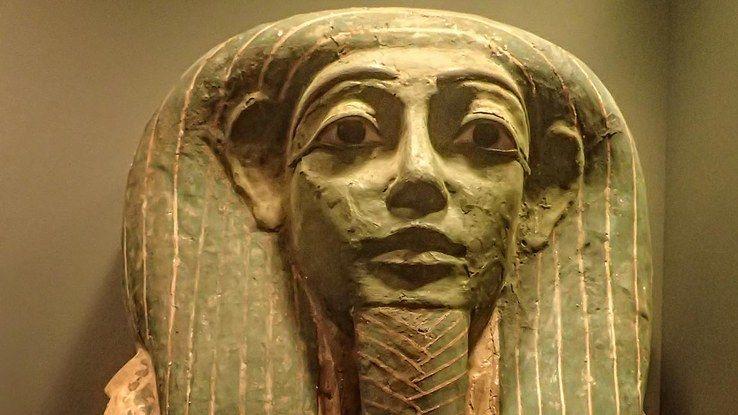

The torchlight trembled against painted walls as a priest in a leopard-skin robe raised a carved adze toward the face of the finished mummy. Every syllable of the incantation had to land precisely. Every gesture had to follow the sequence that priests had rehearsed, copied, and argued over for generations. Because in ancient Egypt, getting the resurrection wrong did not simply mean disappointment in the next world — it meant the soul winked out of existence entirely, snuffed like a flame, gone from every dimension at once.
Engineering Eternity: Three Thousand Years of Deliberate Design

Ancient Egyptians did not merely hope for an afterlife. They engineered one. Over roughly three thousand years of continuous civilization — from the Old Kingdom around 2686 BCE through the late Ptolemaic period — they developed a system of theology, ritual, architecture, and material technology so interlocking and redundant that death itself began to look less like a wall and more like a door that could be opened, provided you had the right keys and knew exactly which way to turn them.
The central anxiety was not death but what Egyptologists sometimes call the “second death”: the permanent, irreversible erasure of the soul that could follow if the rituals failed, the spells were mispronounced, or the right amulet was forgotten in the linen wrappings. A physical death was survivable. A second death was not. Understanding that terror — and the extraordinary human ingenuity it inspired — is the key to understanding ancient Egyptian afterlife beliefs in their full, strange, and deeply moving complexity.
Three Simultaneous Theologies, Zero Contradictions

One of the first things that surprises modern readers is that Egyptian religious doctrine was not a single, tidy creed. It held three simultaneous afterlife ideologies without apparent contradiction: the deceased might dwell in an underworld realm called the Duat, might achieve eternal life alongside the gods in the celestial sphere, or might cycle through death and rebirth in a pattern echoing the cosmos itself. All three were considered true at once. Rather than a contradiction, this was a feature — a theological redundancy ensuring the soul had multiple overlapping chances at survival.
The machinery powering all three pathways was the soul, which Egyptians understood not as a single entity but as a cluster of distinct components that had to be carefully reassembled after death. The ka was the life force, the animating double that needed regular offerings of food and drink to sustain itself. The ba was closer to what we might call personality or spirit — often depicted as a human-headed bird — which could leave the body during the day but needed to return to it each night. The akh was the ultimate goal: the transfigured, glorified dead who had successfully integrated all their components and joined the eternal realm. If the rituals failed, the ka starved, the ba lost its anchor, and the akh never formed. The person ceased to exist in any dimension whatsoever. This is why the Egyptian conceptualization of the otherworld demanded such meticulous, almost compulsive, ritual precision.
The Sun’s Daily Lesson in Dying and Coming Back

The Egyptians found their clearest template for rebirth not in abstract theology but in the sky above them, repeated every single day without fail. The sun died at sunset and was reborn at dawn. That cycle — so reliable, so undeniable — became the governing metaphor for all existence. If something as immense and powerful as the sun could die and return, then surely a careful, well-prepared human soul could do the same.
In Egyptian myth, the solar bark of Ra passed through twelve hours of underworld darkness each night, threading through the Duat, battling the chaos serpent Apophis in a struggle that was genuinely uncertain — the gods had to fight, and their victory was never guaranteed. Every dawn was a triumph, earned rather than automatic. Every deceased Egyptian hoped to join that journey and re-enact it personally, riding the bark of Ra through the darkness and emerging, blinking and radiant, into the morning.
This solar aspiration shaped everything: the orientation of tomb shafts toward the eastern horizon, the careful positioning of a mummy’s face, the selection of spells from the Book of the Dead tucked into linen wrappings. Pharaohs buried in pyramid complexes aligned their monuments to catch the first light. Commoners with far fewer resources still managed to tuck a papyrus spell into their bandages, hoping for the same destination. Everyone, in the most democratic sense, wanted to become Ra. As explorations of rebirth in ancient Egyptian religion consistently show, the solar cycle was not merely a metaphor — it was a literal map the dead were expected to follow.
Osiris and the Murder That Made Resurrection Possible

If the sun provided the daily template for resurrection, Osiris provided the human-scale story — the mythological proof that a being who had been completely destroyed could nevertheless come back. His myth is worth sitting with in its full violence, because the violence is the point.
Osiris was a king, beloved and righteous, until his brother Seth murdered him, dismembered the body, and scattered the pieces across Egypt. It was the ultimate destruction: not just death but annihilation, the body itself erased as a coherent object. And yet his wife Isis gathered the scattered pieces, reassembled the body, and temporarily reanimated him — long enough to conceive their son Horus, heir to the throne and avenger of his father’s murder. Resurrection in Egyptian myth is thus explicitly tied to bodily reassembly. You cannot come back from what you no longer have. This is the theological engine behind the Egyptian obsession with mummification: the body must be preserved because the soul needs something to return to.
Every mummified Egyptian was ritually identified with Osiris. Funerary papyri name the deceased as “the Osiris Ani” or “the Osiris Henuttawy” — the person does not merely hope to reach Osiris, they become him, inheriting his resurrection as something close to a legal right. But the Osiris myth also introduced the moment of final judgment: the Hall of Two Truths, where the deceased’s heart was placed on a scale and weighed against the feather of Ma’at, the principle of truth and cosmic order. A heart heavy with wrongdoing — with lies told, harm done, duties abandoned — was devoured by Ammit, the chimeric beast combining crocodile, lion, and hippopotamus. Devoured by Ammit meant the dreaded second death: no afterlife, no return, no continuation of any kind. The stakes of the Weighing of the Heart were absolute, as scholarly analyses of ancient Egyptian soul and death beliefs make clear.
The Opening of the Mouth: A Ritual That Could Not Fail

Return to that torchlit antechamber. The priest in the leopard skin is performing the Opening of the Mouth ceremony — in Egyptian, wpt-r — the single most critical ritual in the entire architecture of Egyptian rebirth. Performed on the finished mummy before entombment, its purpose was to restore what death had taken: the senses, the voice, the capacity to eat and drink and speak the spells that would navigate the Duat.
The tools were specialized and ancient. The adze — a curved blade associated with the constellation of the Great Bear — was touched to the mummy’s lips. The pesesh-kef, a forked flint blade whose origins stretch back to prehistoric Egypt, was used to touch the eyes, ears, and nose, reopening each sense in turn. Priests took on the roles of Horus and Anubis. Incantations from the Pyramid Texts — first recorded around 2400 BCE in the pyramid of Unas at Saqqara, making them among the oldest religious writings ever discovered — were recited in precise sequence. Immediately after the mouth was opened, food offerings were presented, because the ka was now awake and needed to eat.
The pressure on the officiating priests was immense and entirely real to everyone present. A stumbled line, an improperly consecrated tool, a sequence performed out of order — any of these could leave the mummy inert, the ka homeless, the ba unable to return each night to its body. Wealthy families spent fortunes on the most learned priests available and had the liturgy rehearsed until it was immaculate.
Significantly, the Opening of the Mouth was also performed on statues and sacred images — which reveals something important about how Egyptians understood the ceremony itself. They did not treat it as a one-off miracle reserved for the dead. They treated it as a transferable technology: the same ritual logic that could animate a stone statue could animate a prepared mummy. The logic was consistent, applied, and taken with the utmost seriousness across every register of Egyptian religious life.
Scarabs, Heart Amulets, and the Insurance Policy for the Soul

Even a flawlessly executed funeral rite was not considered sufficient protection on its own. The Egyptians built redundancy into their rebirth strategy through amulets — portable, permanent ritual power that traveled inside the linen wrappings with the body, operative whether or not any living priest was nearby to maintain them.
Among the most potent was the scarab beetle, Scarabaeus sacer. Egyptian observers noted that young beetles hatched from balls of dung — life seemingly arising from dead matter without obvious parentage, rolling across the earth like the sun rolling across the sky. The image was absorbed almost immediately into the symbolic vocabulary of rebirth. The scarab became one of the most widely produced amulets in ancient Egypt, worn by the living and the dead alike, across every social class and every period of Egyptian history.
Heart scarabs were a specialized variant placed directly over the mummy’s chest. Inscribed with Chapter 30B of the Book of the Dead, they carried a specific and remarkable instruction: the heart was told, in effect, not to testify against its owner when placed on the scales of Ma’at. It was a legal pre-emptive strike, a written appeal to the very organ that might condemn its possessor in divine court. The layers of protection — ritual, textual, material — were designed to interlock so that no single failure could bring the entire system down. This account of ancient Egyptian rebirth beliefs traces the theology from its earliest forms through its long development, showing how each layer reinforced the others.
Gender, Identity, and Transformation in the Afterlife
There is one dimension of Egyptian rebirth theology that rarely receives the attention it deserves, precisely because it sounds so strange to modern ears. Egyptian belief held that for a deceased woman to successfully achieve rebirth, she had to briefly turn into a man. Spells in the Coffin Texts written for female owners are composed in masculine grammatical forms, reflecting a theological conviction that the generative, solar-resurrection power was coded as male, and that women needed to briefly adopt that identity to access it fully.
This was not a denial of women’s access to the afterlife. It was, in Egyptian theological terms, a practical solution: identity itself was understood as fluid, borrowable, and strategically deployable in the service of survival. The same logic that allowed any deceased Egyptian to become Osiris — to step into a divine identity not originally their own — allowed women to temporarily inhabit a masculine grammatical and ritual persona in order to complete the solar journey. The Brooklyn Museum’s scholarship on women’s afterlife in ancient Egypt examines this phenomenon in careful detail, situating it within a broader theology where the boundaries of self were far more permeable than modern Western assumptions about identity would suggest.
Why the Egyptian Answer Still Refuses to Be Set Aside
The full picture that emerges from three thousand years of ritual, text, and material culture is not one of a civilization cowering before death. It is one of a civilization that looked at death and decided it was a solvable engineering problem. The Egyptians designed rituals, commissioned texts, oriented their architecture, and loaded their tombs with interlocking redundancies — all aimed at the same objective: guaranteeing that the soul would survive, thrive, and ultimately be transformed into something more glorious than it had been in life.
That insistence — that death is a transition rather than an ending, an opportunity for rebirth and eternal happiness rather than a punishment or a void — is itself a remarkable intellectual achievement. It shaped the Greek mystery religions that absorbed Egyptian ideas through centuries of contact. It echoes in early Christian resurrection theology. It surfaces in Western ideas about the soul’s survival that persist, in various forms, to this day. The Egyptians were not the only ancient civilization to hope for an afterlife, but they were arguably the most systematic, the most thorough, and the most architecturally committed to turning that hope into something that functioned like a guarantee.
Return one final time to the priest in the leopard-skin robe, pressing the adze to the painted lips in the flickering light. When he spoke the words correctly — every syllable, every breath, every gesture landing where tradition demanded — he was not performing magic in the dismissive, fairy-tale sense of the word. He was operating a technology his civilization had tested, refined, debated, annotated, and improved across three millennia. Every person in that torchlit room believed, with the full weight of their culture and their deepest convictions, that it worked.
The Egyptians left us the most detailed manual for confronting death ever written: the Book of the Dead, the Pyramid Texts, the Coffin Texts, the funerary papyri with their spells and their maps of the underworld and their careful instructions for how to address a god holding a scale. We have all of it. We can read every word. And perhaps the most telling thing about the human relationship with mortality is not that the Egyptians tried so hard to solve it — but that, four thousand years later, we still find their answer so difficult to simply set aside.

 Arabic
 French
 Spanish
 Portuguese
 Deutsch
 Turkish
 Dutch
Dutch
 Italiano
 Russian
 Romaian
 Portuguese (Brazil)
 Greek
Greek