


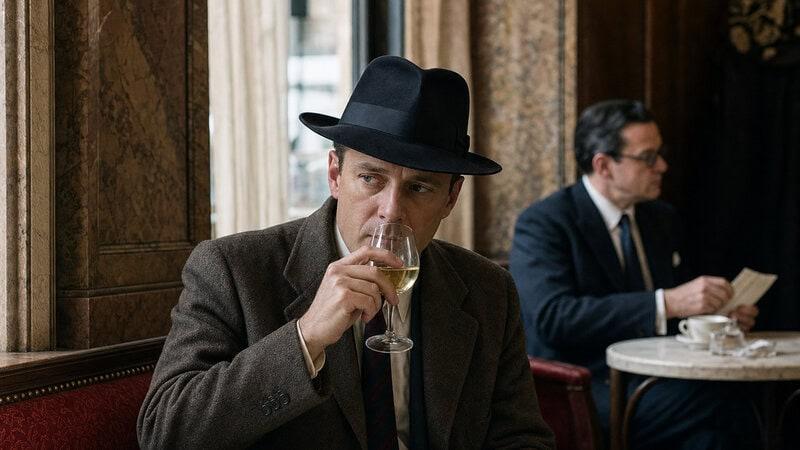

Vienna, 1952. A British intelligence officer nurses a glass of Grüner Veltliner at a corner table in an Innere Stadt café, watching — without appearing to watch — a Soviet cultural attaché three tables away who is almost certainly not a cultural attaché at all. No car chases. No exploding pens. Just two men in overcoats, the hiss of a coffee machine, and the slow, suffocating tension of a world that could end if either of them made a mistake.
It is a scene that never appears in Guy Ritchie’s Operation Fortune: Ruse de Guerre — but it haunts the film anyway. Beneath the designer luggage, the deadpan one-liners, and the Mediterranean sunshine, Ritchie’s 2023 action-comedy is built on an operational architecture that British intelligence spent decades perfecting and has spent even longer trying to forget.
What the Film Actually Does
Jason Statham plays Orson Fortune, a British intelligence operative defined by two things: exceptional competence and an unapologetic commitment to five-star hotels and aged wine. He is dispatched — reluctantly, expensively — to recover a stolen piece of high-tech hardware before Hugh Grant’s arms broker can auction it to the worst available bidder. Aubrey Plaza’s CIA operative and Josh Hartnett’s baffled Hollywood celebrity complete an ensemble that looks, at first glance, like pure glossy invention.
Scratch the lacquered surface, and something older shows through. The gentleman spy who blends aristocratic ease with genuine ruthlessness, the deniable joint mission targeting a private arms middleman, the race to recover catastrophic technology before it crosses the wrong border — none of this is purely imaginary. It is a glamorised, sun-drenched echo of a Cold War operational tradition that shaped MI6’s institutional culture and still echoes in its post-Cold War posture.
The film’s subtitle is its most honest credential. Ruse de guerre is a genuine concept in the laws of armed conflict — a permissible deception, a stratagem that misleads an adversary without violating the rules of war. MI6 planners used exactly this framing, sometimes explicitly, to justify covert peacetime operations that occupied uncomfortable legal grey zones. The phrase signals that Ritchie, whatever his interest in kinetic spectacle over historical fidelity, has at least glanced at the right shelf.
Operation Valuable: Britain’s First Cold War Catastrophe

To understand what real British covert operations looked like in the era that shaped the spy film tradition, start with Operation Valuable — a name that drips with unintentional irony. Beginning in 1949 and limping forward until around 1954, Valuable was a joint MI6-CIA effort to infiltrate Albanian anti-communist guerrillas into Enver Hoxha’s hermetically sealed Stalinist state. The idea was seductive in the way that so many early Cold War ideas were: insert trained local assets, foment internal resistance, begin the rollback of Soviet-backed communism at its periphery.
The reality was a disaster of almost surgical precision. The infiltrators, dropped by boat or parachuted into Albanian territory, were met almost immediately by waiting security forces. Many were captured. Many were killed. The operation haemorrhaged agents for years before the agencies involved could bring themselves to acknowledge it was beyond saving. The reason, pieced together over subsequent decades, was almost certainly Kim Philby — the MI6 officer who had burrowed so deeply into the Anglo-American intelligence relationship that he had access to agent lists and insertion schedules, and passed them directly to Moscow.
The operational architecture of Valuable — small deniable teams, local assets recruited for political motivation rather than tradecraft, a handler network operating at comfortable distance from the actual danger — is precisely the architecture that Operation Fortune dramatises, stripped of its tragic real-world weight. In Ritchie’s film, the small team succeeds. In Albania, they did not. The structural lesson that Valuable burned into the institutional memory of both MI6 and the CIA was stark: covert insertion missions are only as strong as the integrity of the intelligence chain surrounding them. A single compromised link, and everyone on the ground pays for it.
The Arms Broker Problem: Hugh Grant’s Villain Has Real Ancestors

If Operation Valuable supplies the operational skeleton of the film’s plot, the character of the arms broker — Hugh Grant doing something genuinely unsettling with a linen blazer and a moral vacuum — supplies its most quietly accurate element. The private arms broker who operates in legal grey zones, courting buyers that no government can officially acknowledge, moving sensitive commodities across jurisdictions: this is not a screenwriter’s invention. It is a documented feature of Cold War European commerce.
Throughout the 1950s, 1960s, and 1970s, surplus weaponry, prototype technology, and occasionally raw intelligence moved through networks of independent middlemen who owed loyalty to their commission rather than their passport. British intelligence ran operations against these networks when they threatened to pass NATO-adjacent technology eastward — sometimes attempting to recruit the brokers as assets, sometimes working to discredit or neutralise them through more aggressive means.
The specific device at the heart of Operation Fortune — a stolen high-tech commodity with catastrophic potential, auctioned to the highest bidder — echoes documented Cold War anxieties about Soviet purchasing networks using Western intermediaries to acquire military and dual-use technology. The KGB maintained sophisticated procurement operations in Western Europe specifically to exploit grey-market channels. The fact that MI6’s fictional version of this problem has been repackaged as a sun-drenched action-comedy does not make the underlying concern any less real or the dramatisation any less instructive.
Operation Gold: The Tunnel Beneath Berlin

For the purest structural parallel to the Operation Fortune plot — the audacious technical objective, the small expert team, the enormous geopolitical stakes compressed into a single mission — nothing in the Cold War archive quite matches Operation Gold. In 1955, MI6 and the CIA completed a tunnel running approximately 1,476 feet beneath the Soviet sector of Berlin, directly beneath a Red Army signals installation, to tap communications cables carrying Soviet and East German military traffic. The engineering was extraordinary. The intelligence yield, before the operation ended, was substantial.
In practice, the operation had already been betrayed before the first shovel broke ground. George Blake, an MI6 officer present at the planning meetings, was a Soviet agent. He passed the entire plan to the KGB before construction began. The Soviets, in a decision that speaks volumes about Cold War intelligence priorities, allowed the tunnel to operate for nearly a year rather than expose Blake by shutting it down immediately. When they finally staged its discovery in 1956, they presented it as a propaganda triumph.
Operation Gold demonstrates something important about the “retrieve the device before the enemy weaponises it” thriller format that structures films like Operation Fortune (2023): it is not a Hollywood invention. It is a slight dramatisation of real MI6 operational priorities, translated from the grinding, mole-haunted reality of Cold War Berlin into something with better lighting and a cleaner resolution. The dramatic tension of Gold — will the technology be secured before the wrong people understand what they have? — is structurally identical to the tension Ritchie builds around Fortune’s mission, even if the fictional version resolves more satisfyingly and without a Soviet double agent in the briefing room.
The Gentleman Spy and the Institutions He Represents

It would be easy to treat the Cold War spy tradition as sealed history — something that ended when the Berlin Wall came down and the files, some of them, began to open. But the operational model that Valuable and Gold represent did not dissolve in 1991. It evolved. MI6’s post-Cold War posture shifted toward targeted covert actions aimed at proliferation networks, arms trafficking, and technology denial, rather than the grand ideological contest of the superpower era. The targets changed. The methods, to a remarkable degree, did not.
Orson Fortune’s character type — elite, morally pragmatic, institutionally protected, and committed to his own comfort — maps onto this evolution with uncomfortable accuracy. The five-star hotels and fine wine that define his operational style are often read as satire, and they are. But they also reflect a genuine tension in intelligence culture: the operational necessity of blending into wealthy target environments, of being the man at the table who belongs there, sits uneasily against any public institution’s stated commitment to frugality. The expensive dinner is sometimes a legitimate operational expense. The difficulty is that it is also, sometimes, just an expensive dinner, and the difference is rarely scrutinised from the outside.
The presence of Plaza’s CIA operative as Fortune’s closest counterpart reflects something equally real: the deepening of US-UK intelligence cooperation through the post-Cold War and post-9/11 periods, and the development of joint task forces for exactly the kind of technology-denial and proliferation-interdiction mission the film depicts. The special relationship, in intelligence terms, is less a diplomatic nicety than a structural feature of how both services actually function day to day.
Why These Stories Stay Secret — and Why Films Like This Matter
The genuine history of MI6 covert operations remains, to a remarkable degree, officially invisible. The Official Secrets Act provides the legal architecture. Institutional culture provides the motivation. And the deliberate ambiguity that MI6 has always maintained around its own history — acknowledging almost nothing, neither confirming nor denying, letting rumour and fiction fill the space — provides the cover. Operation Valuable remained substantially classified for decades after it ended. Operation Gold’s full story emerged slowly, through the archives of multiple countries rather than any single official disclosure. Dozens of operations from the same era remain, effectively, unknown.
Films like Operation Fortune: Ruse de Guerre function in this silence as a kind of cultural pressure valve. They let audiences engage with the genuine moral complexity of covert action — the use of civilians as unwitting assets (Hartnett’s celebrity, deployed without full knowledge of the stakes), the deceptions layered inside other deceptions, the institutional calculus that decides some lives matter more than others — inside a consequence-free, entertaining frame. Nobody dies at the end who the audience is meant to grieve. The device is recovered. The villain is managed. The team disperses.
That is not a criticism. The spy film tradition, from the early Bond era through to Ritchie’s globe-trotting action-comedies, keeps public imagination tethered to a real institution that cannot speak for itself. It shapes how democratic societies think — imperfectly, partially, but persistently — about intelligence, oversight, and the question of what we permit to be done in our name without our knowledge. Imperfect accountability is still a form of accountability.
The true story behind Operation Fortune is not a single declassified file waiting to be opened. It is the accumulated, half-visible history of a service that has always preferred its best work go entirely unnoticed — the operational record of an institution whose greatest successes are the things that did not happen: the technologies that did not reach the wrong hands, the crises that did not ignite. The Vienna café. The Berlin tunnel. The Albanian hillside. All of it adding up, slowly and incompletely, to the shape of something that a Jason Statham film can gesture toward but never quite illuminate — and perhaps that is exactly as the institution prefers it.

 English
 Arabic
 French
 Spanish
 Portuguese
 Deutsch
 Turkish
 Dutch
Dutch
 Italiano
 Russian
 Portuguese (Brazil)
 Greek
Greek