


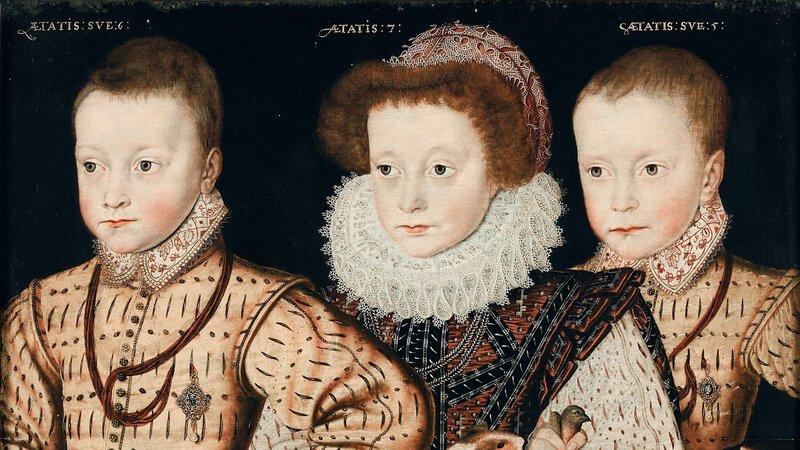

On a Sunday morning sometime in the 1520s, a preacher in Zurich paused his sermon, pointed into the congregation, and denounced a woman’s lace collar as a snare of the devil. The murmur that passed through the pews was not just embarrassment — it was the sound of a civilization arguing, in real time, about whether your soul could be damned by your neckwear.
That moment captures something essential about Reformation-era clothing: it was never merely about fabric and thread. It was a battleground for the most consequential theological arguments of the sixteenth century, and understanding it means understanding how abstract ideas about grace, salvation, and human vanity eventually showed up on people’s bodies.
The Late-Medieval Wardrobe: Opulence as Orthodoxy

To grasp why a collar could trigger a theological crisis, you have to picture the late-medieval European wardrobe in full, almost hallucinatory bloom. By the early sixteenth century, elites had turned clothing into competitive performance. Doublets were slashed to reveal expensive contrasting fabrics beneath. Gowns were embroidered with gold thread and set with semi-precious stones. Women’s headdresses rose to architectural heights. And moving through the courts of England, France, and Burgundy was the newest obsession: the ruff — a starched, cartwheel collar that required its own iron, its own starch, and a small army of servants to maintain. It announced, without a word, that its wearer did nothing with their hands.
The Catholic Church was not standing apart from this spectacle — it was helping to stage it. Bishops processed in vestments of cloth-of-gold. Cathedral interiors blazed with silk hangings and embroidered altar cloths. Visual splendor was considered a legitimate form of worship, a way of honoring God through beauty. The argument ran something like this: if a king’s court should be magnificent, how much more so the court of heaven’s representative on earth?
Rulers had already noticed that this logic was getting out of hand. Sumptuary laws — regulations dictating who could wear what, based on rank and income — had existed across Europe for centuries. Only nobles could wear ermine. Only the very wealthy could afford certain dyes, particularly the scarlet produced from kermes insects and the purple derived from shellfish. These laws were enacted, ignored, re-enacted, and ignored again with cheerful regularity. Into this world of gorgeous, chaotic, largely unenforceable opulence walked Martin Luther, Ulrich Zwingli, and John Calvin, carrying a radically different idea about what the visible world was for.
The Theology of the Plain Coat

The reformers’ attack on luxury dress was not merely a cultural preference dressed up in scripture — it flowed directly from their theology. If salvation came through faith alone, and not through the accumulation of religious merit, then the whole system of spiritual prestige that luxury clothing supported was not just vain but actively dangerous. It directed attention toward the self, toward status, toward the dazzling surface of things, and away from God.
Luther himself addressed dress in several of his writings and sermons, warning that extravagant clothing fostered pride and distracted from inward piety. But it was Calvin, working in Geneva from the 1540s onward, who was most systematic about translating this theology into a concrete dress code. His targets were specific and recognizable: elaborate embroidery, excessive jewelry, the crimson and purple dyes long associated with royalty and high clergy, and above all the ruff, which had come to symbolize everything the reformers despised about aristocratic vanity.
Zwingli in Zurich pursued a parallel course, stripping church interiors of images and ornament on the grounds that visual display corrupted true worship — a logic that extended naturally from the building to the body of the worshipper. The reformers shared a conviction that external splendor was not a path toward God but a detour away from him.
What made their position genuinely interesting, rather than simply puritanical, was the paradox at its heart. They were not calling for sackcloth. They were not demanding ugliness. They were constructing a deliberate alternative aesthetic — one of dignified simplicity, of quality without ostentation, of clothing that communicated virtue rather than vanity. The plain coat was not an absence of meaning. It was a very loud statement, carefully assembled.
Sumptuary Laws With Teeth: Enforcement in the Protestant City-States

What distinguished the Reformation from previous moral panics about dress was that Protestant city councils had both the theological motivation and, in many cases, the political machinery to actually enforce their clothing rules. Geneva’s sumptuary legislation through the mid-sixteenth century was remarkably detailed. Gold trim, puffed sleeves, certain cuts of sleeve — all could bring a citizen before the city’s consistory, a disciplinary body composed of ministers and lay elders with the authority to summon and question residents about their conduct. Tailors who cut illegal styles faced fines. Neighbors were expected to report neighbors. In some Reformed communities, wardens at church doors checked attire before worshippers entered.
This was dress policing as a civic institution, and it spread with the Reformed faith. In the Netherlands, Calvinist communities developed their own versions of restrained dress so characteristic that they defined a visual culture visible in portraiture of the period. In Scotland, John Knox’s influence pushed toward a severity in dress that filtered through Kirk culture for generations. In England, Puritan communities pushed back against the flamboyance of the Tudor and Stuart courts with a counter-aesthetic of dark wool and plain linen that eventually crossed the Atlantic. The dress codes regulating life in seventeenth-century Massachusetts were direct descendants of thinking that originated in 1520s Zurich and 1540s Geneva.
Meanwhile, in Catholic Europe, the visual logic ran in precisely the opposite direction. Spain and Italy doubled down on luxury dress as a counter-signal of orthodox faith. The courts of the Counter-Reformation became, if anything, more spectacular in their display — a deliberate assertion that beauty in service of the Church was holy, not sinful. The Reformation had not merely changed what some people wore. It had split Europe into visually distinct fashion cultures that a contemporary observer could, quite literally, read at a glance.
What Reformation Clothing Actually Looked Like

The emerging Protestant aesthetic had a recognizable family resemblance across its regional variations. Dark wools and linens in black, charcoal grey, and deep brown dominated. Surface decoration was minimal. The falling band — a plain, flat linen collar lying softly against the shoulder — replaced the architectural ruff. Cuts emphasized the body’s function rather than its silhouette. A general preference for quality of material over complexity of ornament distinguished prosperous Protestant dress from the embroidered excess it rejected.
Black deserves particular attention, because it tells a complicated story. Achieving a true, fast black — the kind that did not fade to rusty brown after a season — required expensive dyestuffs, particularly from imported sources, and skilled labor. Deep black was not cheap in the sixteenth century. Yet it became the paradoxical prestige color of the Protestant world. Merchants wore it. Magistrates wore it. Ministers wore it. It communicated seriousness, prosperity, and restraint simultaneously. It said: I am not showing off — and said it with the most expensive dye available. This was, in its way, the most refined form of status signaling imaginable.
The visual evidence is sitting in Europe’s great art museums. Compare a Holbein portrait of a Tudor courtier — the jeweled hat, the slashed sleeves, the heavy gold chain — with a Rembrandt-era portrait of a Dutch merchant rendered in stark black and white, his collar a simple band of linen, his face the undisputed subject of the picture. The shift in visual culture between those two images is the Reformation, made visible in paint. The Dutch Golden Age portrait tradition is, among other things, a long meditation on what Protestant clothing looked like on actual human beings.
Women’s dress in Protestant communities underwent a parallel transformation. The elaborate headdresses of the Catholic courts gave way to linen caps and coifs. Jewelry was reduced or eliminated for churchgoing. Necklines were raised. The goal, as articulated in countless sermons and consistory rulings, was to direct attention toward the face — the seat of reason and the image of God — and away from the decorated body as an object of admiration.
Economic Consequences: Who Lost When Luxury Lost Its Virtue

The economic consequences of the Reformation’s clothing theology were real and broadly felt, even when precise figures have not survived. Silk weavers in Lyon depended on a luxury market that Protestant theology was actively delegitimizing. Lacemakers in Bruges, goldsmiths across the continent, embroiderers and specialist dyers of expensive crimson — all felt the pressure as Protestant communities redirected their spending away from display. The reformers had created a genuine disruption in the luxury goods market by attacking the cultural values that sustained demand for those goods.
This disruption was not total — Protestant elites still needed clothing appropriate to their civic dignity, and skilled tailors, linen drapers, and quality wool merchants found steady custom in Reformed cities. But the composition of demand shifted. The intricate luxury trades — the makers of lace, of cloth-of-gold, of elaborate embroidery — suffered most where Calvinist influence was strongest. In cities that shifted between Protestant and Catholic control during the religious wars, one of the practical consequences was a swing in the fortunes of different segments of the textile trade.
The Long Tail: From Calvin’s Geneva to Modern Minimalism

The influence of Reformation dress culture extended far beyond the sixteenth century. The Puritan dress codes of seventeenth-century England, the sumptuary consciousness of colonial New England, and the plain dress traditions of Quaker communities — all are points on a line that runs back to Calvin’s Geneva and Zwingli’s Zurich. Quaker plainness in particular developed into a self-conscious theology of dress that survived well into the nineteenth century, insisting that simplicity of clothing was inseparable from integrity of character.
Scholars of design history have traced a broader connection between the Protestant plain style and the clean, functional aesthetic that characterizes much Northern European design tradition: the Dutch Golden Age interior with its polished surfaces and absence of clutter, the Scandinavian craft sensibility that prizes honest materials and restrained ornament, the ideal of elegant utility that values good substance over elaborate surface. Whether the line extends all the way to twentieth-century modernism and contemporary minimalism is a matter of interpretive taste, but the family resemblance — the suspicion of ornament for its own sake, the elevation of function, the preference for quality over decoration — is difficult to dismiss entirely.
The reformers did not win forever. By the late seventeenth century, even the most rigorously Protestant elites were capitulating to the French baroque fashions radiating from Versailles. Elaborate wigs, silk coats, and lace cuffs crept back into Protestant wardrobes. The reformers, in a sense, won the theology and gradually lost the wardrobe. But they held the line for roughly two centuries — an extraordinary run for any dress-code revolution, and a measure of how seriously their communities took the connection between clothing and belief.
Clothes as a Confession of Faith: Why This History Still Matters
The Protestant reformers understood something that gets forgotten in the routine business of getting dressed: clothing is never neutral. Every choice about what to wear is a negotiation with authority, identity, and belief. The reformers did not invent this idea, but they argued it more systematically, and with more institutional force, than almost anyone before them. What you wore was a visible confession of what you valued, and what you valued was inseparable from what you believed.
That argument echoes in places we might not expect. Every school uniform debate, every office dress code controversy, every cultural argument about what counts as appropriate dress in a particular context — all carry a ghost of the same question the Zurich preacher was really asking when he pointed at that lace collar: who has the authority to decide what respectability looks like, and what does your answer reveal about your deeper loyalties?
The connection between clothing and ethical commitment is not purely historical. The contemporary sustainable fashion movement makes an argument recognizably related to the reformers’ — that how you consume clothing is a moral statement, that excess in dress reflects disordered values, and that restraint and quality are virtues worth cultivating. Brands like Reformation, which began by selling vintage clothing out of a small Los Angeles storefront in 2009 and now makes sustainable clothing and accessories, with collections also available through Nordstrom, position style explicitly against excess — and the name is not accidental. Customer responses gathered on review platforms like Trustpilot suggest that the appetite for clothing understood as a meaningful choice, rather than pure consumption, remains substantial. The terms have changed; the underlying argument has not changed as much as we might think.
Return, finally, to the woman in the lace collar. She sat in that Zurich congregation while a man in a black coat told her that her neckwear offended God. History does not record what she did next. In all probability she kept wearing the collar — perhaps shifted it under a shawl on Sunday mornings, perhaps did not bother. Because fashion, like faith, has never bent completely to someone else’s rules. The reformers reshaped European dress culture for two centuries through a combination of theological argument, civic enforcement, and genuine persuasion — and yet the lace kept returning, the silk kept whispering, and the ruff had a remarkably long life for something officially condemned as a snare of the devil.
Reformation-era clothing is not a footnote to the story of Protestant theology. It is proof that ideas — even abstract, doctrinal ideas about grace and salvation and the nature of the soul — eventually show up on your body. The most intimate arguments of the sixteenth century were fought not only in churches and universities and printing houses, but in the choices people made every morning when they opened their wardrobes and decided who, today, they were going to be.

 English
 Arabic
 French
 Spanish
 Portuguese
 Deutsch
 Turkish
 Italiano
 Russian
 Romaian
 Portuguese (Brazil)
 Greek
Greek