


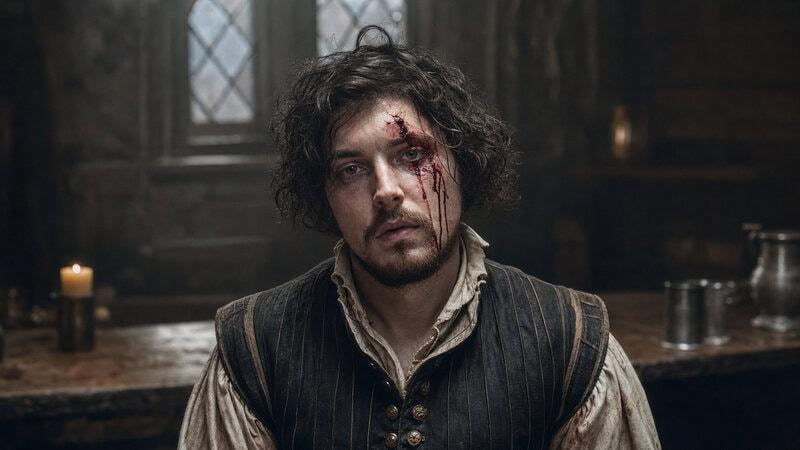

On 18 May 1593, a warrant was issued summoning Christopher Marlowe — playwright, Cambridge scholar, probable spy — to appear before the Privy Council. He complied, reported daily, and was dead within a fortnight, stabbed above the right eye in a Deptford tavern under circumstances that have never been fully explained. He was twenty-nine years old. His death was, depending on who you asked, a drunken brawl over a bill, an assassination ordered by the state, or the predictable end of a man who had spent years moving through the shadows of Elizabethan England’s intelligence world. That all three explanations remain plausible five centuries later tells you something essential about the reign of Elizabeth I — a reign celebrated as England’s golden age, and maintained, in no small part, by terror.
The Golden Age Myth — and Why It Stuck

The familiar portrait is genuinely dazzling. Shakespeare writing at the Globe. Francis Drake circumnavigating the globe and returning with plunder enough to make investors rich. The Spanish Armada — that supposedly invincible fleet — scattered by English ships and English weather in 1588. A queen who called herself mere English, who declared she had the heart and stomach of a king, who never married and so became, in the propaganda of her own court, something more than a woman and more than a monarch: a near-divine figure her flatterers called Gloriana.
Elizabeth I reigned from 17 November 1558 to 24 March 1603, forty-five years in which England genuinely did transform. The Tudor dynasty’s final monarch oversaw an explosion of vernacular literature, overseas exploration, and Protestant consolidation that shaped the nation for centuries. The story is real. The problem is what it obscures.
Elizabethan propaganda was itself a Tudor masterpiece. Royal progresses — the queen’s annual tours through her kingdom, staged as elaborate pageants at her hosts’ ruinous expense — projected accessibility while reinforcing hierarchy. Portraiture codified her image: the pale face, the ruff, the orb and sceptre, symbols chosen with the deliberateness a modern communications team brings to a brand. The cult of Gloriana was manufactured, deliberately, by a court that understood that a female monarch ruling a fractious Protestant nation required an almost mythological legitimacy. The history of Elizabeth’s reign taught in schools still skews heavily toward cultural achievement, partly because the court controlled the narrative then and Victorian romantics reinforced it later. The gilded surface, it turns out, required constant and brutal maintenance.
Francis Walsingham and the Birth of the English Secret State

Enter Sir Francis Walsingham, appointed Principal Secretary in 1573 and arguably the most consequential figure in Elizabethan government that most people have never properly reckoned with. Lean, devoutly Puritan, chronically ill, and entirely without sentimentality, Walsingham built England’s intelligence apparatus into something Europe had rarely seen: a systematic, state-sponsored network with reach from the Catholic seminaries of Douai to the docks of Lisbon.
The architecture was sophisticated. Paid agents embedded in foreign courts reported on diplomatic movements. Informants inside English Catholic exile communities sent letters home — letters that Walsingham’s office intercepted, copied, resealed, and forwarded, their subjects none the wiser. A cipher-breaking operation, funded partly from Walsingham’s own pocket, cracked the encoded correspondence of foreign ambassadors and domestic conspirators alike. The Elizabethan equivalent of mass surveillance ran not through a government department but through the private household of one obsessive man.
The Babington Plot of 1586 shows the operation at its most chilling. Anthony Babington and a circle of Catholic conspirators planned to assassinate Elizabeth and place Mary Queen of Scots on the English throne. Walsingham knew about it almost from its inception. Rather than crush it immediately, he cultivated it — fed it information, allowed the conspiracy to mature, and most crucially engineered a channel of communication between Babington and the imprisoned Mary through a hollowed-out beer barrel. Every letter passed through his cipher-breakers first. When the plot was ripe, he harvested it. Fourteen men were hanged, drawn, and quartered. Mary’s written words, captured in that correspondence, handed Walsingham the legal mechanism to destroy her. That the entire operation involved deliberate state-sponsored entrapment — allowing a murder conspiracy to develop so that it could be more comprehensively punished — troubled remarkably few people at Elizabeth’s court. The darker currents of the Elizabethan era rarely get more clinical than this.
The Rack, the Scavenger’s Daughter, and the Law’s Convenient Blindspot

English common law technically prohibited torture. Elizabethan apologists cited this frequently, and it was not entirely untrue. What it concealed was the Privy Council’s power to issue torture warrants outside common law — a legal fiction that allowed the state to torture prisoners while maintaining that England did not torture prisoners. The Crown had it both ways, as it so often did.
In the Tower of London’s interrogation rooms, the tools were specific and purposeful. The rack stretched the body until joints dislocated and information, or confession, or both, could be extracted. The Scavenger’s Daughter worked in the opposite direction, compressing the body into a foetal position until bones cracked under the pressure. The manacles suspended a prisoner by the wrists until the shoulders gave way. These were not medieval relics by Elizabeth’s reign — they were in active use.
Edmund Campion’s case makes the abstract concrete. A Jesuit priest who had slipped back into England to minister secretly to Catholics, Campion was captured in 1581 after a nationwide manhunt. He was racked multiple times in the Tower, his hands so damaged afterward that he reportedly could not raise them to take an oath. He was offered his life in exchange for recanting. He refused. The trial that followed used words extracted under torture as evidence against him. He was hanged, drawn, and quartered in December 1581, having been convicted of a treason that consisted essentially of being a Catholic priest in Elizabethan England.
Ordinary Londoners watched executions like this at Tyburn and Tower Hill as a form of public theatre. Daily life in Elizabethan England involved a proximity to state violence that modern readers find difficult to register emotionally — it was woven into the calendar, the geography, and the visual fabric of the city. The heads of traitors displayed on London Bridge were not hidden from view. They were the view.
Show Trials and the Theatre of Treason

Elizabethan treason law expanded dramatically through the 1570s and 1580s. Words alone — not plots, not weapons, not armies — could now constitute treason. Privately denying Elizabeth’s religious supremacy, if witnessed and reported, was potentially a capital offence. The practical effect was to criminalise conscience, making the interior life of a Catholic subject potentially treasonous by definition.
Mary Queen of Scots’ trial in 1587 at Fotheringhay Castle stands as the era’s defining show trial. Mary was denied access to her own papers. She had no legal counsel. The commissioners judging her had been appointed by the government prosecuting her. The verdict was never genuinely in doubt. Elizabeth delayed signing the death warrant for months afterward — not from mercy, but from a calculated need for deniability, acutely aware of the precedent of one anointed monarch executing another. When Mary was beheaded on 8 February 1587, Elizabeth reacted with what appeared to be genuine fury at her own ministers, though historians have long debated how much of that fury was performed.
Crucially, Elizabethan repression was not only anti-Catholic. The separatist Barrowists — radical Puritans who rejected the Church of England as insufficiently reformed — were imprisoned and executed in the 1590s. Henry Barrow and John Greenwood were hanged in 1593, the same year Marlowe died, for writing seditious books. The Elizabethan state’s tolerance extended precisely as far as the regime’s stability required, and no further. Trials under Elizabeth were less about establishing guilt than performing power and demanding public assent to whichever definition of loyalty the Crown had chosen that season.
Daily Life in the Shadow of the State

For ordinary people, life in Elizabethan England meant navigating a landscape of religious obligation enforced by neighbours. Recusancy fines — levied on Catholics who refused to attend Church of England services — could reach twenty pounds a month by the 1580s, a sum capable of bankrupting a middling family within a year. Local informants, often motivated as much by personal grudges or the desire to acquire a rival’s land as by religious conviction, reported their neighbours to the ecclesiastical courts. The surveillance state did not require Walsingham’s agents to reach into a village. It had already deputised everyone.
The poor laws and vagrancy statutes of the 1570s through 1590s criminalised poverty with a directness that makes them uncomfortable reading today. Able-bodied vagrants — often people displaced by agricultural enclosure or economic disruption — could be whipped at the cart’s tail, branded through the ear, or, for repeated offences, condemned to a form of compelled labour that contemporaries themselves sometimes described in the starkest terms. This remains a largely forgotten dimension of Elizabethan history, absent from most golden-age accounts.
Censorship was structural and pervasive. The Master of the Revels licensed every play performed in London, cutting or refusing anything that touched on religion or politics in ways the government found inconvenient. The Stationers’ Company controlled the printing trade. Walsingham’s network monitored correspondence. The information environment of Elizabethan England was actively managed by the state in ways that shaped what could be thought in public, read in private, and said aloud.
And yet people pushed back. Catholic recusant networks maintained hidden priests in priest-holes — ingeniously concealed rooms built by a craftsman named Nicholas Owen, himself eventually captured and fatally injured under torture in 1606. Coded manuscripts circulated. Separatist congregations met in secret. The existence of these acts of resistance confirms what the propaganda obscured: Elizabethan subjects understood they were watched, and found ways to exist in the margins the state had not yet fully closed off.
John Hawkins, Slave Trading, and the Economy of Exploration

Any honest account of Elizabethan expansion must reckon with John Hawkins. Between 1562 and 1567, Hawkins conducted three slaving voyages to West Africa, capturing or trading for enslaved people and transporting them across the Atlantic to Spanish colonial markets — voyages conducted with the knowledge and partial backing of the Crown. Elizabeth I lent Hawkins a royal ship, the Jesus of Lübeck, for his second voyage. The profits from these expeditions flowed into the same English commercial networks that funded Drake’s circumnavigation and the broader culture of maritime adventure the Elizabethan golden age is celebrated for. The glory of Elizabethan exploration and its most brutal underside were not separate stories. They shared investors, ships, and royal favour.
Why the Golden Age Label Endures — and What We Lose by Keeping It
The full ledger of Elizabeth I’s reign is genuinely complicated. England’s last Tudor monarch presided over extraordinary cultural achievement — that is not a myth worth demolishing. Shakespeare, Marlowe, Edmund Spenser, and Philip Sidney produced work of lasting consequence. But that achievement was sustained by a surveillance and coercion apparatus that kept dissent suppressed long enough for the arts to flourish in the narrow lane the state permitted, and it was financed in part by commercial ventures whose violence the golden age frame has consistently minimised.
The golden age label is, in a precise sense, an Elizabethan invention. The regime needed that story to legitimise itself, to paper over religious division, to make a female monarch’s authority feel natural and inevitable. England inherited it uncritically through Shakespeare’s cultural dominance — it is difficult to think of Elizabethan England as sinister when its greatest writer is also the English language’s greatest writer — and Victorian nostalgia for English greatness cemented the romance into something that felt like simple historical truth.
The darkness of the Elizabethan era is not a footnote to the golden age. It is the mechanism that made the golden age politically possible. Without the rack, Campion does not die quietly. Without Walsingham’s entrapment, the Babington Plot becomes a genuine crisis rather than a controlled demolition. Without recusancy fines, vagrancy statutes, and the Master of the Revels’ blue pencil, the cultural efflorescence the period is celebrated for takes place in a far more disorderly, contested, dangerous England — one that might not have held together at all.
Which brings us back to Marlowe, dead in Deptford on 30 May 1593. A man who wrote about Faustus selling his soul to the devil, who himself may have sold something similar to Walsingham’s operation, who was killed — or died, or was killed — at the precise moment his usefulness or his danger peaked. His life crystallises everything the reign of Elizabeth I actually was: brilliant, violent, paranoid, creative, and operating always in the space between what was publicly celebrated and what was quietly, systematically, done. To understand the Elizabethan era honestly is to hold both truths at once, without flinching from either.

 Arabic
 French
 Spanish
 Portuguese
 Deutsch
 Turkish
 Dutch
Dutch
 Italiano
 Russian
 Romaian
 Portuguese (Brazil)
 Greek
Greek