


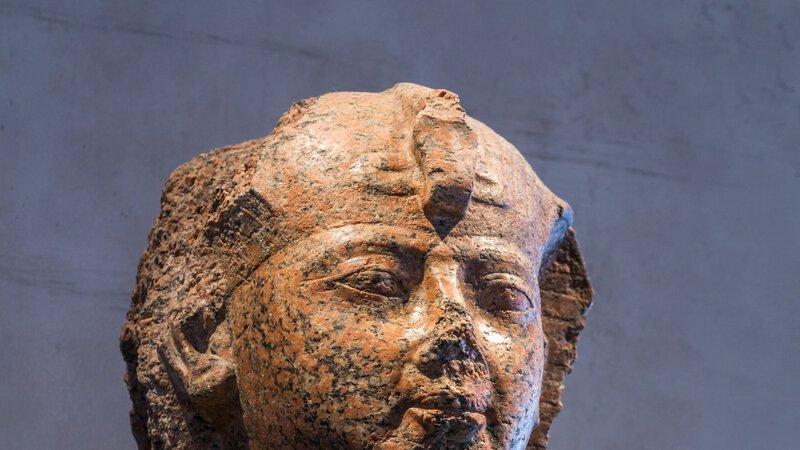

In 2007, Egyptologist Zahi Hawass held a single molar between his fingers — a tooth pulled from a plain wooden box labeled KV60 — and slid it carefully into the jaw of an unidentified, heavyset, middle-aged woman whose mummy had been gathering dust in a Cairo museum storage room for nearly a century. It fit perfectly. In that quiet, clinical moment, one of the greatest detective stories in the history of archaeology reached its conclusion: the unlabeled body was Hatshepsut, ancient Egypt’s most powerful female pharaoh — a ruler who had commanded expeditions, erected obelisks that still pierce the sky above Luxor, and steered her civilization through two decades of extraordinary prosperity, and who had been so methodically scrubbed from the official record that the modern world had simply lost her.
Daughter of a King, Wife of a God

To understand how completely Hatshepsut was erased, you first have to understand how completely she mattered. She was born into the innermost circle of Egyptian power as the daughter of Thutmose I, one of the Eighteenth Dynasty’s great warrior pharaohs — a man who had pushed Egypt’s borders deep into Nubia and Syria. Where most royal daughters were groomed for strategic marriages and decorative piety, Thutmose I appears to have given his daughter something rarer: a genuine education in statecraft. She grew up watching how an empire was actually run.
She married her half-brother Thutmose II, as Egyptian royal custom demanded, and took her place as Great Royal Wife — the highest title a woman could hold in the Two Lands. When Thutmose II died young, leaving behind an infant son by a lesser wife, Hatshepsut stepped into the role of regent. The arrangement was familiar enough in Egyptian history: a capable royal woman holding the throne for a male heir too small to wear the double crown. It was understood to be temporary. It was understood to be subordinate. Hatshepsut had other ideas.
The world she moved through was the New Kingdom at its most confident — the Eighteenth Dynasty, beginning around 1479 BC, an Egypt flush with imperial success, with rules for everything, including, very firmly, who could be pharaoh. The word itself carried a divine weight. The pharaoh was the earthly incarnation of Horus, the intermediary between gods and mortals, the axis around which cosmic order turned. Every piece of iconography, every ritual, every thread of inherited theology said the pharaoh was a man.
The Audacious Pivot: From Regent to Pharaoh

Around 1473 BC, according to Britannica’s account of her reign, Hatshepsut stopped being regent and declared herself pharaoh in her own right — the sixth pharaoh of the Eighteenth Dynasty and the architect of one of the most audacious political maneuvers the ancient world had ever seen. It was not a coup in any violent sense. Thutmose III was not imprisoned or deposed; he remained co-ruler and would eventually emerge as one of Egypt’s most celebrated military commanders. But there was no question about who held supreme authority. Hatshepsut wore the crown.
The legitimacy problem was real, and she solved it with both imagery and mythology. Statues and temple carvings showed her in traditional male pharaonic regalia — the kilt, the crook and flail, and the false beard that was always a symbol of office rather than biology. She commissioned texts claiming that the god Amun himself had chosen her, that her divine parentage made her the rightful ruler not merely by inheritance but by cosmic design. It was political theatre of the highest order, and it worked. For roughly twenty years, Egypt’s female pharaoh ruled a civilization that had never officially made room for her.
What She Built, and Why It Still Stands

Hatshepsut governed like someone who intended to be remembered forever. Her building program was staggering by any standard. At Karnak, she erected obelisks of extraordinary height — among the tallest ever raised in Egypt — their tips sheathed in electrum, a gold-silver alloy, so they caught the sun and blazed across the Nile valley. In inscriptions carved into their bases, she described herself as ruling a kingdom in peace, a deliberate contrast to the militarist boasting that decorated nearly every monument her predecessors had built.
Her mortuary temple at Deir el-Bahri, on the west bank of the Nile at Luxor, is the structure that most completely captures what kind of ruler she was. Designed by her chief steward and architect Senenmut, it is a colonnaded masterpiece carved directly into a dramatic limestone cliff face — three ascending terraces connected by ramps, its clean horizontal lines playing against the raw verticality of the rock behind it. Architects study it today as a work of genius. It was, and remains, one of the most beautiful buildings ever constructed in the ancient world.
The walls of Deir el-Bahri tell the story of her most celebrated achievement: the expedition to the land of Punt. In meticulous painted relief, they document a trading voyage — one of the most thoroughly recorded in Egyptian history — that returned with living myrrh trees carried in pots, alongside ebony, ivory, gold, and exotic animals. Where her male predecessors celebrated conquest, Hatshepsut celebrated commerce, and the reliefs make clear she understood the difference between a kingdom enriched by plunder and one sustained by trade. The Metropolitan Museum of Art’s scholarship on her legacy places this reign among the most productive in Egyptian history — by almost any measure of stability, prosperity, and architectural output, Hatshepsut’s twenty years were extraordinary.
The Erasure: Chisels in the Night

She died around 1458 BC, likely in her fifties, and was buried in the Valley of the Kings in tomb KV20 — an honor reserved for pharaohs, which was, after all, exactly what she was. And then, within decades of her death, someone decided she had never existed at all.
The campaign to erase Hatshepsut from history was systematic, coordinated, and breathtaking in its thoroughness. Her name was chiseled from obelisks. Her face was hacked from temple walls. Statues — dozens of them, perhaps hundreds — were smashed and buried in pits near Deir el-Bahri, as though the physical destruction of her image could retroactively undo her reign. Smithsonian Magazine has documented the sheer scale of this destruction, noting that it touched sites across Egypt in a way that required sustained effort and deliberate organization. This was not vandalism. It was policy.
Scholars have long debated who ordered it and why. The leading suspects are Thutmose III or his son Amenhotep II, with evidence suggesting the erasure occurred late in their reigns rather than immediately after her death — pointing toward political calculation rather than personal rage. The prevailing view is that a powerful female pharaoh who had ruled successfully and independently created a precedent that could destabilize a male royal line that needed its authority to seem natural, inevitable, and ancient. Removing her from the record removed the precedent. Her accomplishments were quietly absorbed into Thutmose III’s official history, her reign erased so thoroughly that for more than three thousand years she was essentially a ghost in her own civilization’s memory.
There is a poignant footnote to the erasure. Her great obelisks at Karnak were not destroyed — probably because dismantling monuments of that size and weight was simply too difficult. Instead, they were walled over, hidden inside a casing of stone. The very effort to conceal them preserved them. When later archaeologists broke through those encasing walls, they found Hatshepsut’s inscriptions intact, her words still legible beneath the stone that was meant to silence her forever.
Rediscovery: Putting the Ghost Back Together

By the nineteenth century, Egyptologists working through the records of the Eighteenth Dynasty began noticing strange absences — references to a female ruler, verb forms in inscriptions that were grammatically feminine where they should have been masculine, gaps in the timeline that refused to resolve neatly. The picture that assembled itself, slowly and fitfully over decades of scholarship, was of a woman who had been systematically cut out of the frame. Piecing together the life of Hatshepsut became one of Egyptology’s great ongoing projects.
Tomb KV20 in the Valley of the Kings was identified as her original burial site, but her mummy was not inside it. Tomb KV60, discovered nearby, held two female mummies: one identified as Sitre In, Hatshepsut’s royal nurse, and one left with no label, no identification, and no ceremony of recognition. That second woman was moved to the Egyptian Museum in Cairo, where she sat in storage, unstudied and uncelebrated, for decades — the greatest female pharaoh in Egyptian history reduced to an administrative afterthought in a museum basement.
The resolution came in 2007, when Hawass’s team conducted DNA analysis and CT scans of the KV60 mummy alongside a canopic box — a container for preserved organs — that bore Hatshepsut’s name and cartouche. Inside the box was a loose molar. CT imaging revealed that the unidentified mummy was missing exactly one tooth from her upper jaw. The molar matched. The woman the ancient world had tried to make invisible was identified not through a dramatic excavation but through a wooden box and a storage room — found waiting, with the patience of the long dead, for someone to finally look closely enough.
The CT scans told a quieter story than legend might prefer. She had been around fifty when she died. She had suffered from diabetes, arthritis, and bone cancer. Her body carried the evidence of a full, complicated life — not the abrupt end of someone overthrown or punished, but the gradual wearing-down of an aging ruler who had simply, eventually, run out of time.
Why Hatshepsut’s Story Still Demands to Be Told

Hatshepsut’s erasure is not just an ancient Egyptian story. It is a case study in how official history is constructed — in who gets to be remembered, who gets to be credited, and how completely a powerful woman’s achievements can be reassigned to the men around her when those in power decide that is more convenient. Her trading expeditions, her architectural legacy, her two decades of stable and prosperous governance: all of it was folded into Thutmose III’s record, attributed to a man who had ruled alongside her, not instead of her.
Today, Egyptologists rank Hatshepsut among the most successful rulers in the long history of the pharaohs — by any metric that measures governance rather than martial glory. Her temple at Deir el-Bahri draws visitors from across the world, a monument that has outlasted the people who tried to erase it by more than three millennia. The obelisks she described herself building “in peace” still stand at Karnak, their electrum long gone but their stone unbroken.
And somewhere in the chain of events that restored her name to history, there is a molar in a wooden box, and an unlabeled woman in a basement, and an Egyptologist who thought to ask whether they might belong to each other. The ancient campaign to unmake Hatshepsut was meticulous and powerful and very nearly complete. But evidence has a stubborn way of surviving. It waits, patient and wordless, for someone to finally ask the right question.

 Arabic
 French
 Spanish
 Portuguese
 Deutsch
 Turkish
 Dutch
Dutch
 Italiano
 Russian
 Romaian
 Portuguese (Brazil)
 Greek
Greek