


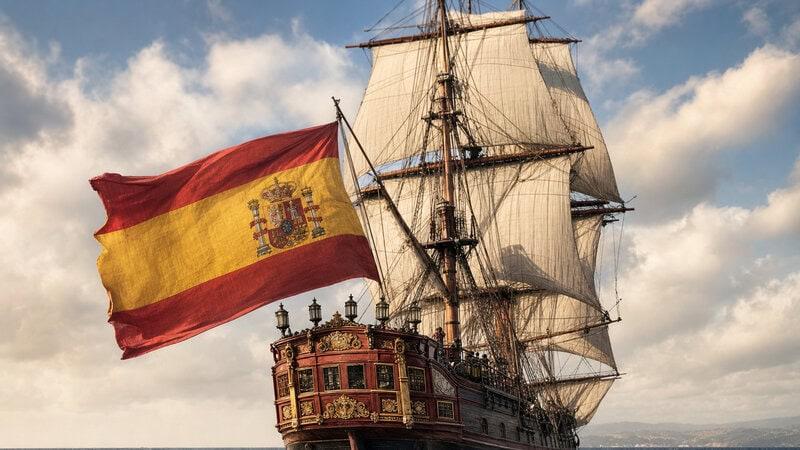

The red-and-gold flag of Spain wasn’t born from poetry or politics — it was engineered by a king who needed his sailors to survive. What follows is the story of how one of history’s greatest empires went through centuries of competing banners before a single, startlingly practical decision in 1785 gave Spain the colors it still flies today.
711 AD — The Visigoth banners fall, and a new Iberian patchwork of symbols begins

When Moorish forces swept across Iberia in 711, they didn’t just shatter the Visigoth kingdom — they shattered whatever fragile visual unity Christian Iberia had managed to assemble. In the fractured kingdoms that rose from the wreckage, each emergent power flew its own device: Castile claimed a golden castle, León a purple lion, Aragon its red and gold bars, Navarre its chains. No single Spanish flag existed, because no single Spain existed.
This heraldic fragmentation would persist for the better part of eight centuries, and it is the essential backstory to understanding why the history of Spanish flags is so tangled. The Reconquista was not one war under one banner — it was hundreds of campaigns fought under dozens of symbols, each one telling a different story about who owned the land and who owned the right to rule it.
1492 — The Lion and the Castle fly over Granada, but Spain still has no single flag

When Ferdinand and Isabella rode into Granada in January 1492, completing the Reconquista after nearly eight centuries, the quartered arms of Castile and León flew over the last Moorish stronghold in Iberia. Later that same year, Columbus carried those same royal arms westward across the Atlantic, planting them — not any red-and-gold standard — on the beaches of the Caribbean. The earliest flag of the Spanish Empire in the Americas was a dynastic emblem, not a national one.
The distinction mattered enormously. The royal standard belonged to the monarchs personally, and ordinary ships, soldiers, and frontier garrisons used a bewildering assortment of pennants and ensigns with no standardized design. The idea of a single, codified Spanish flag — something a sailor or a soldier could recognize as belonging to a nation rather than a dynasty — remained a political impossibility for decades yet to come.
1516-1517 — Charles I inherits Spain and brings the Cross of Burgundy with him

When the young Habsburg prince Charles sailed from the Low Countries to claim the Spanish throne in 1516, he brought more than his court — he brought his flag. The Cross of Burgundy, a ragged red saltire of two crossed branches set on a white field, had been the personal and military emblem of the Burgundian dukes for generations. It was vivid, bold, and already battle-tested. Following his investiture as Charles I of Spain in 1517, the cross was formally adopted as the de facto flag of Spain.
Under this banner, the conquistadors marched. Hernán Cortés entered Tenochtitlan beneath it; Francisco Pizarro raised it in the Andes. The Cross of Burgundy became the standard under which an entire hemisphere was claimed, making it arguably the most consequential flag in the history of Spanish imperial symbolism — even if most people today would struggle to recognize it.
1519-1700 — The Cross of Burgundy rules an empire spanning four continents

For nearly two centuries, the ragged red cross on white flew from Mexico City to Manila, from Cartagena to the Canary Islands. It served simultaneously as military standard and the flag raised over newly claimed territories, blurring any line between dynastic symbol and imperial identity. No other flag in this era covered more of the earth’s surface.
The cross’s visual logic was deliberate: bold diagonals on a high-contrast ground made it readable even when Atlantic gales had half-shredded the canvas. It was a flag designed for distance and chaos, which is precisely the environment in which the Spanish Empire operated. The question of what would come after it would take another century to answer — and the answer would arrive, fittingly, from the sea.
1700 — The Bourbon succession begins quietly transforming Spanish heraldry

When Philip V, grandson of Louis XIV of France, took the Spanish throne following the War of the Spanish Succession, French influence began seeping into every corner of Spanish court culture — including its symbols. The Bourbons brought with them a preference for rationalized, state-centered emblems over the inherited tangle of Habsburg dynastic devices. It was a philosophical shift as much as an aesthetic one: flags should represent states, not bloodlines.
Philip’s reign did not immediately change the ensigns flying over Spanish warships — the transition would take decades. But it recalibrated the political imagination of the Spanish court, creating the conditions under which a king might one day sit down with his naval officers and ask a genuinely modern question: what does our flag need to do?
1785 — King Charles III commissions a new flag specifically so sailors can spot it from a mile away

In 1785, Charles III gave his naval officers one of the most refreshingly practical design briefs in the history of vexillology: create a flag that could be seen at the greatest possible distance at sea, one that could not be confused with the white-heavy ensigns of France, Naples, or Sicily. He reviewed multiple candidate designs and chose the one that answered his brief most directly — bold horizontal stripes of red, then yellow at double width, then red again. High-contrast, distinctive, and difficult to mistake even in fog or battle smoke.
The double-width yellow stripe was not an accident or an aesthetic preference. It was a practical calculation aimed at maximizing color contrast at distance. Charles III had essentially commissioned a piece of visual technology, and it worked. This moment is the true origin point of the Spanish flag’s red and yellow — not mythology, not ancient tradition, but a king with a practical problem and a competition to solve it.
1785-1820s — The red-and-yellow spreads from warships to the wider empire

Charles III had decreed his new design only for the navy and merchant marine, but flags have a way of outrunning their mandates. Within years, the red-yellow-red design was flying over Spanish forts, colonial governors’ residences, and overseas garrisons across the Americas and the Pacific. The colors had become, through sheer ubiquity, the visual shorthand for Spanish imperial authority everywhere.
The proof came in the independence wars of the 1810s. As Spain’s American colonies rose in revolt, revolutionary movements across the continent deliberately designed their new flags as inversions or alterations of the red-and-yellow template — Venezuela, Colombia, and Ecuador all worked from the same chromatic starting point, turning the imperial palette against itself. A maritime decision made for purely practical reasons had, in a few short decades, become the most politically charged color combination in the Atlantic world.
1843 — The red-and-yellow officially becomes Spain’s national flag on land as well as sea

Queen Isabella II settled the question formally in 1843, issuing a royal decree that extended the red-yellow-red flag from a naval ensign to the official flag of all Spanish territory. After nearly sixty years as a maritime tool, the design finally became a national symbol in the fullest sense. The transformation from practical instrument to patriotic emblem was complete — or at least official.
The coat of arms at the center would prove far less stable than the stripes around it, changing repeatedly through the turbulent 19th and 20th centuries as Spain lurched between monarchy, republic, and dictatorship. The symbolic meanings that later generations attached to the colors — courage, generosity, the gold of Castile, the blood of its warriors — were largely retrofitted mythology. The original meaning was simpler and more honest: we need sailors to see this flag from a mile away.
1978 — The democratic constitution enshrines the colors, closing the loop from empire to republic

Spain’s post-Franco constitution of 1978 formally confirmed the red-yellow-red tricolor as the national flag. By 1981, the current constitutional coat of arms had replaced the Francoist eagle that had occupied the center stripe for four decades. The flag had survived monarchy, republic, civil war, dictatorship, and democratic transition — each regime changing the arms at the center, none daring to touch the stripes themselves.
That chromatic stubbornness is the final chapter of the Spanish flag’s history: from Charles I’s Burgundian cross to Charles III’s visibility experiment, through Isabella II’s decree and Franco’s eagle and into a twenty-first-century democracy, the colors chosen by a practical king in 1785 proved more durable than any of the empires, dynasties, or ideologies that flew them.
What began as a solution to a sailor’s problem — how do you tell your fleet apart from everyone else’s on a gray Atlantic morning — ended as one of the most recognizable national identities on earth. Practical decisions, it turns out, have a habit of becoming permanent ones.

 English
 Arabic
 French
 Spanish
 Portuguese
 Deutsch
 Turkish
 Dutch
Dutch
 Italiano
 Russian
 Romaian
 Portuguese (Brazil)