


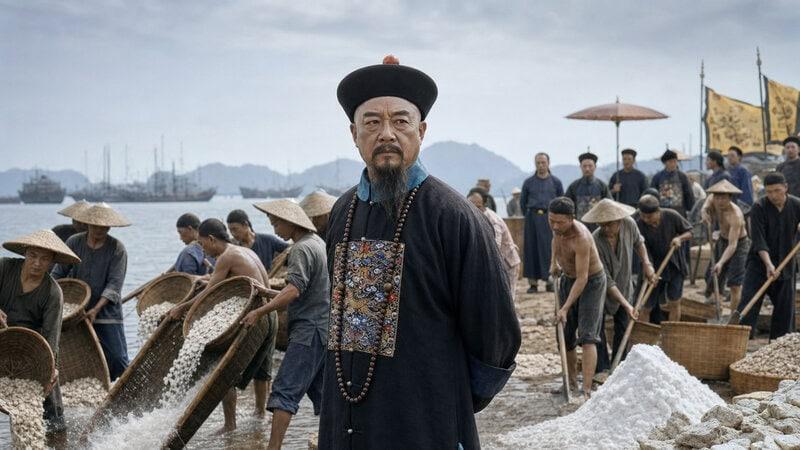

In the summer of 1839, on a stretch of beach at Humen near Canton, more than a thousand tons of opium were mixed with salt and lime by Chinese laborers working in the open air, then sluiced into the sea while Imperial Commissioner Lin Zexu watched. It was one of the most spectacular acts of drug enforcement in history — and Britain decided it was an act of war.
Silver, Tea, and a Trade Imbalance That Drove Britain Mad

To understand why a superpower dispatched gunboats over a drug seizure, you have to go back to the commercial anxiety gnawing at the British Empire in the early nineteenth century. Britain was, in the most literal sense, economically dependent on China. Tea, silk, and porcelain flowed westward in enormous quantities, but China — vast, self-sufficient, and largely unimpressed by European manufactures — wanted little in return. The result was a hemorrhage of silver eastward, and a mounting crisis for British merchants and the British East India Company alike.
The solution the Company settled on was elegant, profitable, and morally catastrophic: opium. Grown in Bengal under Company supervision and sold through private “country traders” who handled the actual smuggling into Chinese ports, the drug gave Britain a commodity China’s population would buy in ever-growing quantities. The arrangement also gave the Company a layer of plausible deniability — it wasn’t officially trafficking drugs; it merely auctioned opium in Calcutta and let independent merchants carry it the rest of the way.
The Qing dynasty, which had ruled China since 1644, had banned opium imports. That ban was systematically and profitably ignored for decades. By the 1830s the consequences were undeniable: millions of Chinese users, an addiction crisis eating through every level of society from laborers to imperial officials, and a currency emergency as silver drained back out of China to pay for the drug. The same court that had once sat serenely at the center of the known world was watching its fiscal foundations crack.
Lin Zexu was dispatched to Canton to end it. He confiscated around 1,200 tons of opium from British merchants — without compensation — expelled foreign traders, and wrote a remarkable open letter to Queen Victoria appealing to her conscience and asking how Britain could justify selling abroad what it prohibited at home. The letter went unanswered. London’s response was to send the Royal Navy.
The First Opium War (1839-1842): Enforcing a Drug Ban Treated as an Act of Aggression

The First Opium War began in 1839 and lasted until 1842. As a military contest it was barely a contest at all. British steam-powered gunboats could navigate rivers the Qing navy could not enter; British-Indian infantry, battle-hardened and professionally drilled, faced armies still organized for a pre-industrial age. The technological and tactical gap was not merely wide — it was, from the Chinese side, almost impossible to bridge in real time. Chinese soldiers and commanders often showed genuine courage; the material mismatch simply overwhelmed it.
Back in London, the war was debated in Parliament with remarkable euphemism. Politicians framed it as a matter of commercial rights and national honor, as if the cargo being defended had been wool or cotton rather than narcotics. William Gladstone — then a young MP, later one of Britain’s defining prime ministers — was a rare dissenting voice, calling it a war more unjust in its origin than any he had known, and expressing shame that the British flag was being used to protect drug smuggling. He was outvoted. The motion to halt hostilities failed by nine votes.
The war ended with the Treaty of Nanjing in 1842, one of the documents the Chinese would come to call the “unequal treaties.” China ceded Hong Kong Island to Britain in perpetuity. Five ports — Canton, Shanghai, Amoy, Fuzhou, and Ningbo — were forced open to foreign trade on foreign terms. A massive indemnity was paid, partly to compensate the merchants whose illegal drug stocks Lin Zexu had destroyed. British subjects in China were granted extraterritorial rights, meaning they could not be tried under Chinese law. It was a template for humiliation that other Western powers — the United States, France, and others — lined up swiftly to copy through their own supplementary treaties.
The Uneasy Interval: Opium Surges, Resentment Builds

The years between the two wars were not peace — they were a slow catastrophe. Opium now flowed more openly through the treaty ports, and the devastating effects of narcotic addiction on Chinese society spread deeper with each passing year. The Qing government, its authority visibly eroding, simultaneously faced the Taiping Rebellion — a catastrophic internal uprising rooted partly in social desperation that would ultimately kill tens of millions and tie down imperial military resources for over a decade. It was a dynasty simultaneously bleeding from wounds inflicted from outside and from within.
Western powers, emboldened by the first war’s outcome, pushed for more: the right to post permanent ambassadors in Beijing, access to China’s interior, broader commercial privileges, and formal protections for Christian missionaries. These demands the Qing court found politically intolerable — not merely because of their content, but because of what accepting them would signal about the dynasty’s sovereign authority and its mandate to rule. Too proud to fully capitulate, too weakened to fully resist, the Qing government was caught in an impossible position. A second conflict was not a question of whether but when.
The Second Opium War (1856-1860): Britain Returns, and Brings France

The trigger for the second war was, even by the standards of imperial pretexts, notably thin. In October 1856, Qing officials boarded a vessel called the Arrow — a lorcha registered in Hong Kong — and arrested several of its Chinese crew members on suspicion of piracy and smuggling. British officials in Canton claimed the ship had been flying the British flag at the time and that hauling down that flag constituted an insult to British honor. The legal basis for this claim was questionable: the Arrow‘s Hong Kong registration had lapsed, and accounts of whether a flag was even flying differed. Contemporary observers, including some British politicians, recognized the incident as a manufactured justification for a conflict that commercial and diplomatic frustrations had already made likely. It served its purpose regardless.
France joined the coalition after the execution of a French Catholic missionary named Auguste Chapdelaine in China’s Guangxi province gave Napoleon III his own pretext. A joint Anglo-French expeditionary force descended on a China already buckled by internal revolt. The military result was, again, not close. Canton was captured, then the Taku forts guarding the approach to Beijing, then the capital’s outskirts themselves.
The conflict’s most shocking moment came not in battle but in Beijing. When Qing officials violated the terms of ceasefire negotiations — capturing and in several cases fatally mistreating European envoys and their escorts — the British commander Lord Elgin ordered the Emperor’s magnificent Old Summer Palace, the Yuan Ming Yuan, to be burned to the ground. The complex had taken generations and enormous imperial resources to construct; it filled hundreds of acres with interconnected pavilions, libraries, lakes, and irreplaceable works of art including pieces looted from across Asia and gifts from European courts. It was reduced to ruins over three days in October 1860. Lord Elgin described it explicitly as a punishment directed at the Emperor rather than at the Chinese people — a distinction that, given the palace’s cultural significance, was not widely accepted. The ruins still stand outside Beijing, preserved deliberately as a monument to what China calls its century of humiliation.
The resulting Convention of Beijing in 1860 went substantially further than Nanjing had. More ports were forced open to foreign commerce. Kowloon Peninsula — the strip of mainland territory directly opposite Hong Kong Island — was ceded to Britain, cementing what would become the colony’s essential geography. Crucially, the opium trade was legalized outright within China, stripping away even the fiction that it had ever been merely a grey-market nuisance that both sides preferred not to examine too closely. Both wars had been fought, in the final accounting, to protect a commercial system built on mass addiction.
The Human Cost: A Public Health Catastrophe Hidden in Treaty Language

It is easy, in tracing the diplomatic and military arc of the Opium Wars, to lose sight of what was actually happening to Chinese people on the ground. Opium addiction carried severe physical and social consequences — chronic dependence, physical deterioration, the collapse of household economies as wages and savings were consumed by the drug. By the late nineteenth century, estimates of the number of Chinese opium users ran into the tens of millions. Entire regional economies were distorted around production, distribution, and consumption of the drug. Families were destroyed. Administrative capacity was hollowed out. A public health disaster of historic proportions unfolded across decades, largely beneath the respectable surface of commercial treaties and tariff schedules.
The Qing state’s attempts to treat the addiction crisis were consistently undermined by the legal and treaty framework that foreign powers had imposed. China could not simply ban imports again without inviting another military confrontation. It could not tax the trade heavily enough to suppress consumption without violating treaty terms. It was trapped — legally obligated to permit the very commerce that was destroying its population.
What the Opium Wars Revealed — and Why They Still Matter

The Opium Wars are sometimes placed in the category of obscure Victorian-era conflicts with limited modern relevance. This is a serious misreading. The wars established a template — military coercion deployed to pry open markets on Western terms — that was applied repeatedly across Asia and Africa throughout the nineteenth century. They also inaugurated what Chinese historians call the “Century of Humiliation,” a period stretching from 1839 to the Communist victory in 1949 during which China was subjected to repeated forced concessions, territorial losses, and violations of sovereignty by foreign powers.
That collective memory shapes Chinese foreign policy in ways that Western governments and commentators repeatedly misread as irrational nationalism or ideological posturing. The fierce insistence on absolute sovereignty, the acute sensitivity to any suggestion of external interference in Chinese internal affairs, the deep suspicion of Western-sponsored international norms and institutions: none of this is irrational in context. When the last sustained engagement with Western commercial demands backed by military force resulted in the burning of the Emperor’s palace and the legalization of narcotics across your territory, a certain wariness about the next set of demands is not paranoia — it is institutional memory.
The Opium Wars are not ancient history in China — they are living political memory, invoked regularly in public discourse, taught carefully in schools, and embedded in the physical landscape through sites like the Yuan Ming Yuan ruins. Western policymakers who engage with China without understanding this context are, in effect, negotiating without reading the other side’s foundational documents.
There is one final irony worth registering. The same British Empire that sent gunboats to protect opium smugglers in 1839 would, within a few decades, be hosting international anti-opium conferences and positioning itself as a leader in global drug reform. Britain eventually supported the International Opium Commission of 1909 and the Hague Opium Convention of 1912, which began the framework of international drug control that still exists today. History has rarely produced a more audacious example of a former dealer presenting itself as the architect of the rehabilitation program.
The Takeaway: The Drug Was Never Really the Point
The opium was, in the end, a mechanism rather than a motive. What Britain was actually trading in was leverage — economic, commercial, and ultimately military — and opium happened to be the most efficient tool available for generating it. The drug created Chinese demand; demand generated silver flows back toward British trade networks; those flows funded the India commerce; and the India commerce funded critical elements of the empire’s financial architecture. When the Qing government moved to interrupt that mechanism by enforcing its own laws on its own territory, Britain treated the enforcement of Chinese law as an act of aggression against British interests. And it was not entirely wrong — because by that point, the interests embedded in the opium trade were vast and deeply structural.
The Qing dynasty’s inability to modernize its military and administrative capacity quickly enough, combined with Western firepower and commercial ruthlessness, produced a catastrophe that reshaped Asia for a century. The soldiers who fought these wars on both sides were caught inside a conflict whose real engine was the intersection of imperial commerce and state power. Britain didn’t fight the Opium Wars because it loved opium. It fought them because it could, and because the profits embedded in the system were too large and too systemic to let another government’s drug laws dismantle them. That calculation, and its consequences, echo forward to the present day.

 Arabic
 French
 Spanish
 Portuguese
 Deutsch
 Turkish
 Dutch
Dutch
 Italiano
 Russian
 Romaian
 Portuguese (Brazil)
 Greek
Greek