


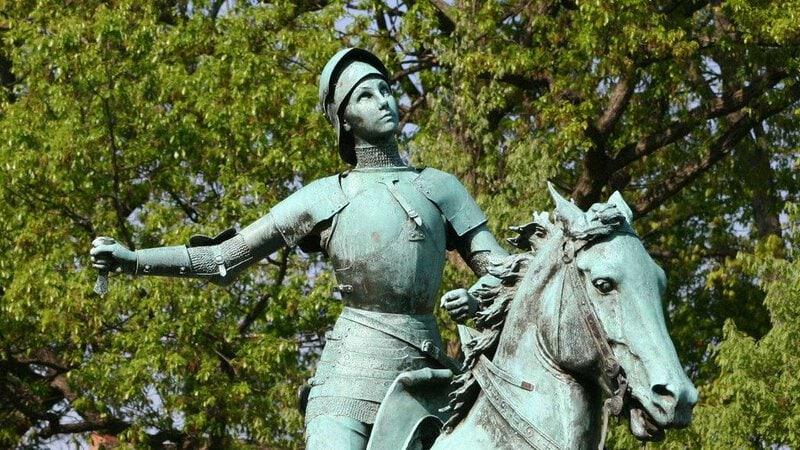

In a cold courtroom in Rouen in the winter of 1431, a team of trained scribes recorded everything — every question put to the nineteen-year-old girl standing before her judges, every answer she gave, every pause and defiance and prayer. They wrote down her words with extraordinary care. Nobody thought to draw her face.
The Most Painted Woman Nobody Ever Portrayed

That omission sits at the heart of one of history’s most disorienting paradoxes. Joan of Arc is almost certainly the most painted woman of the entire medieval period. Her image appears on altarpieces, coins, and postage stamps, and the great museums of the world hold canvases depicting her calling, her battles, her martyrdom, her glory. Yet not one of those paintings can be confirmed as an accurate likeness. Not a single verified portrait of Joan of Arc exists. Every famous image — every armored warrior, every luminous peasant girl, every triumphant standard-bearer — was made after her death, in some cases centuries after.
This is stranger than it sounds. By the time Joan rode to the relief of Orléans in 1429, portraiture had become a reasonably common practice for people of significance across Europe. Kings sat for their likenesses. Popes commissioned artists. Prosperous merchants in Flemish cities paid good money to have their faces preserved in oil and egg tempera. Joan of Arc upended a centuries-old military stalemate, convinced a reluctant crown prince to march to his coronation, and became famous across the continent while she was still a teenager. And yet no authenticated image of her face survives.
The question that follows is the one worth sitting with: if every famous Joan of Arc painting was made by someone who never saw her, what were those artists actually painting? And what does that tell us about the act of depicting Joan — not as history, but as something stranger and more revealing?
What We Actually Know: The Fauquembergue Sketch and the Arras Profile

There is one drawing made during Joan’s lifetime. On the day news reached Paris that Orléans had been relieved in 1429, a court clerk named Clément de Fauquembergue made a marginal sketch in the register he was keeping. It shows a woman holding a sword and a banner. It is almost certainly the earliest image ever made of Joan of Arc. It is also, by any measure, useless as a likeness — Fauquembergue had never seen her, and what he drew was a generic female figure, a symbol scrawled in the margin of a bureaucratic document by a man recording an astonishing piece of news. It tells us nothing about what Joan of Arc actually looked like.
Sometimes cited alongside this is the Arras portrait, a profile image that some historians have suggested might be rooted in a lost contemporary source. But the chain of custody is broken beyond repair. No scholar has been able to establish that it preserves any genuine visual memory of Joan, and most treat it with considerable caution. It is a copy of something unknown, which may itself have been a copy of something imagined.
What the written record does preserve is fragmentary but human. Witnesses who testified at Joan’s rehabilitation trial in 1456 — conducted twenty-five years after her execution, when the political winds had shifted and the French crown needed her reputation restored — described someone physically capable and dark-haired, with a voice powerful enough to address troops in an open field. These are impressions, not a portrait. They give us a body in a room but not a face.
The absence of a contemporary likeness was not entirely accidental. Portraiture of individuals below the rank of royalty was genuinely rare in early fifteenth-century France. And Joan’s enemies, who controlled Rouen and stage-managed her trial and execution, had every political incentive to erase her rather than memorialize her. An image preserves. A burned body and a suppressed memory do not.
How a Legend Fills a Visual Vacuum

When Joan’s reputation was formally rehabilitated in 1456, the political need for her image began to outrun the historical record of it. France, building its identity as a unified kingdom after a century of devastating war with England, needed a founding myth — a figure who embodied national will and divine favor. Artists, not archivists, answered that need.
What followed across the next several centuries was not a tradition of historical documentation but a tradition of cultural projection. Each era dressed Joan in its own visual vocabulary. Renaissance painters gave her the classical armor and composed dignity of a Roman general. Baroque artists bathed her in theatrical light borrowed from religious altarpieces. Romantic painters of the nineteenth century wrapped her in emotion and flowing hair and the aching beauty of a martyr. Joan of Arc portrait history, looked at honestly, is not a history of a woman. It is a history of French self-image at successive moments of crisis and ambition.
The iconographic conventions that feel most historical — the armor, the banner, the raised sword — are largely borrowed from the visual language used to depict warrior saints in medieval and Renaissance religious art. They tell us how painters believed a holy warrior should look, not how Joan of Arc actually appeared on campaign. The written record does confirm she wore male clothing and armor, so the broad convention has that much grounding in fact. But no specific depiction of it does.
What becomes unmistakable when surveying several centuries of these images together is that waves of new Joan of Arc paintings reliably accompany moments of French political crisis. She is reached for when France needs her. That pattern reveals exactly what these paintings are: cultural arguments, made in pigment, about who the French people are and what history owes them.
Jules Bastien-Lepage’s 1879 Masterpiece: Nationalist Grief in Oil

No single painting makes that argument more powerfully, or more beautifully, than Jules Bastien-Lepage’s Joan of Arc, now held at the Metropolitan Museum of Art in New York. To understand it fully, you need to know where Bastien-Lepage was standing when he painted it.
It was the late 1870s. France had just endured the catastrophic Franco-Prussian War, which ended in 1871 with the new German Empire annexing Alsace-Lorraine — the eastern borderlands that had been French for two centuries. The humiliation ran deep. Bastien-Lepage was himself a native of Damvillers, in Lorraine, and he found himself reaching back four and a half centuries for a way to say something about what France had lost and who France still was.
The painting he produced is extraordinary in its stillness. Joan stands barefoot in her parents’ garden in Domrémy, dressed in peasant clothes, her hands slightly raised as though she has just stopped in the middle of an ordinary task. Her gaze is fixed on something beyond the canvas — past the viewer, past the visible world — and behind her, half-dissolved into the foliage, the ghostly forms of Saints Michael, Margaret, and Catherine shimmer in the air. It is the moment of divine calling, rendered in the naturalist brushwork that was Bastien-Lepage’s signature: every plant identifiable, every thread of fabric recorded with almost uncomfortable fidelity, the visionary made to look as factual as a photograph.
The painting was exhibited at the Exposition Universelle in Paris, where it caused a sensation. It was nearly 450 years after Joan of Arc’s death. Any claim to historical likeness was impossible — Bastien-Lepage was painting a face he had invented, in a garden he had reconstructed, depicting a moment no living person had ever witnessed. Yet the painting’s realism invited audiences to feel, powerfully and irrationally, that they were seeing the true Joan.
The political charge was unmissable to anyone paying attention. To paint the patron saint of France as a barefoot girl from Lorraine, at the precise historical moment when France had lost Lorraine, was not an act of historical recovery. It was an act of nationalist grief — a claim about territory and soul expressed through pigment and linseed oil, addressed to an audience that understood exactly what it meant.
Why These Paintings Feel So Convincingly Real

There is a specific psychological mechanism at work when we look at a painting like Bastien-Lepage’s Joan. The more realistic a painting’s technique — bare feet on actual grass, specific identifiable plants, naturalist light — the more authentically the image registers in the mind. The human instinct for facial recognition, tuned over millennia to treat visual information as evidence, does not automatically discount a painted face just because we know, intellectually, that the painter was guessing. The realism bypasses the caveat.
Museums and textbooks have compounded this confusion for generations, displaying post-mortem portraits of Joan as illustrations alongside historical text, training readers to treat invented likenesses as genuine Joan of Arc historical images. A feedback loop then takes hold: once an image becomes iconic enough, later painters copy its details. The strong jaw, the direct gaze, the particular set of the shoulders — features that originated in one artist’s imagination — calcify through repetition into a consensus portrait built entirely on creative invention mistaken for documentary record.
The broader lesson reaches well beyond Joan of Arc. For most of human history, fame and portraiture were not synonymous. Many of antiquity’s most consequential figures — Socrates, Cleopatra, Boudicca — left no verified likeness. Joan is medieval history’s most dramatic instance of the same phenomenon: the more powerful the legend, the more urgently the human imagination produces a face to put on it, and the more convincingly invented that face becomes over time.
What Historians and Art Scholars Conclude

The current scholarly consensus is clear: no painting can properly be called a verified Joan of Arc likeness. The Fauquembergue sketch is the closest thing to a contemporary image and is explicitly, by its own evidence, not drawn from life. Every other image in the tradition follows at a remove of decades or centuries, built on earlier images rather than on any living memory of the woman herself.
Periodically, a portrait surfaces with claims to being a hidden contemporary likeness. The pattern is consistent: forensic art historians and archivists examine the claim, test the provenance, and find the evidence wanting. The desire for a real face to exist is evidently powerful enough to generate these claims on a recurring basis, which is itself revealing. People need Joan to have a face. Her absence feels like a wrong that should be correctable.
What art historians increasingly emphasize, however, is that the post-mortem tradition has genuine scholarly value — not as documentation of Joan, but as documentation of the societies that produced it. The Bastien-Lepage canvas tells us more about Third Republic France’s experience of territorial loss and nationalist longing than it could ever tell us about a teenage girl in Domrémy in 1429. These paintings are primary sources. They are simply primary sources about the wrong century.
There is something worth sitting with in that reorientation. The fact that we cannot know what Joan looked like may be part of the reason she remains so potent. A blank face is a canvas. Every generation gets to fill it with what it needs.
The Face We Keep Inventing
Return to Rouen in 1431, to the scribes writing in the cold. They recorded Joan’s theology, her stubbornness, her wit under pressure, her insistence that she answered to God before she answered to any bishop. They noted what she wore and sometimes what she ate. They did not set down a description of her face detailed enough for any artist to reconstruct it — whether through oversight, through the particular blindness that power has toward the humanity of those it destroys, or simply through the conventions of the time.
Joan of Arc is, by any measure, one of the best-documented individuals of the medieval period. We have her words verbatim. We have the testimony of people who knew her. We have the bureaucratic machinery of both her condemnation and her rehabilitation preserved in considerable detail. We know what she did. We know almost nothing of what she looked like. That gap — between the richness of the verbal record and the blankness of the visual one — is why the paintings keep coming, and why the question of what Joan of Arc looked like still pulls at people six centuries after her death.
Every famous image of Joan of Arc is, in the end, a self-portrait of the era that made it. Bastien-Lepage’s barefoot girl in a Lorraine garden is 1879 France, grieving and defiant. The armored, regal Joan of Renaissance painting is sixteenth-century French statecraft, assembling a mythology for a consolidating nation-state. Whatever image comes next will be ours — carrying our preoccupations, our aesthetics, our political needs — dressed in the convincing costume of history.
The most visually reproduced woman of the Middle Ages has no verified face. That may be exactly why she endures. She is whoever we need her to be, and we have never stopped needing her to be something.

 Arabic
 French
 Spanish
 Portuguese
 Deutsch
 Turkish
 Dutch
Dutch
 Italiano
 Russian
 Romaian
 Portuguese (Brazil)
 Greek
Greek