


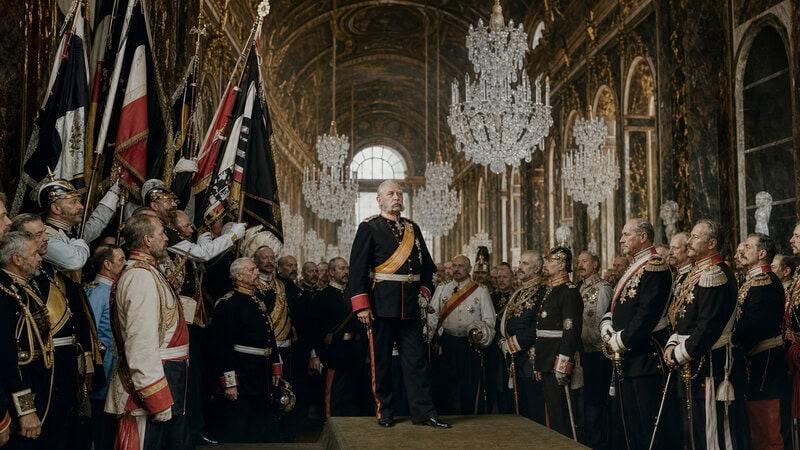

On January 18, 1871, inside the Hall of Mirrors at Versailles — a palace built to glorify French power — Prussian generals and German princes watched Wilhelm I proclaimed Kaiser of a brand-new nation. The chandeliers blazed above the gilded room, the defeated French sulked outside, and one word rang through the ceremony above all others: Reich. It was a word that had been perfectly ordinary for a thousand years. It would never be ordinary again.
What ‘Reich’ Actually Means — Before History Got Hold of It

Strip away the twentieth century and Reich is a surprisingly modest term. It shares its ancient root with the English word rich and reaches back toward the Latin rex, meaning king — the underlying idea being a domain of power, a territory where someone’s authority runs. In medieval German, the word was descriptive rather than mythological. A minor lord had a small Reich. A bishop had one. The word asked only: whose power, and where?
English translators have long reached for empire, realm, and kingdom more or less interchangeably when they encounter it, and that slipperiness is itself a clue. When people search for the German word for empire, they find Reich — but the word’s own history is far messier and more interesting than any single English translation allows. What it meant depended entirely on who was using it, in which century, and to what political purpose.
The First Reich: How ‘German’ Was the Holy Roman Empire, Really?

The original high-political home for Reich was the entity historians call the Holy Roman Empire, which lasted in various forms from 962 until Napoleon dissolved it in 1806. Its full German name — Heiliges Römisches Reich Deutscher Nation, or Holy Roman Empire of the German Nation — wedges three competing ideas of identity into one ungainly title, and the tension between them never really resolved. The rulers of this empire spoke Latin at court, governed Italians, Czechs, and Burgundians alongside German-speaking populations, and the concept of a unified German people was largely a later invention projected backward onto a genuinely plural institution.
New research published on Medievalists.net in 2025 rethinks how “German” the Holy Roman Empire actually was in terms of medieval nationhood, finding that the national categories later generations took for granted barely existed in the minds of the people who lived under it. Voltaire’s famous quip — that it was neither holy, nor Roman, nor an empire — lands as a punchline that also illuminates a real identity crisis baked into the institution from its very founding.
The Empire’s pluralism had practical consequences that matter for understanding Reich‘s meaning. Because the institution encompassed so many peoples, languages, and loyalties, the word naming it could never settle into a single ethnic or national meaning. It pointed to authority and to territory, not to a people. That distinction would prove enormously important once later generations began insisting it should point to a people above all else.
When Napoleon’s pressure finally ended the Empire in 1806, Reich was left briefly homeless — a grand word without a grand object. That vacancy would prove dangerous. Words that once named great things do not quietly retire; they wait for someone ambitious enough to fill them again.
Three Wars and a New Nation: The German Empire of 1871

The man who filled the vacuum was Otto von Bismarck, Prussia’s chancellor and one of the nineteenth century’s most ruthless political architects. His method was straightforward and brutal: war, carefully chosen and carefully won. Prussia fought Denmark in 1864, then the Habsburg monarchy in 1866, then France in 1870 to 1871 — three conflicts in seven years, each one expanding Prussian reach and prestige, each one pulling the fractious German states closer to the Prussian orbit whether they wished it or not.
The result, proclaimed in that mirrored hall at Versailles, was the German Empire — and the numbers alone convey how improbable it was. The new state stitched together 25 separate entities: four constituent kingdoms, six grand duchies, five duchies, and seven further territories, each with its own nobility, its own local pride, its own historical grievances. This was not a natural nation discovering itself; it was a nation being constructed under Prussian dominance, held together by shared language, shared enemies, and Bismarck’s extraordinary skill at managing contradictions.
What made this moment genuinely historic was its novelty. The German Empire formed in 1871 was the first German nation-state — Reich was now doing entirely new work, naming not just any realm but an ethnically and linguistically defined national project. The shift in the word’s meaning was as significant as the political event itself. For the first time, Reich was being asked to carry the weight of national identity rather than simply dynastic authority.
And the new nation grew at staggering speed. Within decades, this improbable patchwork became the most industrially significant nation in Europe, a powerhouse of steel, chemistry, and railways that alarmed Britain and fascinated the rest of the world. The word Reich acquired connotations of modernity and military muscle it had never carried before — and with them, a new kind of pride that was easily weaponized when the empire eventually collapsed.
Collapse, Vacuum, and the Numbering Game

The German Empire collapsed in November 1918 with the speed that empires sometimes do when the logic holding them together suddenly fails. Kaiser Wilhelm II abdicated. The Weimar Republic replaced the monarchy. And Reich entered a strange interregnum — it still appeared on government buildings and official letterheads, still named the legal continuity of the German state, but it no longer named a Kaiser or a war machine or a triumphant national project. It named a traumatized democracy trying to function inside the ruins of the old order.
This is the moment when the retrospective numbering game began, and understanding it is essential to understanding what came next. The labels First Reich, Second Reich, and eventually Third Reich were not contemporary self-descriptions used by those earlier empires. They were invented as propaganda architecture — a narrative spine designed to make one movement’s seizure of power feel like historical destiny rather than political catastrophe. The sequence implied that German greatness followed a grand arc through time, and that the arc was bending, inevitably, toward a third and final culmination.
For anyone asking what Reich meant to Germans during the Weimar years between 1919 and 1933, the honest answer is: it meant different things simultaneously. Legal continuity to lawyers. Lost glory to nationalists. A promised return to extremists already sketching successors. A word carrying that many meanings at once is precisely the kind of raw material demagogues find most useful.
The Third Reich: How Propaganda Poisoned a Word

The phrase Drittes Reich — Third Reich — did not originate with Adolf Hitler. It was popularized by the nationalist writer Arthur Moeller van den Bruck in his 1923 book of the same name, which imagined a coming German spiritual and political rebirth. The Nazis did not coin the term; they weaponized it. By casting their movement as the third in a sequence beginning with the medieval empire and continuing through the 1871 nation-state, Nazi propagandists manufactured an aura of historical inevitability around what had been, just years earlier, a fringe political party.
The Third Reich label was therefore not merely a name — it was a claim. It said: this is where history was always going. It bound the regime’s identity to a thousand-year story of German greatness and presented its crimes as the fulfillment of a destiny rather than choices made by identifiable human beings. The retrospective numbering of the earlier empires was part of the same maneuver: by calling the Holy Roman Empire the First Reich and the 1871 state the Second, propagandists implied that both had been building toward this moment all along.
Ironically, the Nazi leadership itself eventually discouraged use of the phrase after 1939. The logic of the sequence was the problem: if there had been a Third Reich, a fourth might follow. The name implied succession, and succession implied the current one could end. But by then it scarcely mattered. The phrase had been broadcast across the world in newsreels, speeches, and newspaper headlines, and the association between Reich and twelve years of systematic atrocity was effectively permanent.
The postwar German state understood this intuitively. The Federal Republic, founded in 1949, chose Bundesrepublik — federal republic — over any formulation that carried the old word forward. The deliberate avoidance was itself a kind of testimony: even the survivors of the thing could not rehabilitate what the word had come to carry.
What German Speakers Actually Do With the Word Today

Reich did not disappear from the German language, and understanding where it survives illuminates exactly which part of its meaning the twentieth century destroyed. It persists in perfectly neutral compounds that most German speakers use without a second thought: Tierreich for animal kingdom, Pflanzenreich for plant kingdom, Kaiserreich for any historical imperial monarchy. In botanical and zoological classification, the word functions as it always did — descriptive, structural, undramatic. The ghost of the original meaning is still visible in these everyday uses.
What the twentieth century destroyed was not the word’s utility in bounded, technical contexts. What it destroyed was the word’s availability as a term of political aspiration. No serious German politician reaches for Reich as a positive frame. No German institution names itself with it. The damage is not to the dictionary definition but to the word’s emotional register — its capacity to inspire rather than alarm.
Historians, meanwhile, are still working to see the 1871 empire clearly, without the shadow of what came later distorting the view. An examination of the German Empire’s place in the typology of European states in the History Workshop Journal argues that the Second Reich was a genuinely complex constitutional experiment — not simply a forerunner to catastrophe, but an entity worth understanding on its own terms, shaped by the same tensions between nationalism, federalism, and dynastic tradition that were straining every European state in the nineteenth century. The teleological reading — that the 1871 empire was always building toward the 1933 one — flattens a far more contingent and complicated history.
A Plain Noun and Its Long Catastrophe
The story of Reich is ultimately a lesson in what political violence does to language. A word that once described any lord’s modest domain — a bishop’s territory, a petty prince’s fields — was loaded across centuries with grander meanings, reloaded in the Hall of Mirrors at Versailles, and finally detonated across the twentieth century with consequences that reshaped the world. The original meaning did not vanish. It simply got buried under rubble heavy enough that most people stopped digging.
That burial has a cost. When we can no longer see the word’s history clearly, we also lose sight of how the propaganda worked — how a perfectly ordinary medieval noun was fashioned into a claim about destiny, how a retrospective numbering system manufactured a sense of inevitability around events that were not inevitable at all. Understanding what Reich meant before its worst moment is not an act of rehabilitation. It is an act of clarity, and clarity is the one thing propaganda cannot survive.
Both things remain true at once: words have histories longer than their worst moments, and some worst moments are heavy enough to shift a word’s center of gravity permanently. Reich sits at that exact crossroads — ancient and contaminated, ordinary and irredeemable, a perfectly plain medieval noun that history turned into something it never asked to be.

 Arabic
 French
 Spanish
 Portuguese
 Deutsch
 Turkish
 Dutch
Dutch
 Italiano
 Russian
 Romaian
 Portuguese (Brazil)
 Greek
Greek