


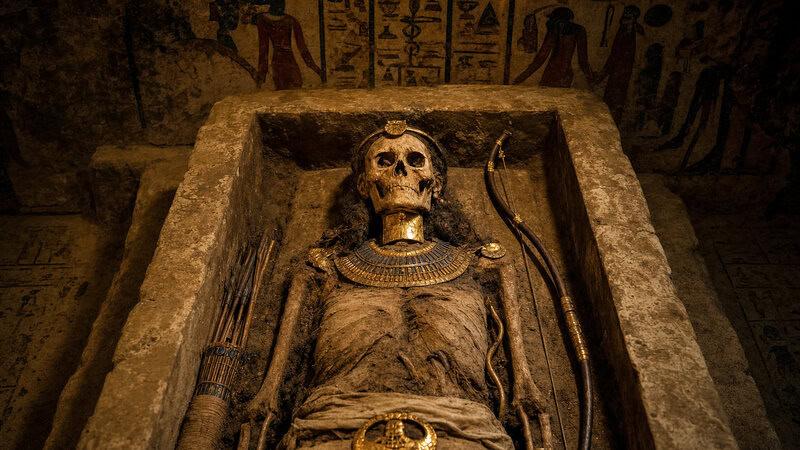

The tomb was sealed with gold at her throat and a recurve bow at her side — and for more than a century, archaeologists filed the bow under “ceremonial” and moved on. A new study suggests they were wrong to do so, and the evidence for that correction has been waiting, quietly, inside the bones of six ancient Egyptian mummies.
Buried With a Bow — and She Knew How to Use It

Picture the moment a burial chamber is opened after three thousand years of silence. Priests would have packed the space with care: canopic jars, amulets, linen wrappings soaked in resin, objects chosen to carry the dead into eternity. Among those objects, in a handful of royal women’s tombs, excavators found weapons — recurve bows built for serious draw weight, and short daggers with handles worn smooth by use. The assumption recorded in catalogue entries across the 19th and 20th centuries was consistent: these were status symbols, markers of prestige placed by attendants, props for the afterlife rather than tools of the life that came before.
That assumption has now been challenged at its foundation. A new study published in the journal Frontiers examined six mummies believed to be ancient Egyptian royal women and found physical evidence — written into muscle attachment points, skeletal stress markers, and patterns of wear on bone — suggesting these women were not passive recipients of ceremonial grave goods. They were active practitioners of the skills those weapons required.
If the findings hold up to the scrutiny they are already attracting, they meaningfully revise the understood silhouette of royal womanhood in one of the world’s most studied and most frequently misread civilizations.
How an Interpretive Assumption Hardened Into Orthodoxy

To understand why the study lands with such force, it helps to understand how stubbornly the old interpretation held. When 19th-century European archaeologists first systematically excavated Egyptian tombs, they carried assumptions about women so deeply embedded they barely registered as assumptions at all. Women were domestic. Women were decorative. Women who appeared in public life did so at the pleasure of men, or as rare exceptions that only proved the rule. That framework shaped not just conclusions but questions — if a scholar never seriously asks “could she have used this bow?”, the physical evidence that she did never gets examined.
Weapons found alongside female mummies were catalogued as ritual or prestige objects almost by reflex. The practical possibility was not argued against; it simply was not argued at all. That interpretive silence hardened into orthodoxy over generations of scholarship built on the work that came before.
The new Frontiers study is part of a broader rethinking driven by forensic and bioarchaeological methods that did not exist when the orthodox view was formed. Rather than relying solely on tomb inventories and artistic iconography, researchers now have tools to ask the body itself what it spent a lifetime doing. As Scientific American reports, this approach is producing findings that challenge assumptions about women’s roles across multiple ancient cultures — Egypt is not alone in being surprised by its own women.
What the Bones Actually Revealed

Bones are biographers. A life of repetitive, demanding physical activity leaves signatures in the skeleton that are distinct from a sedentary life, and distinct again from the musculature built by other forms of labor. Researchers examining the six mummies looked for exactly these signatures — stress markers and patterns of skeletal development at muscle attachment points consistent with drawing a heavy bow repeatedly, over years, beginning in childhood or adolescence.
What they found was striking enough to produce the study’s central characterization: these women were active ritual agents whose lives involved disciplined physical strength. That phrase carries considerable weight when applied to royal women in ancient Egypt. It does not describe someone who held a bow once for a portrait scene. It describes someone whose body was shaped by sustained use of one.
The analysis suggests these princesses were active practitioners of hunting or athletic skills, rather than merely symbolic owners of the weapons found in their tombs. Importantly, the study is disciplined about what it claims and what it does not. It argues for active use and practice; it does not assert that these women charged into battle without evidence to support that specific conclusion. That restraint is part of what makes the findings credible.
Hunters, Athletes, or Soldiers? Parsing the Evidence

The physical evidence points toward at least three possible roles, and the researchers navigate the distinctions carefully. Elite hunting was a royal privilege in ancient Egypt — a practice loaded with religious and political meaning, reserved for those at the apex of society, and depicted in temple reliefs and tomb paintings as an assertion of royal power over nature and chaos. A princess trained with a bow could have been a hunter in exactly this tradition, practicing a skill that was simultaneously athletic, spiritual, and dynastic.
Imagery and texts from ancient Egypt do place royal women in hunting scenes, which provides visual and textual support for the forensic findings. Female archers were not unknown to the culture’s own records — the study’s bones may be confirming what ancient Egyptians sometimes depicted but modern scholars were reluctant to take literally.
Archery was also a core battlefield skill. Egypt’s military relied heavily on archers, and the recurve bows used in war were demanding weapons requiring years of conditioning to draw effectively. A princess who had built exactly that conditioning was practicing something with real tactical meaning, whether or not she ever stood on a battlefield. The physical preparation and the military application were not separate worlds.
Then there are the daggers. Short blades buried alongside some of these women are considerably harder to explain as hunting tools alone. Hunting bows make cultural sense for royal women within established Egyptian tradition. Daggers push the interpretation toward martial training, personal defense, or a court culture in which royal women were expected to be capable of protecting themselves — a reading that might seem radical applied to a Victorian aristocrat but perhaps should not be surprising applied to an Egyptian princess.
The Experts Who Are Not Convinced

Science earns trust through disagreement, and this study has generated the productive kind. Not all experts agree with the study’s conclusions that Egyptian princesses hunted or trained with the military, with some questioning whether skeletal stress markers alone can confirm such activities rather than other forms of demanding royal activity.
The objection is reasonable. Ancient Egyptian royal life was not sedentary even for women who never touched a weapon. Religious ceremonies could be physically demanding, involving prolonged movement, carrying of ritual objects, and postures held under the weight of elaborate ceremonial dress. Oversight of agricultural rituals and temple construction might have produced musculature that resembles, in a skeleton, something else entirely. Bones do not annotate themselves.
There is also the question of sample size. Six mummies is a genuinely compelling result — enough to demand attention and further investigation. It is not enough to rewrite textbooks unilaterally. Scholars urging caution are not wrong to do so, and the study’s authors appear to welcome scrutiny rather than resist it. The debate is itself evidence that Egyptology is asking sharper questions than it was a generation ago.
Royal Women in Ancient Egypt Had More Power Than the Postcards Suggest

What makes these findings feel like a pattern rather than an anomaly is the context they inhabit. Ancient Egyptian women already occupied a legal and economic position that would have been unrecognizable to their Greek or Roman contemporaries. They could own property, initiate divorce, conduct business, and appear in court on their own behalf. The idea of a woman wielding authority — including physical authority — was not culturally inconceivable in ancient Egypt the way it was in the societies that later came to dominate Western historical memory.
At the royal level, the evidence for powerful women is explicit and well-documented. Hatshepsut ruled as pharaoh for roughly two decades, depicted in the full regalia of kingship including the ceremonial false beard. Nefertiti’s role has been reconsidered by scholars who now argue she may have served as co-regent with real political authority alongside Akhenaten. Queen-mothers governed during pharaohs’ military absences, making decisions that affected the defense of the realm. Nubian queens were celebrated as warrior rulers in their own right, a tradition Egypt’s southern neighbors embodied without apparent embarrassment.
Against that backdrop, princesses trained in archery and buried with personal weapons looks less like a radical discovery and more like a missing piece sliding into a picture that was always larger than the postcards showed. The weapons-as-ceremonial assumption may ultimately reveal more about 19th-century European ideas about women than about ancient Egyptian reality.
What Comes Next, and Why It Matters
These six women lived in a way that insisted on being taken seriously. They trained. They built bodies shaped by discipline and repetition. They were buried with objects significant enough to include among everything chosen for eternity — possibly because those objects were among the most personal things they owned.
Their bones have waited millennia to make the argument their contemporaries apparently never needed to make, because in their own time, what these women could do may simply have been known.
Further research will sharpen or complicate the picture. Isotope analysis could add texture to how these women lived and moved through their environments. Broader studies drawing on larger mummy cohorts could confirm whether the pattern holds beyond six individuals. Cross-referencing with textual records of women’s roles in Egyptian court life could ground the physical evidence in richer cultural context. This study opens a door; it does not claim to have mapped everything beyond it.
What it does claim — carefully, peer-reviewed, grounded in physical evidence — is that every era projects its assumptions onto the past. Victorian archaeologists saw ceremonial props because ceremonial props were what their framework for women allowed them to see. Stripping that projection away is not revisionism. It is how history becomes more honest, and how the people buried within it finally get to be who they actually were.
The bow in the burial chamber may not have been placed there by priests who thought a princess deserved to look important in the afterlife. It may have been placed there because, in this life, she earned it — one long draw at a time.

 Arabic
 French
 Spanish
 Portuguese
 Deutsch
 Turkish
 Dutch
Dutch
 Italiano
 Russian
 Romaian
 Portuguese (Brazil)
 Greek
Greek