


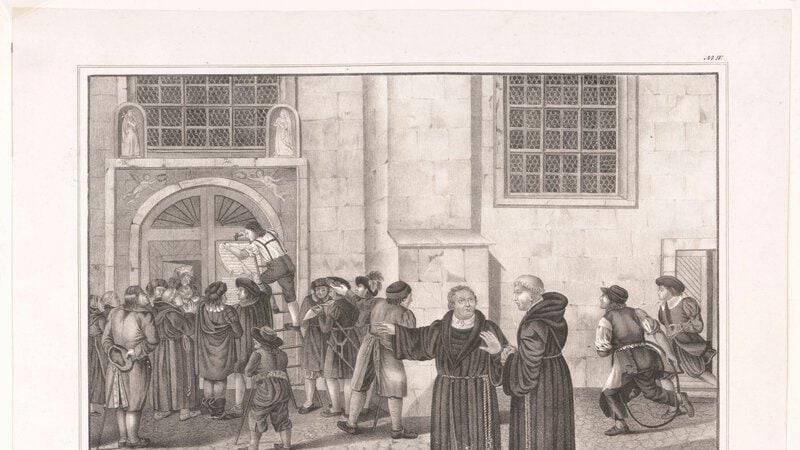

Picture it: a solitary monk in a rough wool habit, jaw set, hammer raised against the cold October air of Wittenberg, driving a nail through parchment into the great wooden door of the Castle Church. It is one of the most recognizable images in Western history — and it almost certainly never happened that way.
The Scene That Never Happened — and Why We Still Picture It

On October 31, 1517, Martin Luther did something genuinely radical. He just did not do it with a hammer. The Augustinian friar and theology professor sat down and wrote a letter — careful, respectful in tone, addressed to the very man most responsible for the scandal he was protesting: Archbishop Albrecht of Mainz. Enclosed with that letter were his now-famous 95 Theses, a set of propositions written in academic Latin and designed to provoke a scholarly debate about the Church’s practice of selling indulgences. It was the act of an insider lodging a formal complaint, not a rebel making a public scene.
The dramatic image of Luther nailing the document to the church door surfaces only decades later, attributed to his close colleague Philipp Melanchthon — who was not even in Wittenberg on that October day. Melanchthon wrote his account in 1546, the year Luther died, and he may well have been doing what movements always do when they mature: constructing a founding myth worthy of the revolution that followed. The truth is stranger and more consequential than the myth. A letter sent by post to a corrupt archbishop is a more unsettling act of defiance than a hammer blow, because it assumes the institution can still be saved from within. That assumption would not survive the decade.
What Luther Was Actually Protesting — and Who Was Getting Rich

To understand why Luther was furious, you have to understand the indulgence trade in its full, almost theatrical corruption. The Catholic Church taught that sinners could reduce the time their souls spent in purgatory by performing acts of penance. Over time, that penance had been formalized into certificates — indulgences — that could be purchased for cash. By Luther’s era, the system had become something close to a spiritual protection racket.
The specific target of Luther’s anger was a Dominican friar named Johann Tetzel, whose traveling roadshow sold indulgences across Germany with the energy of a carnival barker. The money flowed upward for two distinct purposes: partly to fund the construction of St. Peter’s Basilica in Rome, and partly to help Archbishop Albrecht of Mainz repay the debts he had taken on with the Fugger banking dynasty to purchase his ecclesiastical office in the first place. Luther’s 95 Theses were, among other things, a document that threatened to expose this entire financial arrangement.
What makes the moment so layered is that Luther, at this stage, was not attacking the pope. He was a devout friar genuinely alarmed that ordinary German peasants were being sold false comfort — the belief that a purchased certificate could substitute for sincere repentance. His theses were written in Latin, formatted as points for academic disputation, and aimed at theologians and church officials. He expected a scholarly argument. What he got instead was a continent-wide firestorm, and he had Gutenberg to thank for it.
The printing press had been operating in Europe for roughly six decades by 1517. Someone — historians debate exactly who — translated Luther’s theses into German and sent them to printers. Within weeks, copies were circulating across the Holy Roman Empire. The medium had hijacked the message entirely, delivering a document intended for cathedral chapter houses into the hands of merchants, minor nobles, and literate tradespeople who had their own reasons to resent Rome’s financial demands. Luther had lit a match; the press turned it into a bonfire.
The Door Myth: How a Legend Gets Built

Even if Luther did post notices on the church door in Wittenberg — and some historians allow for this possibility — the act would have been entirely unremarkable by the standards of the day. Church doors functioned as community bulletin boards in university towns. Posting an announcement of an academic debate on one was roughly the equivalent of circulating a departmental memo. There would have been nothing theatrical about it: no crowd watching, no symbolic declaration of war against Rome.
Historians, including the Catholic scholar Erwin Iserloh in the 1960s, argued strenuously that the nailing never happened at all, pointing out that Luther’s own letters from the period make no mention of it. The debate Iserloh’s work triggered was fierce precisely because the stakes were high: strip away the hammer and the door, and what you are left with is a theologian who, on the morning that supposedly launched the Protestant Reformation, was trying to work within the system. That image is less satisfying as myth, but far more interesting as history.
Revolutions need creation myths. A lone figure defying entrenched power with nothing but a hammer and a list of grievances is galvanizing in a way that a carefully worded letter to a powerful archbishop simply is not. The myth has endured not because it is well documented but because it tells us the story we want to hear about how change happens — through dramatic, individual acts of courage rather than through the slow, uncertain work of institutional argument.
The Real Reformation: Ideas That Cracked a Continent

Whatever the exact sequence of events on October 31, 1517, what followed was genuinely earthshaking. Luther had not intended to leave the Church; he was summoned, condemned, and ultimately forced out of it. The escalation moved with terrible speed. Papal condemnation came in 1520. In 1521, Luther stood before the Diet of Worms — an imperial assembly presided over by Holy Roman Emperor Charles V — and refused to recant. His defiance there, grounded in the authority of scripture and individual conscience over external ecclesiastical decree, became the Reformation’s true founding statement. He was excommunicated, placed under imperial ban, and survived only because sympathetic German princes had their own political and financial reasons to welcome a break with Rome.
Those structural causes of the Reformation are worth dwelling on, because the history of the Protestant Reformation is often taught as though a single man’s spiritual crisis were sufficient to crack Western Christianity in two. It was not. Rising literacy rates, the Renaissance’s renewed interest in original texts, widespread disgust at clerical corruption and papal worldliness, and the very specific economic interests of German princes who stood to gain enormously by seizing church lands — all of these forces were already building pressure beneath the surface of European Christendom. Luther’s theses did not cause the Reformation so much as they provided a precise point at which all that pressure could erupt.
The effects of that eruption are still being measured. Western Christianity fractured permanently. National churches emerged, each with its own relationship to vernacular scripture. The acceleration of Bible translation into common languages — Luther himself produced a landmark German Bible — placed sacred texts in the hands of ordinary readers and fundamentally altered the relationship between institution and individual. Wars of religion reshaped European borders for well over a century. And the Reformation’s insistence on individual conscience as an arbiter of religious truth laid groundwork, however unintentionally, for concepts of religious pluralism and eventually secular governance that would transform the modern world.
Luther the Man: Beyond the Monument

The portrait of Luther as a heroic truth-teller is, like the door story, a simplification that obscures a more complicated and troubling figure. Later in life, Luther produced virulently antisemitic writings whose ferocity would be cited in contexts he could not have foreseen. In 1525, when German peasants rose in revolt — inspired in part by the Reformation’s language of spiritual equality — Luther sided decisively with the princes who crushed the uprising with brutal force. Those who had understood the Reformation as a promise of social liberation found themselves betrayed by its author.
Luther also was not the first to articulate the arguments that got him condemned. Jan Hus, the Bohemian reformer, had been burned at the Council of Constance in 1415 for positions strikingly similar to Luther’s own. Luther knew this history and was aware of the precedent. What shielded him from Hus’s fate was not the superior force of his arguments but the political cover afforded by German princes and the velocity of the printing press.
Theologically, Luther was in many ways a deeply conservative figure. He rejected the concept of free will in terms that startled even some of his supporters. His understanding of communion kept him closer to Catholic sacramental theology than many later Protestants were comfortable with, and his disputes with the Swiss reformer Ulrich Zwingli over the precise nature of the Eucharist were conducted with a bitterness that made broad Protestant unity impossible from the movement’s earliest years. The tension at the heart of Luther’s legacy — between the reformer who trusted individual conscience and the authoritarian who demanded conformity to his own readings — is the most human and honest version of the story, and the one most worth sitting with.
Reformation as a Living Word: Movements That Carry the Name Forward
The word “reformation” has never been retired. Every generation produces institutions and movements that reach for it precisely because it carries Luther’s original posture: the insider who believes the institution can still be corrected, who sends the letter rather than swings the hammer. The strategy is harder and more vulnerable than outright revolt, because it requires staying in relationship with the very structures one is challenging.
The Reformation Project (TRP), launched in 2013, works explicitly within this tradition. The organization describes itself as a Bible-based, Christian organization whose mission is to advance LGBTQ inclusion in the church — working, in its own framing, toward what it calls an orthodox and affirming church. The choice of language is precise and deliberate: “orthodox” signals an intention to remain within the boundaries of historic Christian theology rather than to abandon them, much as Luther insisted, at least at the outset, that he was correcting the Church rather than leaving it.
In a notable public clarification, TRP announced on February 22nd that it does not agree with or promote queer theology — a distinction that reflects the careful navigation required when any group attempts reform from within a tradition rather than from outside it. The announcement represents precisely the kind of boundary-drawing that serious institutional reformers must engage in: defining not only what they are for but what they are not, in order to maintain credibility with the communities they are trying to reach. The moral theology underlying TRP’s approach has drawn both scholarly attention and significant debate, mirroring in its own way the disputational form Luther himself chose in 1517.
The parallel to Luther is instructive without being exact. TRP operates in a very different religious landscape, addresses questions Luther never engaged, and holds theological commitments that are entirely its own. But the strategic logic — argue from within, use the tradition’s own language and texts, resist the pull toward simply walking out — is recognizably descended from that letter sent to Archbishop Albrecht five centuries ago.
Why the Real Story Matters More Than the Myth
Return, finally, to that letter. Luther wrote to the archbishop politely. He expressed alarm. He asked for a conversation. He enclosed his theses not as a declaration of war but as the beginning of what he hoped would be a debate conducted among educated men of the Church. The act was quieter than a hammer blow, and it required a particular kind of courage — the courage of someone who has not yet given up on the institution he loves, and who therefore risks being ignored or slowly punished rather than dramatically martyred.
The printing press ensured that Luther’s intended audience — a handful of bishops and theologians — was among the last to engage seriously with his ideas on his own terms. Everyone else got there first. The unintended consequences of that original letter dwarfed anything Luther had imagined, a reminder that the medium through which an idea travels shapes it as profoundly as the idea itself. In an era of social media and viral circulation, that lesson has lost none of its edge.
Did Luther nail his theses to the door? Probably not in the way the famous image suggests — not with a hammer, not before an audience of onlookers, not as a theatrical gesture of defiance. And that is precisely the point. The real act was quieter, more vulnerable, and ultimately far more destabilizing than any hammer blow, because it was the act of someone who still believed that the truth of an argument could change the minds of the powerful. That belief was not entirely wrong. It was just catastrophically more effective than its author had anticipated.
The question the Reformation poses to every generation has never been fully answered — not by Luther, not by the movements that came after him, not by the institutions that carry that reforming impulse today. When does working inside a broken institution become complicity in its brokenness? And when does walking out become the only honest move left? These are not merely historical questions. They are live ones. And they begin, as so many live questions do, with a letter that most people have never read, sent by a troubled monk to a corrupt archbishop on a cold autumn morning in 1517.

 Arabic
 French
 Spanish
 Portuguese
 Deutsch
 Turkish
 Dutch
Dutch
 Italiano
 Russian
 Romaian
 Portuguese (Brazil)
 Greek
Greek