


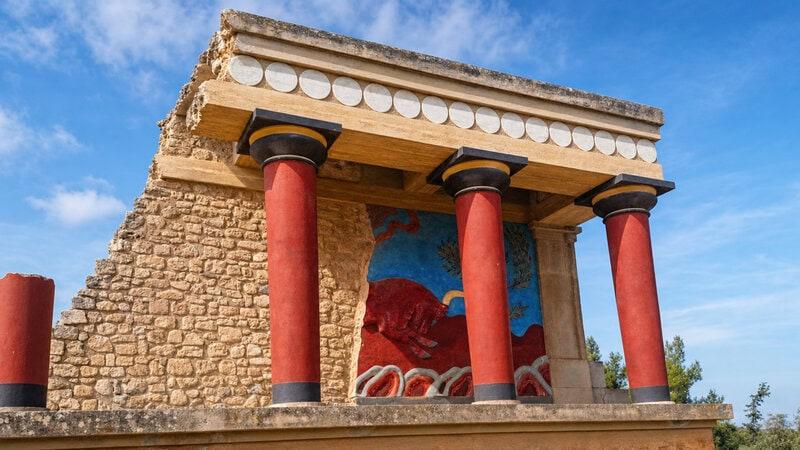

In the spring of 1900, on a sun-baked hillside just south of Heraklion, a British archaeologist named Arthur Evans pushed his spade into the Cretan soil and struck something that had not seen daylight in three thousand years: a fragment of painted plaster, vivid blue and saffron yellow, still clinging to the wall of a room no living human being had entered since the Bronze Age. Within weeks, Evans understood he had not found a ruin. He had found a world.
A Palace No One Was Supposed to Find

The structure that emerged from that Cretan hillside defied every expectation of what ancient Europe was supposed to look like. The Palace of Knossos covers roughly 150,000 square feet and contains more than 1,000 rooms — a sprawling, multi-story labyrinth of throne rooms, storage halls, and ritual spaces that predates the Parthenon by more than a millennium. It is not a footnote in European history. It is the opening chapter, and the civilization that built it — the Minoan civilization — was sophisticated enough to inspire the Greek myth of the Minotaur, skilled enough to install running water in their palaces, and connected enough to trade with Egypt while most of Europe was still organized around scattered farming villages.
And then, with a completeness that still unsettles historians, they vanished. Their writing remains undeciphered. Their own name for themselves is unknown. What we call them comes from a mythical king — a Greek legend, not a Minoan fact. The people who built Europe’s first palace cannot yet speak to us in their own words, and that silence is both the central tragedy and the enduring fascination of their story.
Origins: Farmers Who Became Sailors

The Minoans did not arrive as conquerors. DNA analysis conducted by researchers at the University of Washington revealed that the Minoans descended from Neolithic farmers who had migrated to Crete roughly 5,000 years ago — indigenous islanders shaped by their island, not transplanted Egyptians or Mesopotamians as earlier romantic scholars had guessed. They were Crete’s own children, grown extraordinary on a patch of Mediterranean rock.
The civilization they built flourished from approximately 3000 BCE to 1100 BCE, making it one of the longest-running cultures among the Bronze Age Aegean civilizations. At their height, Minoan ships moved pottery, wine, and olive oil across the Mediterranean with a regularity and reach that would not be matched in Europe for centuries. Their trade networks touched Egypt, the Levant, and the Greek mainland — places that, in the earliest Minoan centuries, had barely begun to organize themselves into anything resembling cities.
When Britannica describes the Minoans as “the first high civilization of Europe,” the phrase can feel like museum-catalog language. It is worth pausing to feel what it actually means: on one island, a people developed writing, monumental architecture, and a complex redistributive economy — concentrating agricultural surplus, managing long-distance trade, and sustaining a class of administrators and artists — while the ancestors of the Celts, the Germans, and the Slavs were living in timber longhouses without a written word between them.
The Palace at Knossos: Power, Ritual, and Running Water

The palace at Knossos is most famous for the myth it supposedly inspired — the labyrinth, the Minotaur, the hero Theseus with his ball of thread. But the reality of the building is, in its own way, just as astonishing as the legend. Its drainage system, a network of terracotta pipes fitted together with tapering joints designed to maintain water pressure, is sophisticated enough that modern engineers have admired its logic. Grand staircases descended through multiple stories, lit by open light wells that funneled daylight deep into the building’s interior. Storerooms stacked floor-to-ceiling with enormous clay vessels called pithoi — some tall enough for a person to stand inside — held the olive oil and grain that made the palace’s economy run.
That economy is key to understanding what these palaces actually were. Knossos was not primarily a royal residence in the way a medieval castle was a lord’s home. It functioned simultaneously as a religious center, an economic redistribution hub, and an administrative headquarters — the kind of institution that defines the transition from chiefdom to state-level society. Farmers brought their surplus here. Craft workers organized here. Religious ceremonies that bound the community together were performed here. The palace was the civilization’s beating heart.
The art that decorated it was unlike anything else in the ancient world. Dolphin frescoes swam across the walls of interior rooms. Bull-leaping scenes — young athletes vaulting over the backs of charging bulls — conveyed a kinetic energy that feels almost cinematic. Goddesses with arms raised, flanked by animals, gazed outward with an authority that was clearly felt by the people who painted them. Compared to the rigid, hieratic formality of Egyptian art from the same centuries, Minoan painting looks startlingly alive — relaxed, even joyful, as if the artists had been told to capture the world in motion rather than freeze it in eternity.
Knossos was not alone. Palaces also rose at Phaistos, Malia, and Zakros, suggesting not a single capital but a network of power centers distributed across the island. In a sense, the whole of Crete was organized as a palace civilization, built around these interlocking nodes of economic and ritual authority.
The Peak: When Minoan Culture Lit Up the Mediterranean

The centuries between roughly 1700 and 1450 BCE represent the apex of Minoan civilization. After an earlier wave of earthquake destruction, the palaces were rebuilt on an even grander scale. Trade networks stretched to their widest extent. Minoan artistic influence spread across the Aegean — Minoan-style frescoes appeared on the walls of Akrotiri on the island of Thera, and images recognizably Minoan in spirit have been identified in elite Egyptian tombs. The civilization that began on a single island had made itself felt across the eastern Mediterranean world.
The administrative machinery supporting all of this was recorded in a script called Linear A — a writing system that appears on clay tablets and remains, to this day, undeciphered. We can see that it was used for bureaucratic record-keeping, the kind of accounting that tracks grain deliveries and workshop outputs, but we cannot read it. Its silence is one of archaeology’s most tantalizing frustrations: somewhere in those tablets may be the names the Minoans gave themselves, the titles of their rulers, the prayers of their priests. We simply cannot yet hear them.
One detail from this peak period has long fascinated historians: Minoan palaces had no defensive walls. Whether this reflects the protection afforded by a powerful navy that made land invasion implausible, a remarkably stable regional order, or a fundamentally different conception of power and threat, it speaks to a civilization operating with a confidence that later centuries would not sustain.
The First Cracks: Thera, Earthquakes, and the Mycenaean Shadow

Around 1628 BCE — though scholars still debate the precise date — the volcanic island of Thera, modern Santorini, erupted in one of the most violent geological events in recorded prehistory. The eruption sent tsunamis racing toward Crete and blanketed the region in ash. How much damage this caused to Minoan civilization, and whether it triggered a lasting decline or merely interrupted a recovery, remains genuinely contested. What is certain is that Crete kept going — but the world around it was changing.
By approximately 1450 BCE, something far more decisive had occurred: nearly every Minoan palace except Knossos was destroyed. Whether the cause was a further round of earthquakes, internal social revolt, or outside attack remains unresolved. What happened next at Knossos is telling: Linear A disappears from the archaeological record, replaced by Linear B — a writing system that has been deciphered and is unmistakably an early form of Greek. The Mycenaeans, the Greek-speaking civilization of the mainland, had apparently taken administrative control of the island’s most important center.
This need not have been a sudden, violent conquest. Many historians now read the Mycenaean takeover as opportunistic — a mainland power moving into a vacuum created by catastrophes the Minoans had already suffered. The story of the Minoan collapse is not a simple tale of one people defeating another. It is messier, slower, and more ambiguous — which is precisely what makes it so difficult to close.
The Collapse — and Why No One Fully Agrees

By around 1100 BCE, Minoan civilization had faded entirely — absorbed, transformed, or simply exhausted. The competing explanations form a list that historians argue over with genuine passion: the Thera eruption and its cascading environmental effects; Mycenaean conquest or infiltration; climate-driven agricultural failure that destabilized the economic system; internal social upheaval as the palace system grew too rigid or too extractive to survive compounding stress. Most serious researchers today suspect not a single cause but a cascade of vulnerabilities — a system that had sustained Minoan civilization for nearly two thousand years ultimately unable to hold.
The Minoan collapse also did not happen in isolation. The broader Bronze Age Mediterranean — the Mycenaeans themselves, the Hittites, and a dozen other interconnected cultures — went through catastrophic disruptions between roughly 1200 and 1150 BCE in what historians call the Late Bronze Age Collapse. The Minoans were not the only civilization to fall; they were simply among the earliest and most complete to disappear.
The deepest honest answer, though, is that we do not fully know — and cannot fully know — because Linear A has never been deciphered. The Minoans cannot tell us, in their own words, what went wrong. They remain a civilization observed entirely from the outside, through their art, their architecture, their trade goods, and the myths that other people — the Greeks — constructed about them.
What the Minoans Left Behind — and Why It Still Matters
Active excavations on Crete continue today, and every new dig carries the possibility of rewriting what we think we know. Recent fieldwork at sites beyond Knossos has expanded our understanding of Minoan settlement patterns, religious practices, and regional variation — a reminder that this is a living field of inquiry, not a closed archive.
The Minoans deserve a place in the popular imagination alongside Egypt and Mesopotamia — not as a lesser or peripheral civilization, but as an equal one, simply harder to reach on their island and harder to read in their silence. Arthur Evans named them “Minoans” after the mythical King Minos, a name they almost certainly never used for themselves. Almost everything we call them, frame about them, and every story we tell about them passes through a filter of later Greek legend rather than Minoan reality. That is a reminder, a caution, and an invitation.
A civilization that gave Europe its first palace, its first complex monumental art, its first organized long-distance maritime trade — and then disappeared before anyone could write down its own name in a language we can read — is not a closed chapter. It is an ongoing conversation between curiosity and the past, between the archaeologist’s spade and the painted plaster still waiting, somewhere beneath the Cretan hillside, to see the light again.

 Arabic
 French
 Spanish
 Portuguese
 Deutsch
 Turkish
 Dutch
Dutch
 Italiano
 Russian
 Romaian
 Portuguese (Brazil)
 Greek
Greek