



Somewhere beneath the pavements of modern London, sealed under centuries of city-making, lies a thin red layer of burnt ash — the scorched ghost of a day in around 60 AD when a British queen and her army erased a Roman city from the map and came closer to ending the occupation of Britannia than any enemy Rome would face on the island again.
The Day London Burned

It began with smoke. Londinium — a brisk, prosperous Roman trading settlement on the north bank of the Thames — had been given up for lost before Boudica’s vast coalition even arrived. The Roman governor, Gaius Suetonius Paulinus, had looked at his numbers, looked at the horizon darkened by the approaching British host, and made the cold calculation that a city full of civilians was not worth the legions he did not have. He marched his soldiers away and left the inhabitants to whatever came next. What came next was fire.
Archaeologists excavating beneath modern London have repeatedly struck the same stratum: a layer of reddish-brown burnt debris, heat-cracked pottery, and scorched grain, dating to the first century AD. It is a geological scar, a city’s death preserved in the earth. Londinium was not the first settlement Boudica destroyed, and it was not the last. In a matter of weeks, three of the most significant Roman settlements in Britain — Camulodunum (modern Colchester), Londinium (London), and Verulamium (St Albans) — were reduced to ash and bodies. The historian Tacitus placed the Roman and civilian death toll at somewhere between 70,000 and 80,000 people, a figure modern scholars treat cautiously but which speaks to the genuine, catastrophic scale of what unfolded.
At the height of the revolt, ancient accounts estimated Boudica’s force at over 200,000 warriors — a number almost certainly inflated, but reflecting a coalition so large it prompted Nero’s administration to reportedly weigh withdrawing from Britain entirely. One woman’s personal grief had become the closest Rome ever came to losing the island of Britannia. To understand how that happened, you have to understand who she was.
Who Was Boudica? The Real Story Behind the Legend

She was queen of the Iceni, a tribe whose territory covered what is now Norfolk and the surrounding region of eastern England. The Romans knew her name, feared what it represented, and left us enough detail to sketch a portrait: Tacitus described her as tall, with long red hair falling to her hips, a harsh voice, and a piercing gaze. He was not writing a compliment — Roman historians rarely celebrated their enemies without an edge of threat — but the description has lodged in the imagination for two thousand years.
The Iceni occupied a complicated political position in Roman Britain. They were a client kingdom — technically allied with Rome, permitted to keep their own king and customs in exchange for loyalty and cooperation. Boudica’s husband, Prasutagus, navigated this arrangement with apparent skill, ruling in an uneasy but functional peace. When he died around 60 AD, he left a will intended to maintain that balance: his kingdom would be divided between his two daughters and the Emperor Nero, a gesture designed to satisfy Roman appetite while preserving something for his family.
Rome ignored it entirely.
Roman officials moved into Iceni territory and annexed it as though it were conquered land. Nobles were stripped of their estates. In what Tacitus records as a deliberate act of subjugation, Boudica was publicly flogged and her daughters were assaulted. These were not incidental cruelties — they were calculated humiliations, designed to demonstrate to the Iceni, and to every other client tribe watching, that Roman patience with native autonomy had its limits and those limits had been reached.
The calculation failed catastrophically. Instead of crushing the Iceni’s will to resist, Rome had handed Boudica both a personal wound and a political cause that neighbouring tribes were ready to join.
The Revolt Ignites: Boudica’s War Against Rome

The Trinovantes of Essex had their own grievances, older and festering. The Roman colonia at Camulodunum — modern Colchester, the symbolic capital of the occupation — had been expanded at the expense of Trinovantian land. At the centre of the city stood a temple to the deified Emperor Claudius, paid for in part by local taxation, a daily architectural reminder of who was in charge and what the natives owed. When Boudica’s coalition came together, the Trinovantes came with it, and Camulodunum was the first target.
The city fell and was razed. Its defenders made a last stand inside the temple of Claudius; they were killed regardless. The Ninth Legion — the IX Hispana, one of Rome’s most storied units in Britain — marched to relieve the city and walked into an ambush. The infantry was almost entirely destroyed, one of the worst single Roman military defeats in the history of the British occupation. A message had been sent with brutal clarity: this was not a tribal skirmish. This was a war.
With the Ninth Legion shattered and Suetonius Paulinus campaigning in north Wales, the road south lay open. Londinium and Verulamium had no meaningful defences. The governor could not reach them in time with sufficient force. He arrived, assessed the situation, and withdrew, leaving both cities to burn in succession. In the space of a few weeks, Boudica’s army had done something no other enemy of Rome achieved in Britain before or after: destroyed three major settlements, killed tens of thousands, and made the survival of the Roman province a genuinely open question.
Three Cities, One Queen, and an Empire Shaken to Its Core

The psychological impact on Rome was profound. Nero’s administration, receiving reports from the far north-western edge of the empire — a province that had always been expensive, difficult, and only marginally profitable — appears to have seriously weighed the option of abandoning Britain altogether. Boudica had not just won battles; she had made retreat thinkable for the most powerful military state in the Western world.
But Suetonius Paulinus was still in the field, and he was one of Rome’s most accomplished commanders. He reassembled his forces — roughly 10,000 legionaries and auxiliaries, heavily outnumbered by any count — and began looking for the right ground to fight.
He found it: a narrow defile opening onto a plain, with forest covering his flanks and rear. The terrain was the strategy. Boudica’s vast numbers, which had been her greatest weapon in open country, became a liability when the ground funnelled attackers into a space where Roman discipline and formation fighting could operate at full effectiveness.
The battle was decided by those two qualities. The Roman line held against the initial assault, then advanced in a tight wedge formation that the larger, less uniformly armed British force could not absorb or outmanoeuvre. When Boudica’s warriors broke and tried to retreat, they found their path blocked by their own wagons — parked in a semicircle at the field’s edge by family members who had come to watch what they expected to be a victory. The Romans did not stop. Tacitus records the slaughter as enormous, though his figures, like most ancient battle statistics, should be read as impressionistic rather than precise.
Boudica herself did not survive to be paraded through Rome. Tacitus says she took poison. Other ancient accounts suggest she fell ill and died. Her burial place remains unknown — one of history’s more tantalising gaps, given that she was almost certainly the most consequential enemy Rome faced in Britain.
The Aftermath: How Defeat Changed Roman Britain
Rome’s response to its victory carried an instructive irony. The officials whose rapacity and arrogance had ignited the revolt — the men who had flogged a queen and assaulted her daughters, who had treated a client kingdom as conquered territory to be stripped — were replaced. Roman policy in Britannia was quietly reformed. The province was stabilised through administration rather than exemplary punishment, a tacit acknowledgement that Boudica’s rebellion had exposed something genuinely rotten in how Rome was governing its most distant north-western territory.
She had lost the battle and won an argument. The revolt did not end Roman occupation, but it changed the shape of it — and that is a kind of victory that rarely gets recorded as such in histories written by the winning side.
Why the Story Endures: Boudica as Warrior Queen and Symbol

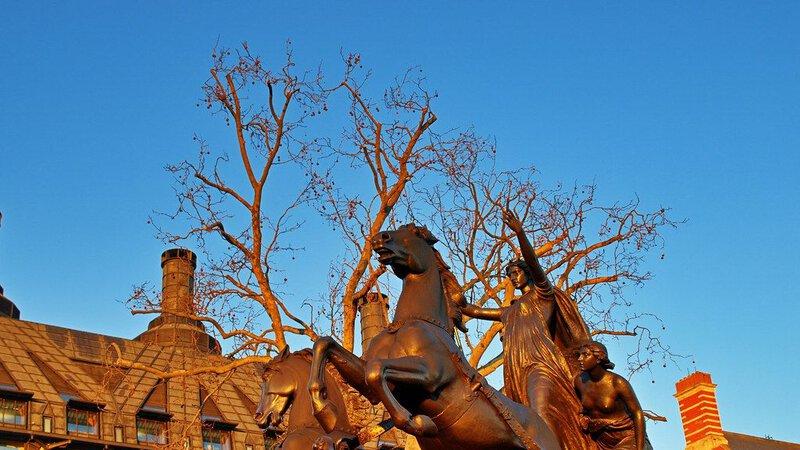
Largely overlooked through the medieval period, Boudica was rediscovered during the Renaissance and gradually built into a national myth. By the Victorian era the parallel was irresistible: an island queen defending British soil against a continental empire, her very name sharing its root meaning of “victory” with that of the reigning monarch. The bronze statue of Boudica driving her war chariot, erected near Westminster Bridge on the Thames Embankment, has stood since 1902 and remains one of London’s most recognisable landmarks — a monument to someone who burned the city the statue now overlooks, which is either deeply ironic or deeply British, depending on your perspective.
What makes Boudica’s real story so persistently compelling is its dramatic architecture. It contains, in clean and almost novelistic sequence, every element of great historical narrative: injustice visited on the powerless, the transformation of grief into action, a series of stunning reversals of fortune, near-total triumph, and final irreversible tragedy. It also contains something rarer — a woman at the centre of all of it, as victim, commander, avenger, and symbol simultaneously, at a period when history’s record of women in those roles is almost vanishingly thin.
The result has been continuous adaptation: novels, stage productions, television series, video games. Each generation reaches for her story and finds something new in it — colonial grievance, gendered violence, the fragility of imperial overreach, the question of what resistance costs and what it achieves.
The 2023 Film: Bringing Boudica Back to Screen
The 2023 British action drama Boudica, also released as Boudica: Queen of War, is written and directed by Jesse V. Johnson. The film centres on the Iceni queen in the immediate aftermath of personal catastrophe — Prasutagus is killed by Roman soldiers, a dramatic compression of the historical record that places vengeance at the story’s heart even more directly than Tacitus does. From that wound, the film builds outward toward coalition, campaign, and confrontation.
Writing for The Conversation, a reviewer with expertise in the historical Boudica described the film as “a lively and violent retelling of the ancient British queen’s story” — a characterisation suggesting Johnson has leaned into the battle-driven, viscerally physical qualities that defined the historical campaign rather than smoothing them for mainstream palatability. The film is listed on IMDb and is available to stream on Netflix.
That the film exists at all — and that audiences are seeking it out — reflects something about the cultural moment. An era of renewed interest in histories long told only from the perspective of the powerful has made Boudica’s story feel less like a footnote to Roman imperial history and more like its own complete and urgent thing. She was not a footnote. She was a queen who took three cities from the most organised military force on earth, made an emperor reconsider an entire province, and has proved impossible to forget for nearly two thousand years. Whatever happened on that final battlefield, that is not a story that ends in defeat.

 Arabic
 French
 Spanish
 Portuguese
 Deutsch
 Turkish
 Dutch
Dutch
 Italiano
 Russian
 Romaian
 Portuguese (Brazil)
 Greek
Greek