


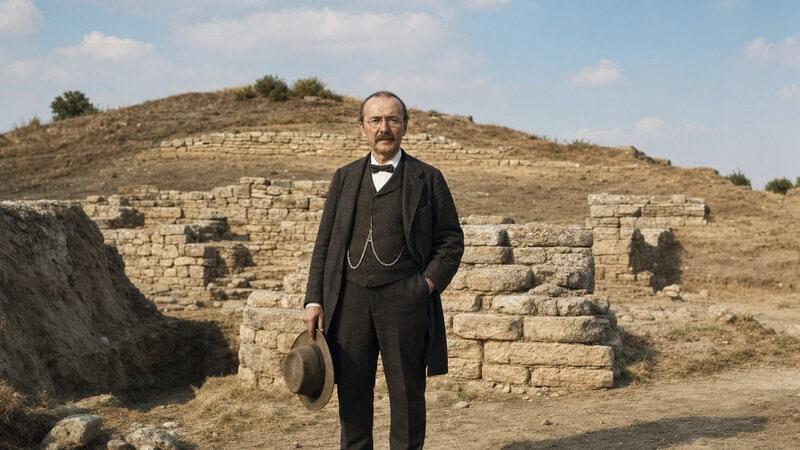

In 1871, a self-made German businessman named Heinrich Schliemann arrived at a windswept mound of earth in northwestern Turkey, armed with a copy of Homer and a conviction that would have embarrassed most respectable scholars of his day. He believed he was standing on Troy — and against every reasonable expectation, he was not entirely wrong.
The Hill That Shouldn’t Have Mattered

The mound at Hisarlik rises about 32 meters above the surrounding plain in what the ancient Greeks called the Troad, sitting close to the mouth of the Dardanelles — exactly where legend had always placed the great city of Priam. Schliemann’s peers largely dismissed him as a romantic amateur playing at archaeology. What he found silenced some of them, though it also complicated everything.
He did not find one Troy. He found nine — nine distinct cities stacked on top of each other like geological strata of human ambition, each civilization built directly on the rubble of the last, spanning thousands of years of continuous habitation. It was one of the most consequential discoveries in the history of archaeology, and it immediately sharpened a question that has never been fully resolved: the city was real, the walls were real, the ash and the arrowheads were real — but does any of that prove the war Homer sang about actually happened?
Archaeology gave us the place. The limits of history gave us the argument.
What the Ancient World Actually Believed

Before reaching for modern skepticism, it is worth pausing on how the ancient world itself treated the story. The Trojan War was not, in Greek eyes, a fairy tale. It occupied roughly the same mental space that the Norman Conquest occupies for the English — distant, somewhat mythologized, but understood as something that genuinely happened to real people in a real place.
Thucydides, the fifth-century Athenian historian who essentially invented evidence-based historical writing, was willing to treat the Trojan War as a real, if exaggerated, event. He subjected it to rational analysis — questioning the scale of the Greek fleet, doubting the more supernatural elements — but he did not dismiss it as pure invention. Serious historical consideration of the war dates back to at least the second half of the fifth century BC, meaning the Greeks were debating its reality roughly 700 years after it supposedly took place. That is a long cultural memory, and it suggests the story was not manufactured out of nothing.
Later Greek authors went further still, assigning specific calendar dates to the war. Competing ancient chronologies placed the fall of Troy variously around 1184 BC or even earlier, showing how urgently people wanted to pin the legend to an actual moment in time. The ancient willingness to believe is itself a kind of historical evidence — it tells us the story was old, widely circulated, and treated as inherited memory rather than invented legend, even by people who lived relatively close to the events in question.
Troy Was Real: The Archaeological Evidence at Hisarlik

Whatever one thinks of the war, the physical evidence for the city itself is now substantial. The site at Hisarlik in northwestern Turkey sits in precisely the strategic location that would have made a wealthy Bronze Age city viable — commanding the approach to the Dardanelles, positioned to extract tribute or taxes from maritime traffic moving between the Aegean and the Black Sea. This was not a backwater. It was a place worth fighting over.
Schliemann’s most dramatic moment came in 1873, when he unearthed what he immediately declared to be Priam’s Treasure — a hoard of gold, silver, and bronze objects of remarkable sophistication. He had his wife Sophia photographed wearing the jewelry, projecting the find into global headlines. There was one significant problem: later scholarship determined he had dug too deep. The layer he called Priam’s city, known as Troy II, dated to roughly 2400-2200 BC — nearly a thousand years too early for the Homeric war, which tradition places around 1200 BC.
The more archaeologically compelling layer is Troy VIIa. Dated to approximately 1190-1180 BC, this stratum contains evidence of fire, violent destruction, arrowheads embedded in walls, and unburied human skeletal remains — the kind of physical record that suggests catastrophic conflict rather than peaceful abandonment or gradual decay. It is not proof of a Greek siege, but it is proof that something terrible happened here at roughly the right moment in history.
Modern excavations have deepened the picture considerably. Work led by archaeologist Manfred Korfmann beginning in 1988 revealed a lower city far larger than the citadel mound alone had suggested — a substantial Bronze Age settlement with defensive ditches and dense habitation extending well beyond what Schliemann had uncovered. Troy, at its height, was a genuine regional power, not a village that borrowed a famous name.
Myth, Legend, or Dim Memory?

The Trojan War is described as a legendary conflict between the early Greeks and the people of Troy in western Anatolia — and that word “legendary” is doing important work. It does not mean false. It means the story exists in the contested space between recoverable history and mythological tradition, where events may be real but their transmission has been shaped by centuries of storytelling, cultural need, and poetic invention.
The most defensible scholarly position is probably this: some form of conflict involving the city of Troy most likely did occur, but its true nature — its causes, its scale, its duration, and the precise identity of those involved — remains genuinely unknown. That is an intellectually honest place to stand, even if it is an unsatisfying one.
The Bronze Age context makes the broad outline plausible. The thirteenth and twelfth centuries BC were a period of extraordinary turbulence across the eastern Mediterranean — widespread conflict, mass migration, the collapse of palace civilizations, the destruction of cities from Greece to the Levant. A Mycenaean Greek raiding expedition or prolonged siege against a wealthy Anatolian city fits this era so naturally that it would almost be surprising if nothing of the sort had ever occurred.
The danger lies in the literary evidence itself. Homer’s Iliad was composed somewhere around 750 BC, roughly four centuries after the events it describes. It was transmitted orally across those generations — sung, reshaped, and reperformed by bards who were artists as much as archivists. The Iliad tells us what the Greeks remembered, what they valued, and what they wanted the war to mean. It does not give us a war correspondent’s account of what actually happened on the plain of Troy.
The Hittite Connection: The Most Intriguing Clue

The most striking external evidence comes not from Greece at all, but from the Hittites — the powerful Bronze Age empire centered in Anatolia that left behind a rich archive of cuneiform tablets. Among those tablets, scholars have identified references to a place called Wilusa and a people called Ahhiyawa, widely interpreted as corresponding to Ilios, an ancient name for Troy, and the Achaeans, Homer’s collective term for the Greeks.
One Hittite document known as the Tawagalawa Letter, dated to around 1250 BC, references a dispute involving Wilusa — tantalizing evidence that friction between the Greek world and western Anatolian cities was a real political phenomenon, not a poet’s invention. The significance of this document is hard to overstate: here is a source with no connection to Homer, no stake in Greek mythology, and no reason to fabricate a conflict — and it appears to describe exactly the kind of geopolitical tension from which a war over Troy might have grown.
The caveat is real, however. The identifications of Wilusa with Troy and Ahhiyawa with the Mycenaean Greeks, while broadly accepted by many scholars, are not universally agreed upon. The debate over what the Hittite records actually prove about the Trojan War remains active and unresolved. These tablets are a clue — perhaps the most important external clue we have — but a clue is not a verdict.
Why the Question Is So Hard to Answer

At its core, the difficulty is this: we are trying to verify events from roughly 3,200 years ago using later literary texts, archaeology that can show destruction but not its cause, and fragmentary administrative records from a civilization that collapsed before it could preserve a complete account of itself.
Archaeology is extraordinarily good at proving that things happened. It is almost entirely mute on the question of why. Arrowheads embedded in a wall tell us nothing about whether they were fired by Mycenaean Greeks avenging a king’s honor, by raiders seeking grain stores, or by a rival Anatolian city-state settling a trade dispute. Ash is ash. It does not carry a motive.
There is also the problem of narrative compression. Ancient cultures routinely folded multiple real events — raids, feuds, migrations, defeats — into single grand narratives. The Trojan War as Homer presents it may be a cultural memory that compressed decades or even centuries of Greek interaction with western Anatolia into one ten-year siege and one catastrophic night of burning. If so, the tradition is real in aggregate, even if no single campaign ever looked quite like what the Iliad describes.
And then there is the oral tradition gap. If Troy VIIa fell around 1180 BC and Homer composed the Iliad around 750 BC, the story crossed approximately 430 years of spoken transmission before anyone wrote it down. That is time enough for much to change, to grow, and to become something grander and stranger than the original events could ever have been.
The Honest Answer: Probably Yes, But Not Like This
Synthesize what we know and the picture that emerges is surprisingly coherent, even if it is not the one Homer painted. Troy existed. It was strategically valuable, substantially populated, and regionally significant. It was violently destroyed in a period consistent with Mycenaean Greek military activity. Both the Greek literary tradition and Hittite administrative records suggest that conflict between Greek-world powers and western Anatolian cities was a real feature of the Bronze Age political landscape. The broad historical view holds that some kernel of real conflict likely underlies the Trojan War tradition.
But the ten-year siege, the thousand ships, the divine interventions, the wrath of Achilles, the wooden horse — these belong to the realm of epic, which is its own kind of truth, but not the kind that appears in archaeological strata. The war that Homer gave the world is the war filtered through four centuries of oral tradition, shaped to carry the values and sorrows of the Greeks who kept retelling it.
What the story’s enduring power reveals may be as interesting as the history itself. The question — did the Trojan War actually happen? — has gripped people for nearly three millennia because we need history to be heroic. We need the past to have contained moments that matched the scale of our myths. Schliemann needed it so badly he dressed his wife in Bronze Age gold and called her Sophia of Troy.
He dug into a windswept mound and found a real city. The war that made it immortal may be the most consequential story ever told about something we will never fully prove — and perhaps that is precisely why, 3,000 years on, we are still asking.

 Arabic
 French
 Spanish
 Portuguese
 Deutsch
 Turkish
 Dutch
Dutch
 Italiano
 Russian
 Romaian
 Portuguese (Brazil)
 Greek
Greek