


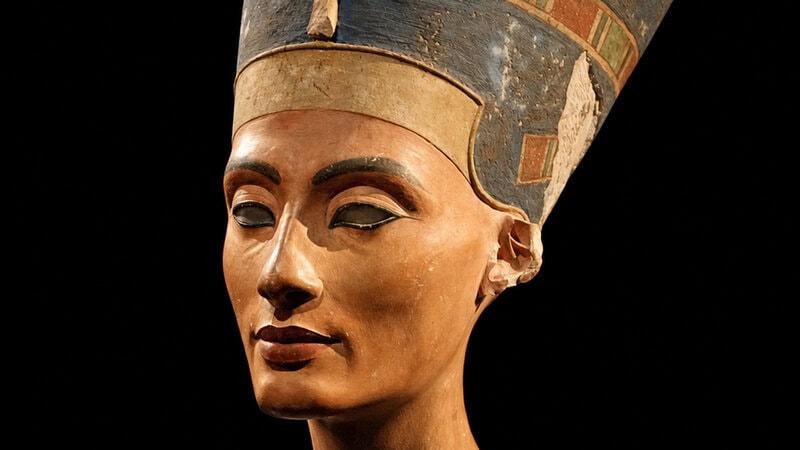

In the winter of 1912, a German excavation team working in the sun-scorched ruins of Amarna, Egypt, lifted a painted limestone bust from the rubble and found themselves staring into a face so composed, so absolute in its authority, that it seemed to belong not to a queen but to something closer to a deity. What they could not have known — what historians would spend the next century slowly, reluctantly admitting — is that the woman gazing back at them may have been exactly that: not merely a royal wife, but a pharaoh of Egypt, wielding a king’s power behind a queen’s title.
The Queen Who Refused to Disappear

History handed Nefertiti a supporting role. She was catalogued, in the official language of Egyptology, as the “great royal wife” of the pharaoh Akhenaten — a remarkable woman, certainly, a beauty beyond argument, but a consort. The crook and flail of sovereign power, the double crown of Upper and Lower Egypt, the right to stand alone before the gods as humanity’s representative on earth: those belonged to her husband. Or so the story went.
But evidence has been accumulating for decades, quietly and then insistently, that this story is wrong. That Nefertiti did not simply vanish into death or disgrace when she disappeared from the official record around the twelfth year of Akhenaten’s reign. That she re-emerged — not as a queen, but as a pharaoh, ruling Egypt under a throne name, wearing male regalia, issuing the decrees of a king. And that the reason this story took so long to be told has everything to do with who was allowed to write history, and who was convenient to erase from it.
If the theory holds, Nefertiti would not merely be ancient Egypt’s most famous face. She would rank among the most consequential rulers in more than three thousand years of Egyptian civilization — a woman who governed an empire in crisis and was then methodically deleted from the record of her own reign.
Who Was Nefertiti? The Woman Behind the Legend

Even the basics of her life resist certainty. Born approximately 1370 BC, Nefertiti rose to become the great royal wife of Amenhotep IV during Egypt’s 18th Dynasty — the dynasty that produced some of antiquity’s most dazzling rulers and its most explosive religious upheaval. Her name means, in ancient Egyptian, “the beautiful one has come,” and while that translation has always been convenient for those who preferred to see her as ornament, its deeper implication is arrival, presence, consequence.
Her origins are disputed. Some scholars have placed her birth in a foreign court — possibly Mitanni — which would make her marriage to Amenhotep IV a diplomatic alliance as much as a personal one. Others argue for Egyptian nobility, pointing to a possible connection to the high official Ay, who may have been her father. The uncertainty itself is telling: for a woman who became so central to the most radical transformation in Egyptian religious history, the silence around her early life is remarkable.
That transformation came when her husband changed his name from Amenhotep IV to Akhenaten — “effective spirit of Aten” — and proceeded to dismantle Egypt’s ancient polytheistic order, suppressing the worship of Amun and the gods, closing temples, and elevating the sun-disk Aten as the sole divine force in the universe. It was an act of theological revolution without precedent in Egyptian history. And Nefertiti did not stand beside him as a passive consort. She stood as a co-celebrant, depicted in temple carvings smiting enemies — an iconographic act reserved, in every other context, for pharaohs alone.
The Berlin Egyptian Museum, which holds the 1912 bust, has acknowledged openly that written records providing concrete information about Nefertiti are remarkably limited. This has too often been read as evidence of her insignificance. It is far more plausibly evidence of something else entirely — that she was important enough to warrant deliberate erasure.
A Revolution in the Desert: The Amarna Years

Akhenaten did not merely change Egypt’s religion. He built a new city to house it. Rising from bare desert cliffs on the eastern bank of the Nile, Akhetaten — the modern site of Amarna — was constructed from nothing in a matter of years, a gleaming administrative and spiritual capital dedicated entirely to the Aten. And on its pylons, its boundary stelae, its temple walls, the image that appeared again and again, at a scale that dwarfed almost any queen in Egyptian history before her, was Nefertiti’s.
She was depicted wearing the blue khepresh, the war crown associated with military authority and divine kingship. She performed religious rites that, in any other reign, would have been the exclusive province of the pharaoh. She appeared not beside Akhenaten as a dependent figure but parallel to him — a second axis of cosmic power in a theology that was itself rewriting the rules of divine authority.
In Egyptian religious thought, this was not mere artistic flattery. The pharaoh was not a ruler who also happened to be sacred — the pharaoh was the literal mediator between the human and divine worlds, the point at which the order of the cosmos touched the earth. To depict Nefertiti performing those functions was not decorative. It was a statement of metaphysical authority, a declaration in the visual language of Egyptian culture that she held a piece of that cosmic role.
The couple had six daughters and no known male heir — a pressure point that would eventually destabilize the dynasty and, according to the theory that has gained serious scholarly traction, elevate Nefertiti to a position that required an entirely new name to contain it.
The Disappearing Act — and What It Really Means
Around year twelve of Akhenaten’s reign, Nefertiti disappears from the official record. For most of the twentieth century, Egyptologists treated this as a straightforward biographical endpoint: she had died, fallen from favor, or retreated from public life. Her story was considered finished. The famous bust went on display in Berlin and became a global icon of feminine beauty — the kind of cultural object that is appreciated rather than interrogated.
But disappearing from the record as a queen and reappearing as a male-titled co-regent or successor pharaoh was not unprecedented. It was, in fact, exactly what Hatshepsut — one of ancient Egypt’s most successful rulers — had done a century earlier, adopting male regalia, a throne name, and the full iconography of kingship while slowly having her own history overwritten after her death. The pattern was known. It was simply not being applied to Nefertiti.
After Akhenaten’s death and before the boy-king Tutankhamun took the throne, someone ruled Egypt. The historical record identifies this ruler as Neferneferuaten — a pharaoh who reigned for approximately two to three years, issued royal decrees, managed a kingdom in profound crisis, and left behind cartouches and epithets that scholars have been debating for more than a century. The question of who Neferneferuaten actually was has become one of Egyptology’s most consequential open cases.
Nefertiti as Pharaoh Neferneferuaten: The Evidence
The core of the argument rests on language. Egyptologists including Jacobus van Dijk and James P. Allen identified that the epithet attached to Neferneferuaten — translated roughly as “effective for her husband” — contains a grammatically feminine suffix. In ancient Egyptian hieroglyphics, this construction is not ambiguous. It points to a woman. Someone female sat on the throne of Egypt during those transitional years, and the linguistic fingerprint she left in her own royal titulary says so plainly, to anyone willing to read it on its own terms.
Additional evidence accumulates around this. Amarna-era artifacts, including what some scholars refer to as the Coregency Stela, depict a figure in pharaonic regalia that a number of Egyptologists read as Nefertiti in a transitional role as co-regent — still alive and holding power before assuming the throne as sole ruler after Akhenaten’s death. The progression is coherent. The co-regency model, in which a senior ruler elevated a successor to share power before death, was standard Egyptian practice. It would have been the natural mechanism through which Nefertiti moved from queen to king.
Perhaps most striking is evidence from Tutankhamun’s tomb. Among the funerary goods discovered by Howard Carter in 1922 were shabtis and other objects that appear to have been originally made for Neferneferuaten and then repurposed for Tutankhamun’s burial. This kind of recycling suggests not casual reuse but something more deliberate: the systematic dismantling of one reign’s memory to furnish another’s — the physical trace of an erasure in progress.
The scholarly debate is not closed. Some Egyptologists argue that Neferneferuaten was not Nefertiti but Meritaten, one of Akhenaten’s daughters, who may have assumed the throne name and regalia. But the feminine epithet, the timeline, the iconographic continuity, and the circumstantial weight of available evidence have led a significant number of leading scholars toward Nefertiti. The identification is not proven beyond dispute. It is, however, far more defensible than the old default assumption — that she simply died and was forgotten — ever was.
Why History Looked Away — and Kept Looking Away
The ancient erasure has a clear mechanism and a clear motive. After the Amarna Period collapsed, the pharaohs who followed — ultimately including the general Horemheb, who ruled with systematic thoroughness — set about destroying Akhenaten’s legacy with the same totalizing energy that Akhenaten had brought to destroying the old religion. Temples were dismantled stone by stone. Names were chiseled from walls. The city of Akhetaten was abandoned and then quarried for building material. Anyone whose identity was bound up with the heretic pharaoh’s revolution was a target for the counter-revolution. Nefertiti, the most visible face of that revolution besides Akhenaten himself, was an obvious casualty.
But the modern erasure is harder to excuse, because it was not the product of political emergency. It was the product of assumption. When nineteenth and early twentieth century Egyptologists began reconstructing ancient Egypt from its surviving fragments, they brought with them the intellectual frameworks of their own era — frameworks in which women did not rule states, did not command armies, did not perform the ceremonial functions of sovereign power. Hatshepsut’s pharaonic identity was dismissed for decades, her monuments attributed to male rulers, her kingly statues explained away. The pattern repeated with Nefertiti, except that in her case the famous bust provided a seductive alternative story: here was a beautiful woman, a great queen, an icon of aesthetic perfection. The image of her, stripped of its political context, became the image the world remembered.
The scarcity of written records about Nefertiti was read, for generations, as evidence that she was a minor figure relative to her husband. It is at least as plausibly read as evidence of exactly the opposite — that she was important enough, and threatening enough to successive regimes, to warrant deliberate, systematic deletion. Powerful figures who are erased from history tend to leave precisely this kind of silence: not nothing, but a shape, an absence, a hole in the record that perfectly fits the thing that was removed.
The Search Continues: What New Evidence Could Confirm
The question is not closed, and the tools for answering it are improving. Ongoing excavations at Amarna continue to yield new material. Advances in linguistic analysis of hieroglyphic cartouches are allowing scholars to trace the authorship of royal texts with greater precision. Forensic studies of mummies in the Valley of the Kings — including an unidentified individual known as the Younger Lady, found in tomb KV35, who has been proposed by some researchers as a possible candidate for Nefertiti’s remains — have kept open the possibility that her body may already be in our possession, awaiting definitive confirmation. DNA analysis and isotopic studies unavailable to earlier generations of scholars are slowly narrowing the field of candidates, though no confirmed identification has yet been made.
If the identification holds — if Nefertiti is confirmed as the pharaoh Neferneferuaten — then the story of ancient Egypt’s most turbulent dynasty takes on a different shape than the one history has been telling. The 18th Dynasty’s radical religious revolution, its implosion, its uncertain aftermath, and the eventual restoration of the old order under Tutankhamun and then Horemheb: all of this unfolded under a female architect who has been hiding in plain sight for more than three millennia. Her authority is visible in every carving that shows her with the war crown and the enemy held by the hair. Her name is encoded in a grammatically feminine epithet that waited patiently for someone to read it correctly.
That painted limestone face in Berlin has been studied by millions of visitors for over a century. It has appeared on museum posters, in art history textbooks, in popular culture across the globe. It has become the world’s defining image of ancient feminine beauty — passive, timeless, decorative. And it is possible, even probable, that those millions of visitors were looking at a pharaoh, and being told, very quietly and very consistently, that they were looking at a pretty queen. History is not a fixed record. It is an ongoing argument, shaped by who asks the questions and who is permitted to answer them. In the case of Nefertiti, that argument is finally being conducted on terms worthy of the evidence she left behind.

 Arabic
 French
 Spanish
 Portuguese
 Deutsch
 Turkish
 Dutch
Dutch
 Italiano
 Russian
 Romaian
 Portuguese (Brazil)
 Greek
Greek