


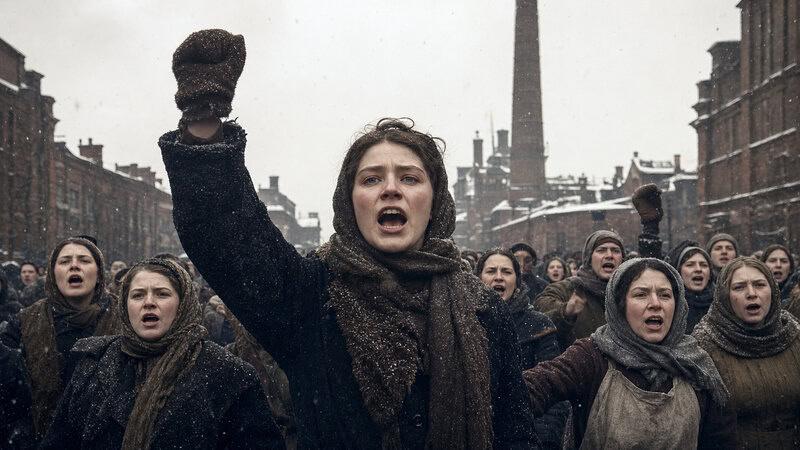

On the morning of March 8, 1917, women textile workers in the Russian capital of Petrograd walked off the job and into streets locked in bitter winter cold, shouting for bread. They had no manifesto, no party backing them, no revolutionary committee waiting in the wings — only hunger, fury, and three centuries of accumulated grievance. Within eight days, the Tsar of all the Russias had abdicated. Within eight months, an entirely different revolution would replace the one they had accidentally started.
One Year, Two Revolutions — and a Calendar That Made Everything Worse

The Russian Revolution was not a single event but two distinct upheavals in 1917, separated by eight months of chaos, war, and desperate improvisation. The first toppled a dynasty. The second installed a dictatorship. Together, the February Revolution and the October Revolution reshaped the modern world — and the confusion begins before you even open the history books, because the months in their names are the wrong months entirely.
In 1917, Russia still ran on the Julian calendar — the “Old Style” system that had governed the Orthodox world for centuries, running a full thirteen days behind the Gregorian calendar that the rest of Europe had long since adopted. The result is a paradox that has tripped up students ever since: the revolution named “February” began on what the rest of the world called March 8, and the revolution named “October” fell on what the rest of the world called November 7. When the Bolsheviks abolished the Julian calendar in February 1918 and aligned Russia with the Gregorian standard, the revolutionary names were already fixed in history. The confusion was permanent.
This is why the question of when the Russian Revolution happened produces two technically correct but genuinely confusing answers depending on which calendar you use. The February Revolution’s core events span roughly March 8-16, 1917 (New Style Gregorian); the October Revolution falls on November 7-8, 1917 (New Style). History books typically use the Old Style names; the actual calendar dates most commonly cited today are New Style. Both framings are legitimate. Context, as always, is everything.
The First Revolution: A Spark Nobody Struck on Purpose

In late February 1917 (Old Style), workers at factories across Petrograd began putting down their tools. It was not supposed to be the beginning of anything historic. What happened arrived on its own brutal schedule, driven not by ideology but by bread queues that stretched into the frozen dark, by casualty lists from the Eastern Front that had grown too long to comprehend, and by a monarchy that had managed, through three centuries of Romanov rule, to make itself resented by nearly every class in Russian society.
Within days of the first factory walkouts, the strikes had spread across the capital. No political party had organized the February Revolution or even immediately recognized it as revolution while it was happening — it was a spontaneous cascade, a city tipping over all at once. Tsar Nicholas II, away at military headquarters and poorly advised by those around him, ordered troops to disperse the crowds. The troops began joining them instead. When the coercive machinery of an autocracy refuses to function, the autocracy has perhaps a matter of days left. Nicholas had about five.
By March 15, 1917 (New Style), the Tsar had signed his abdication. A Provisional Government took power, and Russia found itself — bewilderingly, briefly — something resembling a republic. The women who had walked out demanding bread had not set out to end an empire. They had done it anyway.
Lenin Almost Missed It

In Zurich, a forty-six-year-old Russian exile named Vladimir Lenin was reading the newspapers when word arrived of the February Revolution. He had spent years in European exile writing pamphlets, quarreling with fellow socialists, and nursing a revolutionary vision that seemed, in early 1917, increasingly remote from practical reality. According to accounts from his contemporaries, he had expressed doubt just weeks earlier about living to see revolution in Russia. He was far from home, and the Tsar’s empire, for all its cracks, had survived the upheaval of 1905 and seemed capable of surviving him too.
The news from Petrograd changed everything — and created an immediate, serious problem. Lenin needed to get back to Russia, but he was a wanted man trying to cross a continent at war. His solution was one of history’s more audacious travel arrangements: he negotiated passage through Germany in a sealed railway carriage. The German government was pleased to deposit a professional revolutionary agitator into the heart of their enemy’s capital. The carriage was technically sealed to preserve the legal fiction that Lenin had not set foot on German soil; in practice, it was a calculated wager by Berlin that Lenin would cause more damage to Russia than to Germany. They were not wrong.
Lenin arrived at Petrograd’s Finland Station on April 3, 1917 (New Style), and immediately surprised his own Bolshevik allies. The April Theses he issued were not a cautious assessment of the situation. They were a demand for immediate socialist revolution, for no cooperation with the Provisional Government, and for an end to the war at any price. His own party initially thought he had overreached. He persuaded them otherwise, and the clock began ticking toward November.
The Eight Months Between: A Pressure Cooker, Not an Intermission

The Provisional Government’s fatal miscalculation was straightforward and catastrophic: it kept Russia in World War I. Soldiers went on dying. Workers went on going hungry. The bread queues did not shrink. Lenin’s core promises — peace and land — resonated precisely because the February Revolution, for all its drama, had delivered neither. The Soviets, the workers’ and soldiers’ councils that had sprung up alongside the Provisional Government, grew steadily more radical through the summer and autumn. The Bolsheviks, a disciplined minority with a clear program and no interest in compromise, methodically built the organizational infrastructure that the February uprising had entirely lacked.
This is the crucial distinction that a close reading of 1917’s two revolutions makes plain. The February Revolution was a crowd. The October Revolution was a plan. Where the first succeeded through sheer accumulated pressure and the collapse of authority, the second succeeded through coordination, timing, and a willingness to move before anyone else was quite ready to stop them.
The Provisional Government also faced a structural problem that no amount of goodwill could easily resolve: it shared authority uneasily with the Petrograd Soviet, creating what historians call a condition of “dual power” — two bodies each claiming legitimacy, neither able to govern decisively. The Bolsheviks understood that this paralysis created an opening, and they prepared to use it.
The Second Revolution: Engineered by Dawn

On the night of November 6-7, 1917 (New Style), Leon Trotsky chaired the Military Revolutionary Committee as Bolshevik forces seized Petrograd’s key infrastructure — bridges, telegraph offices, railway stations, the State Bank. It was a coup with a timetable, not a spontaneous popular uprising. The Winter Palace, seat of the Provisional Government, fell in the early hours of November 7. The Provisional Government was finished.
Lenin himself nearly was not there. Hiding in disguise to evade arrest — the Provisional Government had issued warrants for his detention after a failed Bolshevik uprising in July — he slipped into Bolshevik headquarters on the night of the 6th. His party had debated right up to the final weeks whether the moment had truly come. Lenin had to argue, badger, and threaten to act alone before the vote swung his way. The October Revolution, which the Soviet Union would later commemorate as an inevitable triumph of historical forces, came within a few committee votes of not happening on schedule at all.
By dawn on November 7, Lenin stood before the All-Russian Congress of Soviets to announce that Soviet power had begun. Contemporary accounts of that night describe the proceedings being punctuated by the sound of artillery fire — the cruiser Aurora had fired a blank round earlier in the evening as a signal, though the shot has since acquired considerable myth. The broader arc of what we now call the Russian Revolution period did not end in November 1917. Civil war, famine, foreign intervention, and political terror would continue until Bolshevik rule was consolidated across much of the former empire by late 1922. What happened that November was not the end of anything. It was the beginning of something far longer and far darker.
Why the Two-Revolution Story Changes Everything

Most people searching for facts about the Russian Revolution expect a single event with a single date. Understanding that there were two revolutions in 1917 — separated by eight months and utterly different in character — radically changes the moral and political story. The first brought something like democratic possibility within reach; the second closed that possibility down. The February Revolution demonstrated that even a deeply entrenched autocracy could collapse in a matter of days when its own instruments of coercion refused to obey. The October Revolution demonstrated that a disciplined minority with a coherent plan and a tolerance for ruthlessness could outmaneuver a disorganized majority almost every time.
Both lessons echoed through the rest of the twentieth century. Taken together, the February and October revolutions of 1917 represent one of history’s sharpest case studies in how uprisings mutate: a genuine popular movement becomes raw material for a political organization disciplined enough, and ruthless enough, to use it for its own ends. The unanswered question — whether the February Revolution might have led somewhere else under different leadership and different circumstances — remains one of the most debated counterfactuals in modern history.
For seventy years, the Soviet Union celebrated November 7 as the anniversary of the Great October Socialist Revolution — a holiday named for the wrong month, observed under a calendar that no longer matched the Julian reckoning, commemorating an event that its own architects had come within days of postponing. The confusion surrounding the date of the Russian Revolution is not a footnote to the story. It is a small, precise emblem of everything 1917 was: two calendars, two governments, two revolutions, and a country lurching between worlds it could not quite name.
What began with women demanding bread on a freezing Petrograd morning ended, years later, with a new kind of state that would shape global politics for the rest of the century. Which is why, more than a hundred years on, the question of when the Russian Revolution happened still carries more weight than any single date can hold — and why the honest answer is always at least two dates, sometimes more, and never quite what you expected.

 Arabic
 French
 Spanish
 Portuguese
 Deutsch
 Turkish
 Dutch
Dutch
 Italiano
 Russian
 Romaian
 Portuguese (Brazil)
 Greek
Greek