


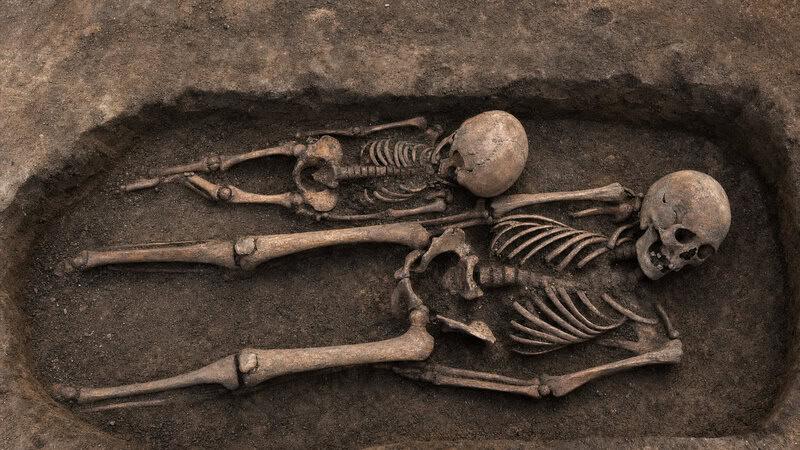

Sometime in the medieval period, a small child was laid carefully into a grave in Sweden — tucked beside an adult, the burial deliberate and tender. For centuries, anyone looking at that grave would have assumed the obvious: here lies a family. Ancient DNA evidence has now proved that assumption almost certainly wrong, and in doing so, has cracked open one of the quietest mysteries in medieval archaeology.
A Child in a Stranger’s Grave
Picture a medieval Swedish cemetery clustered near a newly built stone church, its grounds slowly filling with the parish dead. Gravediggers lower a child into the earth beside an adult — the placement careful, the choice deliberate. Whoever made that choice knew both people. Whoever made that choice had reasons.
For generations, archaeologists read shared graves as family graves. Two bodies side by side meant mother and child, husband and wife, siblings or grandparents. Proximity felt like proof. It was a reasonable assumption, rooted in the oldest human instinct: we bury our own together. But a new study published in the journal Science Advances has tested that assumption with ancient DNA, and the results are startling. Across three medieval Swedish cemeteries, people buried in the same grave were rarely close biological relatives at all.
That finding doesn’t diminish the intimacy of those burials. If anything, it deepens it. These were not accidental pairings or hasty wartime trenches. These were considered, intentional acts of interment — which makes the absence of kinship all the more extraordinary. Someone chose to place that child beside that particular adult. The question the bones could not answer, and the DNA now forces us to ask, is: why?
What the Bones Couldn’t Tell Us — Until Now

Skeletal archaeology has always had a fundamental limitation when it comes to relationships. Bones can reveal age, sex, disease, diet, and sometimes travel history through isotope analysis. What they cannot do, on their own, is confirm whether two people who shared a grave ever shared a bloodline. Proximity in death felt like meaningful evidence — and it is meaningful, just not in the way researchers long assumed.
Ancient DNA analysis has transformed this picture. By extracting and sequencing genetic material from centuries-old remains, researchers can now map biological relationships with a precision that was unimaginable a generation ago. They can determine whether two individuals were parent and child, siblings, cousins, or complete strangers. The technology has already rewritten chapters of prehistoric and early historic archaeology, and it is now doing the same for the medieval period.
The study examined Viking Age and medieval graves across Sweden — a period stretching across some of the most dramatic social and religious transformation Scandinavia ever experienced. The researchers focused on three cemeteries, giving the study both geographic range and chronological depth. Together, the sites span the transition from Norse paganism to Christian parish life, making them an unusually rich lens on shifting beliefs about community, death, and the proper ordering of the dead.
The Pattern That Defied Expectation

When the genetic results came in, they did not produce the family clusters that conventional wisdom had predicted. Even at cemeteries where shared burial was common — where grave after grave contained multiple individuals — close biological relatives were surprisingly rare among those interred together. The data actively resisted the family-grave interpretation that had shaped decades of archaeological thinking about medieval children buried alongside adults.
Some of the most striking findings involved children specifically. In medieval Sweden, children who shared graves with adults consistently ended up beside adults of the same sex — a pattern suggesting that something other than family logic was organizing these burials. And then there is the detail that lingers longest: infant girls found buried among men. That particular pairing is almost impossible to explain through kinship alone. A father buried beside his daughter is plausible; a pattern of unrelated infant girls placed among unrelated men points toward social categories and community roles operating well beyond the family unit.
Ancient DNA analysis challenged the family assumptions embedded in medieval cemetery interpretation at site after site, grave after grave — and the researchers’ surprise is implicit in the consistency of the findings themselves. This was not a result anyone was confidently predicting.
The Christian Revolution in Death

To understand why medieval Swedes might bury strangers together, it helps to understand just how radically Christianity transformed Scandinavian attitudes toward death. The Norse burial tradition was intensely personal and often familial. Grave goods reflected the individual’s identity, status, and journey into the afterlife. Boat burials, weapon burials, cremations on ancestral land: these were acts rooted in the particular self and the particular family.
Christianity brought something fundamentally different. The dead were now members of a universal community of believers, awaiting collective resurrection. They were parishioners before they were daughters or sons. The churchyard was not a family estate; it was shared sacred ground belonging to the whole congregation. Early Christian burial practices across Europe deliberately blurred the old markers of individual and clan identity, replacing them with the markers of faith, gender, and spiritual category.
In Sweden, as in the rest of northern Europe, this transformation was neither instant nor uniform. The Viking Age sites included in the study represent precisely the transitional moment — a society mid-conversion, still working out what Christian death was supposed to look like. The burial patterns visible in the DNA data may be catching that shift in progress: old graves organized by blood giving way to new graves organized by something the Church considered more fundamental than biology.
Gender-segregated burial, for instance, was a recognizable feature of early Christian practice in parts of medieval Europe. If communities were grouping the dead by sex and spiritual status rather than by family unit, the patterns in the Swedish data begin to make a coherent kind of sense — strange to modern eyes, but internally logical within its own world.
So Who Were These People to Each Other?

If not family, then what? The DNA study establishes who these people were not to each other, but the warmer question — what they actually were to one another — remains open, and it is one of the most compelling puzzles in medieval social history.
Medieval Swedish communities were tight, overlapping webs of obligation. Neighbors shared labor and resources across seasons. Lords and servants lived in close daily proximity. Guilds and confraternities created bonds of loyalty that could rival family ties in their intensity. The Church, above all, created a vast network of spiritual kinship: godparents and godchildren, linked by the sacrament of baptism into relationships that carried real social weight and genuine mutual obligation.
Godparenthood is particularly suggestive when examining the infant burials. In medieval Christian communities, a godparent was responsible for a child’s spiritual formation and, in extremis, their physical care. A godfather burying his godchild beside himself, or a community placing a baptized infant in the grave of a respected church member, would not have seemed strange to medieval observers — it would have seemed right. The bond was real, even when the blood was absent.
The discovery that infant girls were buried among men in some cases may reflect exactly these kinds of spiritual or social sponsorship arrangements, though the study appropriately stops short of certainty on specific mechanisms. What it does establish is that the organizing principle behind these burials was social, not genetic — and that medieval people had rich and varied languages for closeness that had nothing to do with shared ancestry.
What This Changes for Medieval Archaeology

The methodological implications of this study reach well beyond Sweden. For decades, interpretations of medieval cemetery layouts have rested on the assumption that spatial proximity signals biological relationship. Families buried together, the thinking went, and so clusters of graves — or shared graves — could be mapped onto family structures and used to reconstruct household organization, inheritance patterns, and social hierarchy.
The Swedish DNA data suggests that this interpretive framework needs serious revision. Shared burial space, the evidence now indicates, is a social statement — a declaration of community, obligation, or spiritual connection — not necessarily a genetic one. That realization carries implications for medieval cemetery analysis at sites across Europe, wherever similar assumptions about kinship and co-burial have shaped scholarly interpretation.
Sweden’s unusually well-preserved medieval burial record makes it a particularly valuable test case for these questions. The conditions that kept genetic material recoverable across centuries of northern European winters have effectively given researchers a window that is only now opening. As ancient DNA techniques improve and costs continue to fall, population-scale analyses like this one will become routine — and they will almost certainly continue to surprise.
The Living Logic Behind the Dead
Every burial decision in a medieval churchyard was made by a living person standing in grief and obligation. Someone dug that grave. Someone decided who would share it. Someone lowered the child in beside the adult, smoothed the earth, and walked away carrying the knowledge of why.
What the DNA evidence reveals is that medieval identity in death — as in life — was shaped by forces more varied and more interesting than blood alone. Community mattered. Faith mattered. Social role mattered. The obligations created by baptism, by service, by neighborly care, by guild brotherhood, by the entire dense texture of medieval communal life: all of these could apparently outweigh the pull of family when it came time to decide where the dead belonged.
Medieval cemeteries, seen through this new lens, are not simply family plots. They are community statements, written in the language of careful interment and shaped by the living world’s most pressing relationships and deepest beliefs. The graves were always telling us this. It took centuries of silence, and the patient work of extracting ancient DNA from Swedish soil, to finally hear it clearly — and what they say is stranger, richer, and more human than the simple story of family we thought we already knew.

 Arabic
 French
 Spanish
 Portuguese
 Deutsch
 Turkish
 Dutch
Dutch
 Italiano
 Russian
 Romaian
 Portuguese (Brazil)
 Greek
Greek