


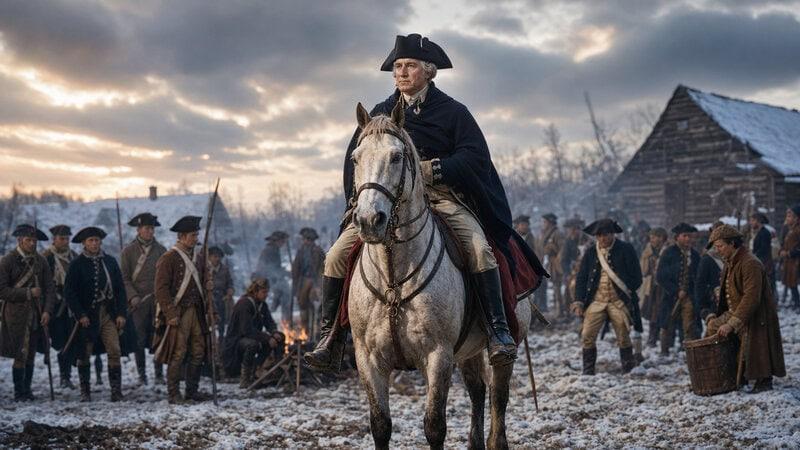

In January 1780, soldiers at Morristown, New Jersey scraped the insides of their shoes for anything edible and watched snowdrifts pile higher than a standing man’s head. At least twenty-eight major storms battered the encampment that winter, temperatures plunged to depths that shattered every record in living memory, and the Continental Army came closer to outright dissolution — through mutiny, starvation, and desertion — than it ever had at Valley Forge. Almost nobody remembers it.
The Winter Nobody Remembers

Valley Forge owns the mythology. It has the national park, the Emanuel Leutze painting of Washington crossing the Delaware (which depicts a different moment entirely, but never mind), and a narrative arc so satisfying it nearly writes itself: despair, endurance, renewal. Morristown, the encampment of 1779 to 1780, has a quieter monument and a fraction of the footprint in popular memory — even though historians now consider it the true nadir of the Continental Army’s suffering. The cold was statistically worse. The supply collapse was more complete. The mutinies were real and documented.
This is the kind of gap between legend and fact that Ken Burns was made to excavate. His 2025 documentary The American Revolution — six episodes, twelve total hours, co-directed with Sarah Botstein and David Schmidt — doesn’t exist to flatter the founding mythology. It exists to complicate it, and in doing so, it surfaces a story far stranger, bloodier, and more astonishing than the civics-class version most Americans carry around in their heads.
What follows is a guided excavation of the history the series gets right, where it breaks new ground, and why the effort matters at this particular moment.
What Ken Burns Actually Built This Time

The structural bones of The American Revolution are worth understanding before diving into the history, because the architecture shapes everything. The series spans 1754 to 1783 — starting not with the Boston Massacre or the Stamp Act, but with the opening shots of the Seven Years’ War in the Ohio River valley, when a young Virginia militia officer named George Washington stumbled into a skirmish that would eventually ignite a global conflict. Ending in 1783 rather than at Yorktown allows the documentary to reckon with the Peace of Paris and its cascading consequences across three continents.
The release itself broke new ground for the Burns brand. In a first for a Ken Burns series, all six episodes dropped simultaneously for on-demand streaming — no waiting a week between installments, no cable subscription required. The full twelve hours became available at once on PBS.org and on the free PBS App, accessible on platforms including Roku. Viewers can also find guidance on local broadcast schedules from stations such as WQED and WUCF, and the series is available on Blu-Ray for those who prefer a physical copy. For anyone accustomed to rationing Burns documentaries one broadcast night at a time, the immediate availability feels almost disorienting — like being handed the whole map instead of one square at a time.
But the series’s sharpest editorial choice is its framing thesis. The documentary characterizes the American Revolution not as a single clean story of colonies versus crown, but as four overlapping conflicts happening simultaneously: a war for independence, a war of conquest, a civil war, and a world war. That quadruple lens is historically defensible — arguably it is simply accurate — and it serves as the spine of everything that follows.
The Valley Forge Myth vs. the Morristown Reality

Valley Forge, the winter of 1777 to 1778, was genuinely brutal. Roughly two thousand men died of disease and exposure in those months, and the supply system failed catastrophically. But the Continental Army entered that encampment with real momentum — the victory at Saratoga that autumn had been a turning point significant enough to draw France toward formal alliance — and it emerged with something transformative: the Prussian-born drillmaster Friedrich von Steuben had spent the winter hammering raw recruits into something resembling a professional army. Valley Forge has a narrative arc. It has a through-line from suffering to competence.
Morristown offers no such consolation. The winter of 1779 to 1780 delivered record cold, near-complete supply collapse, and mutinies that Washington suppressed only through a combination of personal authority and the execution of ringleaders. The men who survived did not emerge with new discipline or renewed purpose. They emerged simply having survived. The documentary’s willingness to sit with that — to refuse the compensating uplift — is one of the places where it earns its runtime.
The deeper point the series makes, implicitly, is that suffering in the Revolutionary War was not a single photogenic moment but a recurring condition across eight years. The mythology requires a valley and a forge, a low point and a redemption. The actual history is more grinding: cold, then hunger, then cold again, punctuated by battles that were often chaotic and inconclusive. Why does Valley Forge dominate the memory while Morristown fades? Because Valley Forge has a national park and a monument that draws visitors, and commemoration, once institutionalized, shapes what counts as history. Burns has always been interested in that feedback loop — the way Americans remember is itself a historical subject — and here he interrogates it with unusual directness.
A War of Conquest: The Story Inside the Story

Of the documentary’s four framings, the one that will feel most unfamiliar to general audiences is probably the most important: the Revolution as a war of conquest. This refers not to British aggression against the colonies, but to the Continental push westward against Indigenous nations who had their own sovereign stakes in the outcome — and who largely, and rationally, sided with the British, the power less likely to flood their lands with settlers.
Beginning the story in 1754 makes this legible in a way that a 1775 start date never could. The Seven Years’ War — called the French and Indian War in American memory — had already fundamentally disrupted Indigenous alliances and land arrangements across the eastern half of the continent. The Revolution did not interrupt that process; it accelerated and radicalized it. The Sullivan-Clinton Campaign of 1779, ordered by Washington himself, systematically destroyed dozens of Haudenosaunee towns across present-day New York and Pennsylvania — burning crops, leveling longhouses, killing or displacing thousands of people. It was not incidental to the Revolution. It was policy.
The Haudenosaunee Confederacy — one of the most sophisticated political structures in North America — was effectively shattered by a war its members had not started and could not easily escape. Covering this inside a documentary nominally about the founding of the United States requires a kind of moral seriousness that the series, to its credit, does not flinch from. It is one of the starkest examples of the gap between the civics-class version of the Revolution and what the historical record actually shows.
The Civil War Nobody Named: Loyalists and Fratricidal Violence

Roughly one-fifth of the colonial population remained loyal to the Crown throughout the war — a proportion large enough to constitute a genuine political constituency, not a fringe. They were not simply wrong about liberty; many were people for whom the existing order had worked, or who feared, reasonably, that independence would mean the tyranny of a local majority replacing the tyranny of a distant king. Their concerns were not always unfounded.
What happened to them was frequently savage. Tarring and feathering, property seizure, exile, and killing of Loyalists were common, particularly in areas where Patriot control was contested. The Carolinas saw something that deserves the word “civil war” without quotation marks: guerrilla campaigns between Patriot and Loyalist militias in which atrocities moved in both directions and neighbors settled old scores under the cover of revolutionary ideology. Approximately sixty thousand Loyalists were eventually exiled, many to Canada, others to the Caribbean or Britain itself.
Enslaved people who accepted Lord Dunmore’s 1775 Proclamation — which promised freedom to those who escaped Patriot masters and joined British forces — represent some of the war’s most tragic actors. Many gained a real, if tenuous, freedom during the conflict. When British promises collapsed at the war’s end, the outcomes for those individuals were often devastating. The documentary’s civil war framing recontextualizes even familiar figures: Benedict Arnold’s treason, so often treated as simple villainy, looks more complicated when you understand that choosing sides was a genuine moral and practical crisis for thousands of families across the colonies.
The World War Frame: France, Spain, and Stakes Nobody Taught You

France entered the war formally in 1778, transforming what had been a colonial rebellion into a global conflict. Spain joined in 1779. The Dutch Republic entered in 1780. Britain suddenly found itself fighting simultaneously in North America, the Caribbean, at Gibraltar, in India, and in the North Sea. The siege of Yorktown in 1781, the engagement that effectively ended the American war, was as much a French military operation as an American one: the Comte de Rochambeau’s troops matched Washington’s in number, and French Admiral de Grasse’s naval victory at the Chesapeake Bay closed the trap around Cornwallis without which no siege was possible.
The Peace of Paris in 1783 reshuffled colonial holdings across multiple continents. Florida changed hands. Caribbean islands were traded. The settlement that ended the American war was negotiated alongside settlements affecting territories and peoples who had no voice in Philadelphia or London. For general audiences, this global frame may be the most immediately surprising of the four: British sailors were fighting Dutch sailors in the North Sea while Cornwallis was preparing to surrender at Yorktown.
The series’s 1754-to-1783 scope makes this visible in a way that a tighter frame never could. Revolutionary war history, compressed to its most familiar episodes, can feel like a local story with a universal moral. Stretched to its actual dimensions, it looks like what it was: one theater of a worldwide collision between empires, with consequences still unfolding two and a half centuries later.
Where the Series Could Be Stronger
No twelve-hour documentary escapes without tradeoffs, and a fair accounting requires noting them. The series’s four-part framing, while intellectually powerful, occasionally strains under the weight of so much material: the world war thread, in particular, can feel compressed relative to the space it deserves when France’s Caribbean strategy and Spain’s ambitions along the Gulf Coast are as consequential as anything happening in Pennsylvania. Viewers new to the period may also find the early episodes dense as the documentary establishes its unusually wide 1754 starting point before the more familiar Revolutionary narrative gains traction.
These are modest criticisms of an ambitious undertaking. The series does not always resolve the tensions it surfaces — the contradiction between the Revolution’s liberty rhetoric and its simultaneous expansion of slavery, for instance, receives honest treatment but resists the tidy conclusion some viewers will want. That resistance is probably the right call historically, even if it leaves the emotional experience more unsettled than a conventional documentary would.
Why This Documentary, Why Now — and How to Watch It
The simultaneous streaming release on PBS.org and the free PBS App represents a genuine democratization of access. No cable subscription is required, and the PBS App’s availability on platforms like Roku means the full twelve hours reach well beyond laptop screens. Local broadcast information is available through stations including WQED and WUCF. The official series page at kenburns.com also carries supplementary materials including extended interviews and educator resources that meaningfully expand the experience beyond the episodes themselves — a dimension worth mentioning that a straightforward broadcast review might skip past.
The timing of the release is pointed in a different way, too. Releasing a documentary that insists the Revolution was contested, multiracial, globally entangled, and internally violent into the current moment of argument about American history is itself an editorial act. The series doesn’t resolve those arguments — it predates them, in a sense, by showing how long the contestation has been running. The founding was not a settled consensus; it was a negotiation conducted under fire, in freezing mud, across fault lines of race and loyalty and empire that the subsequent mythology mostly papers over.
The series’s implicit argument is also its greatest strength: honoring the Revolution doesn’t require sanitizing it. The actual story — frozen soldiers at Morristown, Loyalist families torn apart and exiled, Haudenosaunee towns burned on Washington’s orders, French admirals making Yorktown possible — is more extraordinary than the myth. It is also more useful. A revolution that was genuinely hard-won, genuinely contested, and genuinely complicated belongs to more people than a revolution that was simply inevitable.
Back at Morristown, in January 1780, the men shivering in their inadequate huts did not know they were founding a nation. They did not know whether the alliance with France would hold, whether the army would mutiny before spring, whether independence was possible or even desirable in any form that would survive the peace. They were just trying to last until morning. Twelve hours of Ken Burns, at its best, is a reminder that history is made by people that cold, that hungry, and that genuinely uncertain of how it all ends — and that the story is richer, and truer, for including them.

 Arabic
 French
 Spanish
 Portuguese
 Deutsch
 Turkish
 Dutch
Dutch
 Italiano
 Russian
 Romaian
 Portuguese (Brazil)
 Greek
Greek