


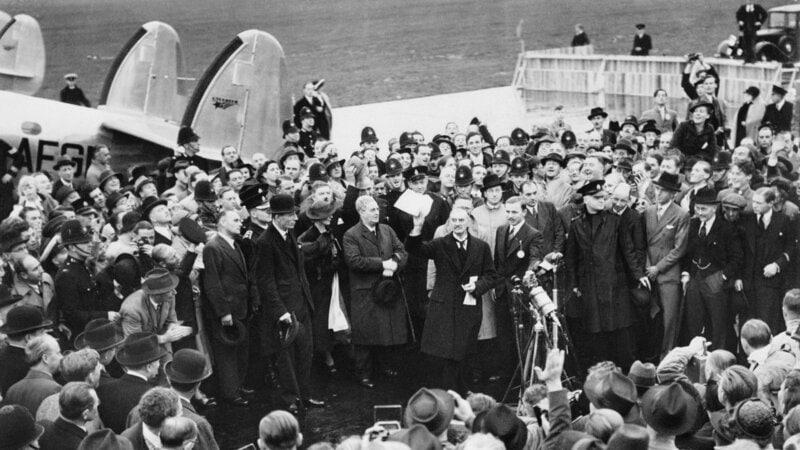

It was just past 1 a.m. on September 30, 1938, when four men scratched their signatures onto a document inside a Munich palace and handed Adolf Hitler an entire country without firing a single shot. Neville Chamberlain flew home clutching that paper, waved it at a cheering crowd, and called it “peace for our time” — a phrase history would spend the next eighty years transforming into the very definition of catastrophic misjudgment.
The Film and the Far Stranger Reality Behind It
Netflix’s thriller Munich: The Edge of War dramatizes the frantic days leading up to that moment with considerable tension — fictional diplomats racing through corridors, secret documents changing hands, the fate of Europe balanced on a knife’s edge. The real story, however, is stranger, more desperate, and more morally tangled than any screenplay. The film’s narrative ends before the war even begins, and that restraint is precisely the point. The horror of Munich is not a battle. It is a room full of men who chose not to fight — and the cascading consequences of that choice.
What Was Actually at Stake: Czechoslovakia’s Defenses

The Sudetenland was a mountainous border region of Czechoslovakia inhabited by roughly three million ethnic Germans. Its strategic importance, however, had nothing to do with ethnicity. The region contained the fortified mountain passes and layered defensive networks that formed the backbone of Czech military strategy — fortifications that contemporary observers compared favorably to France’s Maginot Line. Without those natural barriers and prepared positions, Czechoslovakia would be militarily exposed on every front.
Hitler had spent 1938 manufacturing a crisis with characteristic precision, orchestrating outrage through the Sudeten German Party under Konrad Henlein and staging incidents designed to make Czech “oppression” of ethnic Germans the dominant headline across Nazi-controlled media. The grievances were largely artificial; the military consequences of yielding were devastatingly real. Surrendering the Sudetenland was not a territorial compromise. Military analysts at the time, and historians ever since, have characterized it as the surgical removal of Czechoslovakia’s capacity to defend itself — a distinction the negotiators in Munich understood and chose to accept anyway.
Four Signatures, One Absent Victim

The signatories were Hitler, Chamberlain, French Premier Édouard Daladier, and Italian dictator Benito Mussolini. The Czechs themselves were not invited to negotiate their own dismemberment. Czech representatives waited in an anteroom and were informed of the terms only after the agreement had already been concluded — a procedural humiliation that the film renders with quiet, accurate force.
Mussolini played the role of honest broker, presenting a memorandum that had in fact been drafted in Berlin. It was a piece of theater that momentarily deceived most of the room. Daladier reportedly braced himself for an angry reception when his aircraft touched down in Paris. Instead he found cheering crowds, and turned to an aide in something close to revulsion. The public’s relief at avoiding another European war was overwhelming; to Daladier, the acclaim felt like a rebuke.
The conference itself had no formal agenda and no fixed timetable. It broke repeatedly into chaotic side conversations as interpreters scrambled and delegations argued in corridors and anterooms. The atmosphere of desperate improvisation so vivid in the film was entirely, uncomfortably authentic. No international framework governed proceedings; the outcome rested almost entirely on the personal calculations of four men in a single room.
Neville Chamberlain: Villain, Fool, or Tragic Realist?

The standard historical verdict on Chamberlain’s appeasement policy is damning, and it is not entirely without foundation. But the full picture is considerably more complicated. Britain’s military chiefs had advised him privately that the country was unready for war in 1938. The Royal Air Force was still in the middle of a rearmament program, radar networks along the southern coast were incomplete, and the British army was in no condition to mount an effective land campaign on the European continent. Chamberlain was not ignorant of Hitler’s character so much as he was acting on serious professional military advice counseling restraint.
He also believed, with evident sincerity, that he could treat Hitler as a rational actor who, once awarded the Sudetenland, would have his territorial appetite satisfied. It was a catastrophic misreading of the man across the table — but one shared at the time by much of the British and French foreign policy establishment, many of whom had direct diplomatic experience of Hitler and still reached the same wrong conclusion.
Some historians argue that the year purchased by Munich allowed Britain to produce the Spitfires and complete the radar installations that proved decisive during the Battle of Britain in 1940. The counter-argument is equally specific and considerably grimmer: Germany used that same year to absorb Czech industrial capacity, Czech weapons stockpiles — including roughly 1,500 aircraft and nearly 500 tanks that passed directly to the Wehrmacht — and Czech gold reserves. The Czech army, which military planners estimated could have delayed a German advance by several critical weeks, simply ceased to exist. Whether Munich bought Britain survival or merely delayed a reckoning that arrived in worse circumstances remains one of the most genuinely contested questions in twentieth-century historiography.
What the Film Gets Right — and Where It Invents
The film’s two central characters — British diplomat Hugh Legat and his German counterpart Paul von Hartmann — are fictional. They are, however, built around a documented reality. There genuinely were junior officials and diplomats on both sides who recognized the catastrophe unfolding around them and felt entirely powerless to alter its course. The depiction of German resistance figures attempting to pass evidence of Hitler’s expansionist intentions to the British delegation is grounded in historical fact: members of what became known as the Oster conspiracy, operating within German military intelligence under Admiral Wilhelm Canaris and General Hans Oster, did attempt to warn London that Hitler’s demands would never stop at the Sudetenland. Those warnings were received, assessed, and largely disregarded.
Where the film compresses and dramatizes, the true story is arguably more unsettling, not less. There was no secret document that changed the outcome, no last-minute intervention by a clear-eyed hero. There was exhaustion, there was palpable relief, and there was a disastrous piece of paper signed in the early hours of the morning while the country being dismembered waited in a corridor outside.
The Morning After: How Quickly It Unraveled

German troops began occupying the Sudetenland on October 1, 1938 — fewer than twenty-four hours after the ink had dried — moving with a speed and operational precision that confirmed the invasion had been planned long before any diplomatic “crisis” was announced. The timeline made the manufactured nature of the emergency retroactively obvious to anyone who cared to look.
By March 1939, Hitler had absorbed the remainder of Czechoslovakia entirely, dissolving what the Munich agreement had nominally guaranteed and finally extinguishing whatever residual belief Chamberlain retained in a durable peace. The details of the aftermath were grim in their specificity. Czech gold reserves held on deposit in London were transferred to the Reichsbank on Bank of England instructions — a decision that would embarrass British financial officials for decades. Within eighteen months of that night in Munich, every head of government who had signed the document was leading a nation at war. The country sacrificed to prevent that war had ceased to exist on any political map.
Why the Shadow of Munich Never Quite Lifts
“Munich” entered the political vocabulary as a byword for the perils of appeasement and has been invoked in nearly every significant international confrontation since 1938 — Korea, Suez, the Falklands, Iraq, and beyond. Sometimes it functions as a genuine and instructive historical parallel. More often it serves as rhetorical cover for decisions already taken, a historical citation wielded by those who have already chosen force and want moral authority for the choice. The word carries enormous weight, and that weight is frequently deployed with very little precision.
The reason this episode continues to generate serious argument is precisely because it resists reduction to a clean morality tale. It is not a story of monsters easily identified across a clear line and defeated by heroes who saw through the deception. It is a story of intelligent, genuinely frightened people — men who had lived through one catastrophic European war and were viscerally unwilling to begin another — making a civilizational miscalculation under extreme pressure, with incomplete information, and with the casualties of 1914 to 1918 still vivid in their generational memory.
The film’s most honest instinct — the quality that separates it from standard wartime thriller territory — is its decision to end before the shooting starts. The horror of Munich is not the war that followed, though that war was horrific enough. It is the silence that came first: the brief, false peace, the cheering crowds, the waved piece of paper, and the slow, terrible awareness that something irreversible had been set in motion by men who persuaded themselves they had no other option. The question that conference continues to pose remains genuinely, uncomfortably alive: at what point does accommodation become surrender, and how do you recognize the difference before it is already far too late to matter?

 Arabic
 French
 Spanish
 Portuguese
 Deutsch
 Turkish
 Dutch
Dutch
 Italiano
 Russian
 Romaian
 Portuguese (Brazil)
 Greek
Greek