


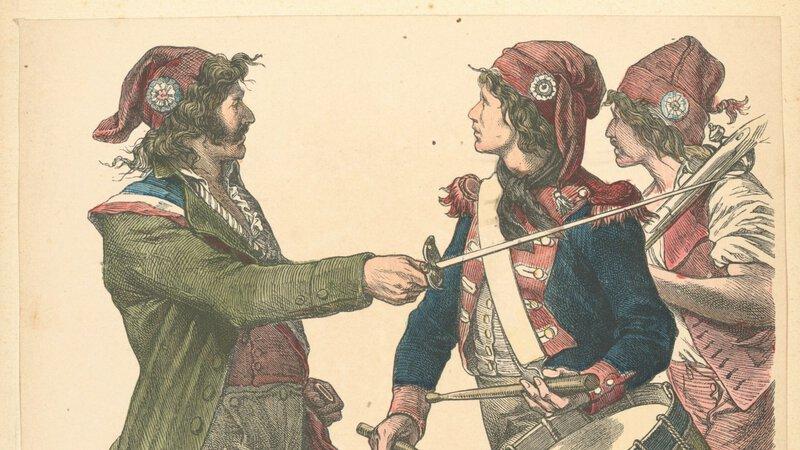

On a sweltering June day in 1792, a crowd of Parisian radicals forced their way into the Tuileries Palace and pressed a soft red cap into the hands of King Louis XVI. The king — cornered, pale, with nowhere to run — placed it on his own head. The mob roared. In that single gesture, one of Europe’s most powerful monarchs had been made to wear the badge of revolution, and a hat became the most dangerous object in France.
A Symbol Nobody Fully Understood

The cap Louis XVI wore that day was the bonnet rouge — red wool, brimless, with its tip flopping forward at a soft angle. To the sans-culottes who thrust it at him, it was a declaration: power now belonged to the people, not the palace. What almost none of them knew — what makes the whole scene shimmer with historical irony — is that the hat they were using to humiliate a king had spent roughly two thousand years meaning something far more specific. It was, at its root, the hat of a freed slave. The men and women of the French Revolution believed they were inventing a new symbol. They were, in fact, reaching back further than Rome.
Trace the history of the Phrygian cap and you find a journey so long and so layered that the hat itself seems to grow more meaningful with every century it survives. From a kingdom on the edge of the ancient world to the barricades of Paris to the official seals of modern republics — this is a symbol that has outlived every single person who ever thought they owned it.
Ancient Origins: A Cap From the Edge of the Known World

Begin in Phrygia, a kingdom in what is now central Turkey, flourishing in the centuries before Rome rose to dominance. The soft conical cap with its apex bent forward was practical headwear for the horsemen and herdsmen of the region — brimless, made of felt or soft leather, shaped by climate and by the demands of life on horseback. It was distinctive enough that Greek and Roman artists adopted it as visual shorthand: if you wanted to signal that a figure in a painting or on a coin came from the East, from somewhere beyond the comfortable borders of the Mediterranean world, you put this cap on their head.
Trojans wore it in Greek art. Mithras, the Persian deity whose cult spread across the Roman Empire, is almost always shown wearing one. Attis, the Phrygian god of vegetation, wears it in sculpture after sculpture. The cap carried the flavour of the foreign, the distant, the not-quite-Roman. As scholars of ancient iconography have noted, the Phrygian cap was associated in antiquity with several peoples of the region, including both Phrygians and Thracians, which is why it carries multiple names to this day — Phrygian cap, Thracian cap, and eventually, liberty cap. That last name was still centuries away. First, Rome had to do something unexpected with it.
Rome’s Radical Gesture: The Hat That Freed You

Roman society had a formal ritual for the liberation of enslaved people. When an owner chose to grant freedom — the act called manumission — the ceremony was deliberate and public. At its heart was a brimless felt cap called the pileus, placed on the newly freed person’s head as a visible, physical declaration of changed status. You were no longer property. You were, to whatever limited degree Roman law allowed, free. The cap said so.
Over centuries, as the pileus and the Phrygian cap blurred together in art and in collective memory — similar in shape, worn by overlapping populations in the Roman imagination — the bent-tipped conical cap absorbed this meaning. Freedom. Specifically, the freedom of someone who had been in bondage and was now released. The conflation was imprecise by scholarly standards, but symbols are never wholly tidy, and the emotional charge was clear and lasting.
That charge grew more electric when Roman politics turned violent. After Julius Caesar’s assassination in 44 BCE, coins were struck showing two daggers flanking a pileus — the cap of liberty, positioned between the instruments of a tyrant’s killing. The message was unmistakable: this cap now signified freedom from tyranny, not merely freedom from bondage. One meaning stacked on top of another, and the hat carried both forward. By the time the ancient world faded into the medieval period, the liberty cap had already learned to mean several things at once.
The Long Sleep and the Atlantic Awakening
For more than a millennium the cap existed mainly in scholarship — in manuscripts, in the careful study of classical coins, in allegorical prints produced by Renaissance humanists who wanted their personifications of Liberty or Virtue to look properly ancient. Artists painting allegories across Europe gave their figures the bent cap as a costume prop borrowed from antiquity. It was recognisable to the educated. It was kept alive by people who read Latin.
Then the Atlantic world began to heat up. In Britain’s North American colonies, liberty poles topped with a cap appeared in town squares as protests against Crown taxation grew louder in the 1760s and 1770s. The image circulated on broadsides and pamphlets. The liberty cap became a potent symbol of American freedom before independence was fully secured — a classical image recruited into a modern argument about rights.
It was the right moment for it. The 1780s Atlantic world was not only arguing about political liberty in the abstract. It was arguing, loudly and bloodily, about slavery — about whether the freedom that educated men defended in pamphlets was the same freedom that enslaved people in the Caribbean and the American South were dying to reach. The cap’s original meaning, buried under centuries of allegory, was suddenly relevant again in ways that should have made everyone uncomfortable. Almost no one noticed the connection.
1789 and the Bonnet Rouge: When a Hat Became a Weapon

The bonnet rouge became firmly associated with the French Revolution from 1789 onward, appearing among radical clubs and street protesters as the revolution’s temperature climbed from reform to rupture. The red colour was not accidental or purely aesthetic — red already carried the raw language of danger, of blood, of the pike raised in anger. Fusing that colour to a cap with two thousand years of classical liberty behind it created something with both street menace and intellectual pedigree. You could wear it to frighten an aristocrat and cite Brutus in the same breath.
Wearing the bonnet rouge became a loyalty test. Crowds demanded that public figures, officials, and even priests don it in public, on the spot. Hesitate too long, and the hesitation was noticed. Refuse entirely, and the consequences could be severe in a city where the line between popular justice and mob violence had all but dissolved. Revolutionaries who preferred the classical reference called it the bonnet phrygien — the Phrygian cap. The ancient name lent the symbol intellectual weight. The red wool gave it something older and more visceral than any Latin text.
All of it crystallised in that June 1792 scene at the Tuileries: a king in a red woollen cap, sweating, surrounded, wearing on his own head the emblem of everything his reign was losing. The moment was never captured in oil paint — it survives in witness accounts alone, which somehow makes it sharper and stranger than any formal portrait could.
The Irony the Revolutionaries Never Grasped

Here is the historical knot that refuses to come untied. The sans-culottes — working-class Parisians who knew what it felt like to be ground down by aristocratic privilege — wore a freed slave’s cap to announce their own liberation. They almost certainly had no idea that this was the hat’s deepest meaning. They were reaching for classical authority and revolutionary colour, not for a meditation on manumission.
And yet, at the exact moment they were doing this, enslaved people in Saint-Domingue — the French Caribbean colony that would become Haiti — were rising in the largest and most successful revolt by enslaved people in recorded history. France, the country whose radicals marched under the liberty cap, was simultaneously debating with murderous seriousness whether Black people in its colonies could be free at all. The symbol’s original meaning was not abstract. It was happening, in blood, across the Atlantic.
The revolutionary government eventually abolished slavery in 1794 — a decision reached under enormous pressure, and one that Napoleon reversed within a decade. Meanwhile Marianne, the allegorical female figure of the French Republic, was depicted wearing the Phrygian cap, enshrining it in official iconography. Liberty, the republic declared, wore this hat. The hat that had first belonged to someone whose freedom had been a Roman master’s gift to bestow or withhold. Symbols are smarter than the people who carry them. The liberty cap kept asking a question about whose liberation actually counted, long after the crowds who wore it had stopped listening.
What the Cap Was Made Of — and Why It Looked the Way It Did
It is worth pausing on the object itself, not only the idea. The bonnet rouge worn during the Revolution was a simple, unlined cap of coarse red wool, typically knitted or cut from cloth and shaped so that the crown fell forward over the brow. It had no brim, no stiffening, no ornamentation. It was cheap to make and cheaper to buy, which was precisely the point: this was headwear that a working Parisian could own and wear every day. It was the deliberate opposite of the powdered wigs and tricorn hats associated with aristocratic and royal dress.
The red dye varied in intensity depending on what a wearer could afford, ranging from a deep crimson to something closer to rust. Images from the period — prints, caricatures, and painted scenes — show the cap worn pushed back on the head, tilted to one side, or pulled down firmly, each angle carrying its own charge of attitude. It was a garment that communicated before a single word was spoken. In a city obsessed with reading the political loyalty of strangers at a glance, that mattered enormously.
The Cap After the Revolution: A Symbol That Refused to Die
The bonnet rouge did not retire when the guillotine stopped falling. It travelled. It appears on the seal of the United States Senate. It sits on the national arms of numerous Latin American republics — nations born from their own revolts against colonial power, which reached for the same classical shorthand their French predecessors had used. Early designs for what would become the Statue of Liberty incorporated the Phrygian cap before a crown of rays was chosen instead. Marianne still wears it on official French government imagery today, looking out from stamps and official documents with the same bent tip that horsemen in ancient Phrygia pulled over their ears against the wind.
The symbol proved so durable because it worked on every register at once. Visually, it is simple and immediately recognisable. Classically, it carries the authority of ancient coins and allegories that educated people across the Western world had been trained to respect. Emotionally, it layers Eastern origin, Roman freedom, and revolutionary fire into a single garment small enough to fit in a coat pocket. Any liberation movement that needed a shorthand image with genuine historical weight could reach for it. Many did, and many still do.
For anyone drawn to the history of the French Revolution hat wanting to understand where the bonnet rouge came from, the honest answer is: it was not invented in 1789. It was borrowed from two millennia of contested meaning and set ablaze. The revolutionaries who wore it were the latest in a very long line of people who found in this soft conical cap exactly the image they needed — and who understood its history only partially, which may be how all of us use symbols, always.
The next time you see a soft red cap bent at the tip — on a government seal, on a coin, on a national flag — you are looking at two thousand years of arguments about freedom. The hat has been present at most of them. It has never quite given a final answer. It is still wearing the question.

 Arabic
 French
 Spanish
 Portuguese
 Deutsch
 Turkish
 Dutch
Dutch
 Italiano
 Russian
 Romaian
 Portuguese (Brazil)
 Greek
Greek