


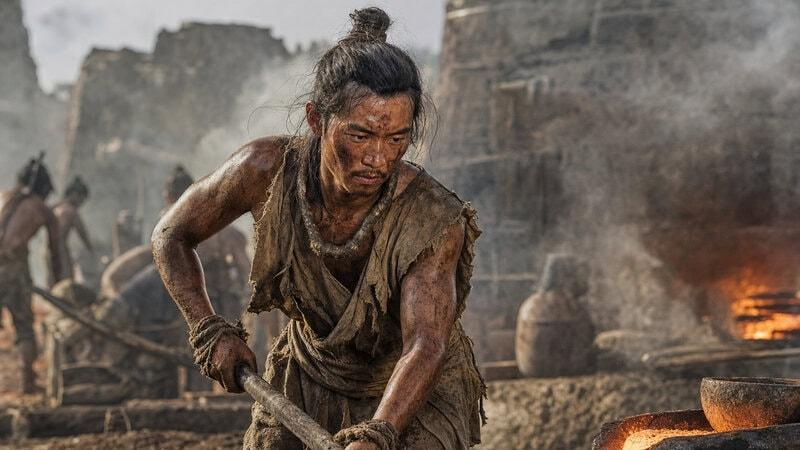

Somewhere around 1200 BCE, in the workshops surrounding the Shang royal court, molten bronze was being poured into clay molds shaped like dragons and ritual vessels. The men feeding the furnaces, hauling the ore, and breathing the metallic smoke were not celebrated craftsmen. They were captives — taken in war, stripped of their names, and set to work in service of a civilization that would one day be admired across the world. The bronze vessels survived. The workers did not, at least not in the official memory of a culture that was otherwise extraordinarily careful about writing things down.
War as the Original Source: Where Slavery in Ancient China Begins

The first slaves in ancient China were prisoners of war. This is documented in some of the oldest written records China produced. The Shang dynasty, which flourished roughly between 1600 and 1046 BCE, left behind thousands of oracle bone inscriptions: questions posed to ancestors and gods, scorched into bone and shell, then archived with bureaucratic devotion. Those inscriptions record mass captures of enemy peoples. Some captives were sacrificed in elaborate rituals at royal burials. Others were absorbed into the state’s workforce, consigned to furnaces, fields, and construction sites that kept the court functioning.
Two fates — ritual death or forced labor — reveal almost everything about the value placed on a conquered person’s life. Neither fate was considered remarkable enough to warrant anything beyond a tally. When the Zhou dynasty overthrew the Shang around 1046 BCE, the cycle did not end; it simply restarted under new management. New rulers took new slaves, embedding the practice into the logic of dynastic succession itself. Every major expansion of Chinese territory brought fresh captives, which means that the history of slavery in China is inseparable from the history of Chinese warfare and state-building. The empire grew, and the enslaved population grew with it.
Beyond the Battlefield: Hereditary Status and Debt Bondage

War was the founding engine, but it was never the only one. Two civilian pathways kept the institution fed through centuries of relative peace. The first was hereditary status: in ancient China, some people were born into slavery because their mother was enslaved. The child inherited not a name or a trade but a legal condition — property passing from one generation to the next, no battlefield required.
The second pathway was debt. Families sold members — sometimes children, sometimes daughters specifically — to settle what they owed. Picture a Han-dynasty farmer after a catastrophic flood, the harvest rotting in the field, creditors at the door. The transaction that followed was legal, commonplace, and almost never discussed in the grand chronicles that recorded the deeds of emperors and generals. A daughter entered a creditor’s household. The debt was settled. The official record noted neither her name nor her fate.
These pathways meant that ancient Chinese slaves were not merely a wartime phenomenon — a temporary underclass created by conquest and dissolved by peace. They were a permanent feature of the social landscape, present in elite households during the most prosperous periods of Chinese history. The gendered dimension of this reality deserves particular attention. Women sold into slavery frequently faced sexual exploitation within the households they entered. The official literary tradition, shaped by Confucian values that prized hierarchy and domestic harmony, had a strong incentive to euphemize or simply ignore this dimension of the institution entirely.
Property with a Price Tag: What Legal Codes Reveal

For anyone seeking to understand the legal architecture of slavery in Chinese history, the Tang Code is an extraordinary document. Established during the Tang dynasty, which ruled from 618 to 907 CE, it is one of the most detailed legal codes to survive from pre-modern China — and it mentions slaves repeatedly, in the dispassionate language of property law. The code states, across multiple provisions, that slaves could be bought and sold. It does not treat this as a controversial proposition requiring justification. It treats it as a fact of commercial life requiring orderly regulation.
The code also codified a distinction that had existed in practice for centuries: the division between official slaves owned by the government and private slaves owned by individual households and nobles. Slavery in medieval China operated across both registers simultaneously. Official slaves worked in state workshops, imperial kitchens, and public construction projects; they could be redistributed by imperial decree like any other government asset, transferred between ministries or gifted to favored officials. Private slaves lived and died according to the whims and finances of a single master, with far less institutional oversight and correspondingly fewer protections.
What makes the Tang Code so valuable to historians is precisely its coldness. The very precision of its language about slave transactions — careful definitions, specified penalties for various infractions involving enslaved people — underscores how normalized the institution had become by that period. Legislators write detailed regulations for things that happen all the time. The code is, among other things, a bureaucratic record that slavery was routine.
Earlier dynasties provide comparable evidence. Han dynasty records document government-owned slaves working in imperial manufactories, and legal texts from the Qin period treat the sale and punishment of slaves with similar matter-of-fact precision. The legal paper trail, taken together across dynasties, reveals an institution that was not occasional or marginal but structurally embedded in Chinese statecraft for well over a millennium.
Forced Labor and the Monuments We Still Admire

The physical landmarks of Chinese civilization — the palace complexes, the canal systems, the great imperial tombs — were built by massive labor forces that historians are still working to understand fully. The challenge is that forced labor in ancient China took at least two distinct forms that ancient sources sometimes blur together. Corvée was compelled labor extracted from free peasants as a form of taxation; they worked for the state for a set period and then returned to their villages. Slave labor, by contrast, was extracted from people who were legally property — prisoners of war, hereditary slaves, and criminals whose sentences had reduced them to slave status.
Both systems operated simultaneously, often on the same construction sites. The great mobilizations of the Qin and Han dynasties — the projects that reshaped the Chinese landscape — drew on both pools. Enslaved prisoners of war and convicted criminals worked alongside drafted civilians, and the distinction between them in the archaeological and historical record is frequently invisible. This blurring is not accidental. When a monument is celebrated and its laborers are invisible, official memory quietly sanitizes who actually built the empire. The Great Wall endures. The names of the people who died building it do not.
The Attempts to Limit Slavery — and Why They Failed

Several Chinese rulers and reformers attempted to restrict or abolish slavery at various points across Chinese history. These efforts were real, and they reflect genuine moral and political contestation around the institution. They also consistently failed to end it. China’s long road toward abolishing slavery was not a steady march toward liberation but a centuries-long cycle of reform, resistance, and reversion.
Wang Mang, who seized power and established the short-lived Xin dynasty between 9 and 23 CE, issued edicts attempting to ban the private sale of slaves and land — a sweeping reform that collapsed almost immediately under elite resistance and was reversed after his overthrow. Later dynasties issued their own periodic restrictions, with similarly limited effect. The reason bans failed is not mysterious. Elite households depended on slave labor for both prestige and productivity. The state depended on official slaves for administrative and manufacturing functions. Economic and political interests were deeply invested in maintaining the institution, and they consistently overwhelmed reformist edicts issued from above.
There is a useful irony embedded in this history: the very edicts attempting to restrict or ban slavery are among our best documentary evidence that it existed at significant scale. Rulers do not ban things that are not widespread. Slavery persisted continuously throughout pre-modern Chinese history, adapting its legal forms and vocabulary across dynasties but never disappearing until the pressures of the modern era — including Western diplomatic contact, internal reformist movements, and ultimately the upheavals of the twentieth century — finally dismantled its legal foundations.
For a deeper exploration of how scholars are recovering this history, this podcast episode on understanding slavery in medieval China offers a valuable window into the ongoing work of historians piecing together a story that official records were designed to obscure.
The Erasure: How Official Memory Was Constructed

The mechanisms of historical erasure were not conspiratorial — they were structural. Confucian scholars writing official histories focused on rulers, court rituals, and moral lessons drawn from the behavior of the powerful. The enslaved were invisible in a literary tradition that valued hierarchy and social harmony above uncomfortable social truths. A history organized around the virtue of emperors has no natural place for the millions of people those emperors owned, traded, and worked to death.
The erasure was also linguistic. Classical Chinese texts frequently used terms for enslaved people that could be translated as “servants” or “retainers,” softening the legal reality of ownership into something that reads more like employment or household dependency. Translators working centuries later sometimes reproduced that softening, compounding the original obfuscation. Recovering the actual history requires reading legal codes and oracle bone inscriptions — documents that were never meant to be narratives — rather than relying on the polished official chronicles that dominate the canon.
Why This History Matters Beyond China
Understanding the full history of slavery in ancient China matters for reasons that extend beyond China itself. It complicates the idea that slavery was uniquely a Western or Atlantic phenomenon — a peculiarity of one civilization rather than a recurring feature of complex societies throughout human history. It challenges narratives of unbroken cultural continuity that smooth over the violence required to sustain any ancient civilization. And it demands that we look honestly at what gets remembered and what gets forgotten when a culture writes its own story.
Somewhere in an unread archive or an unexcavated tomb, the traces of millions of ancient Chinese slaves almost certainly remain. The story was suppressed, not destroyed. Historians are slowly reassembling it, fragment by fragment, oracle bone by legal code. The bronze vessels endure in museum cases worldwide, gleaming under careful lighting, celebrated as masterpieces of human ingenuity — and the hands that fed the furnaces, that hauled the ore, that made all of it possible, remain, for now, unnamed.

 English
 Arabic
 French
 Spanish
 Deutsch
 Turkish
 Dutch
Dutch
 Italiano
 Russian
 Romaian
 Portuguese (Brazil)
 Greek
Greek