


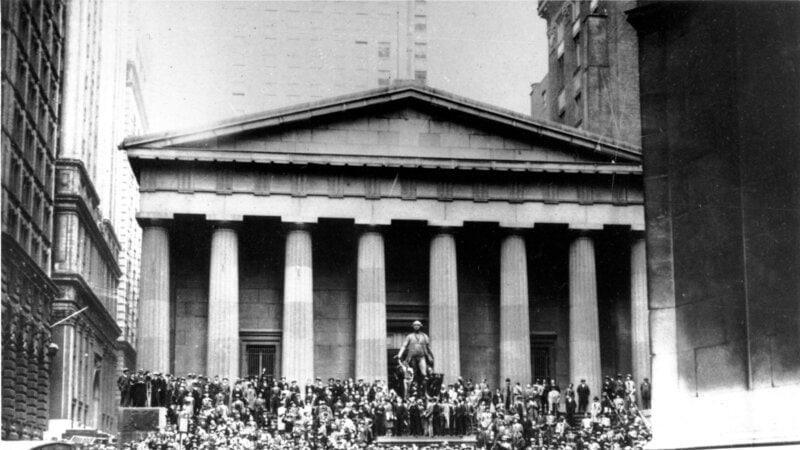

On the morning of October 24, 1929, sell orders piled up on the New York Stock Exchange faster than the ticker tape could print them — the machine running hours behind reality, spitting out numbers that had already become ghosts of prices no longer on offer. Outside on Broad Street, crowds pressed against the windows of the exchange as if proximity to the building might tell them what the tape could not. Fortunes that had taken a decade to build were evaporating before lunch. What almost no one understood then — and what popular history has spent nearly a century distorting — is that the crash was not the beginning of the Great Depression. It was the moment the pressure finally blew the lid off a boiler that had been building steam for years.
What the Great Depression Actually Was — and Wasn’t

Strip away the mythology and the Great Depression reveals itself as something far larger and more complicated than a single market crash. It was a worldwide economic collapse — the longest and most severe depression the industrialized world had ever experienced — stretching from 1929 until roughly 1939 and touching virtually every corner of the globe. It was marked by catastrophic unemployment, mass poverty, shuttered banks, and governments scrambling for answers they simply did not have.
The first misconception worth clearing away is that this was purely an American story. It was not. While U.S. financial conditions and American policy decisions were the primary engine of the catastrophe, the Depression spread through trade collapse and financial contagion into Europe, Latin America, and Asia, destabilizing democracies and generating the kind of political desperation that helps authoritarian movements find their footing. The world that emerged from the 1930s was a fundamentally different place — partly because of a morning on Wall Street, but far more because of the decade of structural rot that preceded it and the cascade of policy failures that followed.
At the human scale inside the United States, unemployment reached roughly one in four workers nationwide. In some industrial cities the figure climbed far higher. Breadlines stretched around city blocks. Families that had considered themselves comfortably middle class found themselves doubling and tripling up in apartments, selling furniture to buy food, watching banks close their doors with savings still inside. An entire generation’s relationship with money, security, and the role of government was permanently rewired by what they witnessed and endured. The Great Depression remains the benchmark against which every subsequent economic crisis is measured — the historical ghost that haunts every recession, the worst economic catastrophe of the twentieth century by any honest accounting.
The Roaring Twenties Were Already on Fire

To understand what caused the Great Depression, you have to rewind past October 1929 and look clearly at the decade that preceded it. The 1920s presented the appearance of extraordinary prosperity: rising stock prices, new consumer goods, a culture drenched in optimism and novelty. Beneath the surface, the structure was riddled with rot.
Ordinary Americans were buying stocks on margin — borrowing heavily to purchase shares, betting that prices would keep rising forever. Banks were lending recklessly, extending credit without adequate reserves, operating in an environment almost entirely free of the regulatory guardrails that might have slowed the speculation. Industries were overproducing goods that a wage-constrained public increasingly could not afford to buy, because wages for ordinary workers had failed to keep pace with the profits their labor was generating. The agricultural sector, far from sharing in the boom, had been in quiet distress for most of the decade — commodity prices depressed, farm debt rising, rural banks already failing long before Wall Street noticed.
Layered over all of this was a precarious global financial architecture left behind by World War I. European nations owed enormous war debts to the United States. Germany was burdened by reparations payments that strained its economy severely. European banks were fragile, heavily interconnected, and one serious shock away from cracking. The United States, now the world’s dominant creditor nation, had tied its financial fate to these unstable foundations without fully reckoning with what that meant.
By 1929, the U.S. economy was a beautifully decorated structure with termite-eaten beams. The stock market crash did not build the fire. It just knocked over the lamp.
Black Thursday and the Cascade That Followed

October 24, 1929 — Black Thursday — was the day panic selling first overwhelmed the market’s capacity to absorb it. A consortium of major bankers intervened, pooling resources to buy shares and steadying prices enough that the immediate crisis appeared, briefly, to have been contained. For a few days, confidence flickered back. Then on October 28 and 29, the full collapse arrived. Those two days — particularly October 29, which history labeled Black Tuesday — are where the popular myth of a single catastrophic crash took root and has lived ever since.
The mechanism that turned individual panic into systemic avalanche was the margin call. Investors who had borrowed heavily to buy stocks were suddenly required to repay those loans immediately. To do that, they had to sell — everything, at whatever price the market would bear — which drove prices lower, which triggered more margin calls, which forced more selling. The spiral was self-reinforcing and nearly impossible to stop once it had momentum.
The crash rippled onto Main Street with remarkable speed. Consumer confidence cratered. Businesses, uncertain about the future, stopped investing. The first wave of layoffs began. Yet here is the detail that most accounts omit: even after the crash, the Depression was not yet inevitable. Economic conditions actually began to stabilize and show tentative signs of improvement in early 1931. The story was not over. In fact, its worst chapter was still being written elsewhere.
The Second Blow: When Europe’s Banks Fell

Just as fragile signs of recovery appeared in early 1931, a development that most popular accounts of Great Depression history leave out almost entirely brought the recovery to an abrupt end. A series of bank collapses in Europe sent new shockwaves through the American economy. Bank runs spread across the continent. European banks, desperate for liquidity, began calling in loans they had extended to American institutions. U.S. banks, already weakened, tightened credit further in response. That fragile American recovery was strangled before it could take hold.
Then U.S. policymakers made the crisis dramatically worse. The Federal Reserve, in an effort to defend the gold standard and halt an outflow of gold from the country, raised interest rates in 1931 — the precise opposite of what a collapsing economy needed. Credit became more expensive exactly when businesses and individuals needed it to be cheaper. Banks that might have survived with support instead failed. The money supply contracted sharply. What might have been a severe but recoverable recession deepened into something far more catastrophic.
This sequence is the core of what actually caused the Great Depression — not a single morning in New York, but a chain reaction that unfolded across years and continents, driven by structural weakness, financial contagion, and a series of policy decisions that amplified shocks rather than absorbed them. The interplay between American financial policy and global economic instability is what transformed a severe market crash into a decade-long catastrophe.
Life Inside the Depression: The Human Reality Behind the Statistics

Statistics can make suffering abstract. The lived reality of the 1930s was anything but. Families who had never known serious want found themselves unable to feed their children. Men who had held steady jobs for years joined lines outside soup kitchens and felt the particular shame of a culture that measured personal worth by economic productivity. In the Great Plains, the economic disaster compounded with an ecological one — years of severe drought combined with decades of poor farming practices to produce the Dust Bowl, storms of topsoil that buried homes and livestock and drove hundreds of thousands of families from land they had spent generations working.
The psychological dimension of the Depression is one of its most enduring legacies. Those who lived through it — who watched banks absorb their savings, who learned to repair rather than replace, who spent years distrusting financial institutions — carried those lessons in ways that shaped their behavior for the rest of their lives. The generation that came of age in the 1930s approached money and security with a caution that their children and grandchildren sometimes found puzzling, because the grandchildren had never felt the floor disappear beneath them.
Globally, the trade collapse that accompanied the financial crisis struck export-dependent economies with particular brutality. Nations across Latin America, Asia, and Europe saw their primary markets shrink or vanish. Political systems that had seemed stable buckled under the pressure. The human cost of the Depression was measured not only in unemployment figures but in the political catastrophes — including the rise of fascism in Europe — that followed in its wake.
The New Deal and the Long, Uneven Road to Recovery

Recovery from the Great Depression was neither swift nor clean. When Franklin D. Roosevelt took office in March 1933, unemployment stood at roughly 25 percent and nearly 4,000 banks had failed in the preceding three years. His administration moved quickly, pushing through an extraordinary sequence of legislation in the first hundred days — creating federal deposit insurance, regulating securities markets, establishing relief programs, and beginning the large-scale public works projects that became the visible face of the New Deal.
What the New Deal accomplished, and what it failed to accomplish, remains one of the most genuinely contested questions in American economic history. Relief programs provided desperately needed income to millions of unemployed Americans and stabilized communities on the edge of collapse. Regulatory reforms — particularly those governing banking and securities — addressed structural weaknesses that had made the crash possible in the first place. But unemployment remained stubbornly high throughout the decade, hovering above 14 percent even in 1937, and a premature effort to reduce federal spending that year triggered a sharp new recession that set recovery back further. Full employment did not return until the massive government spending of World War II rearmament finally drove it there in the early 1940s.
The legacy of the New Deal was less a solution to the Depression than a fundamental reshaping of the relationship between citizens and the federal government — an acknowledgment that economic catastrophe on this scale required a government response of comparable scale, and that leaving it entirely to markets to sort out was not a viable position.
Why the Real Lessons Keep Getting Buried Under the Myth
Reducing the Great Depression to a single stock market crash is not just historically inaccurate — it is a genuinely dangerous simplification, because it makes catastrophe look like a bolt from the blue rather than the predictable result of accumulated, ignored warning signs. If the Depression was just a surprise crash, then there was nothing to be done differently, no structural choices to revisit, no policy levers that might have been turned the other way. History becomes fate, and fate requires no accountability.
The actual causes of the Great Depression — speculation built on debt, severe inequality in the distribution of economic gains, the absence of meaningful financial regulation, and policy decisions that amplified shocks rather than cushioning them — are patterns that economic historians recognize in virtually every major crisis that has followed. They are not ancient history. They are a recurring grammar of economic catastrophe, one that becomes legible only when we refuse the comfort of the simple story and look honestly at the conditions that were already present before the ticker tape began to fall.
The Depression ended, appropriately, with none of the clarity of a single dramatic event. Recovery came gradually and unevenly — through New Deal programs that reshaped the role of government, through the enormous fiscal stimulus of wartime production, through a decade of grinding adaptation at the family and community level. It was as distributed and as messy as its beginning. Understanding that complexity is not an academic exercise. It is the clearest map we have for recognizing when structural pressures are building to a dangerous point — and for choosing, before the floor gives way, to do something about it.

 Arabic
 French
 Spanish
 Portuguese
 Deutsch
 Turkish
 Dutch
Dutch
 Italiano
 Russian
 Romaian
 Portuguese (Brazil)
 Greek
Greek