


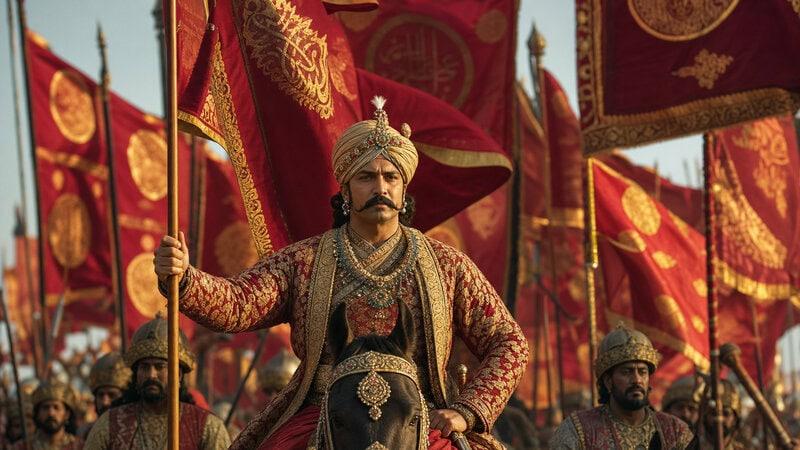

The dust had not yet settled on the road south when the silks began to move. Akbar’s armies crossing into the Deccan carried dozens of standards overhead — rippling fish-shaped emblems, crescent-topped poles, banners dense with calligraphy catching the morning light — and not one of them was the Mughal flag. All of them were.
The Banner That Changed With Every Emperor

Here is the paradox at the heart of one of history’s greatest empires: the Mughal dynasty ruled perhaps 150 million people at its seventeenth-century peak, commanded armies that terrified Central Asia, and built monuments that still stop the breath — and it never settled on a single unified flag. No one emblem, no one design, no one piece of cloth that said this is the Mughal Empire to every subject from Kabul to Bengal.
For most readers shaped by the modern assumption that empires come with flags the way nations come with anthems, this feels like an oversight. It was not. The plurality of Mughal standards was a considered feature of imperial rule — a visual language sophisticated enough to speak differently to every audience that saw it. To understand why the Mughals never chose one flag is to understand how they held together a world of incompatible faiths, languages, and conquered kingdoms for more than three centuries.
The key to that language is a word worth knowing: the alam (علم). Usually translated as “standard” or “banner,” the alam was something far more loaded than cloth on a pole. It was power made visible — a mobile throne, a devotional object, and a military nerve centre all at once. Any serious exploration of Mughal imperial history begins here.
What We Mean When We Say ‘Mughal Empire Flag’
Type the phrase into any search engine and you will find confident images — a green field, a golden disc, a crescent — presented as the Mughal flag. Most of these are reconstructions, regional variants, or symbols from one specific reign lifted out of context and given a false universality. The honest historical record, as documented in the Wikipedia entry on the flags of the Mughal Empire, is unambiguous: the empire used a number of imperial flags and standards, not a single unified flag.
The alam was the closest thing to an official imperial standard — the principal symbol representing the authority of the Timurid Emperor of Hindustan. But “principal” did not mean “exclusive.” The alam coexisted with an entire ecosystem of subordinate banners, ceremonial standards, provincial emblems, and battle flags, each carrying its own context and audience.
The sheer variety becomes tangible when you examine the surviving visual record. The Wikimedia Commons category for Mughal Empire flags contains sixteen distinct files — sixteen different answers to the question of what the dynasty’s standards looked like. Each represents a real, documented standard or emblem from across the dynasty’s history. Taken together, they do not suggest confusion. They suggest a system.
Roots in the Steppes: The Timurid and Mongol Inheritance

To understand why the Mughals thought in plurals about their symbols, you have to go back before Hindustan — back to the wind-scoured steppes of Central Asia where the dynasty’s ancestors learned what a banner actually meant.
The Mughals were Timurids: descendants of Timur (Tamerlane) through one line and of Chinggis Khan through another. Their inheritance was nomadic and militant, and in nomadic Turkic-Mongol culture, the standard was not decorative. It was the ruler’s surrogate presence on a battlefield stretching for miles. The tugh — a standard made from horse-tails mounted on a pole — was carried by Turkic and Mongol commanders as a mark of rank and of heaven’s sanction. To lose the standard was not merely to lose a flag; it was to lose proof that divine favour backed your cause.
Babur, who founded the Mughal dynasty after his decisive victory at the First Battle of Panipat in 1526, carried this tradition into Hindustan. But he did not arrive at a blank canvas. The Delhi Sultanate had its own visual traditions. Rajput clans had their own banners and clan insignia, some ancient beyond traceable memory. Babur and his successors layered their Central Asian symbolism onto these existing vocabularies rather than erasing them, and the result was a visual culture that was hybrid from its very first generation. Mughal imperial history is, at its core, a story of synthesis, and the banners told that story before the chronicles did.
The Alam: Power Made Visible

Picture the alam in the field. It was tall — sometimes dramatically so — mounted on a long pole and carried by a dedicated standard-bearer who occupied one of the most dangerous positions in any Mughal army. Enemies knew precisely what the alam signified, which meant they targeted it. To capture the imperial standard was to symbolically sever the emperor’s authority on the field. Standard-bearers died in numbers that the chronicles record with a particular kind of grief.
The alam’s form shifted from reign to reign, reflecting each emperor’s aesthetic and theological preoccupations. Akbar, always the most restless intellect among the Mughals, experimented with cosmological Persian imagery in his standards — the sun, the cosmic fish, symbols drawn from a visual vocabulary that reached across the Islamic world and into Hindu and Jain astrological tradition. His religious experimentalism, visible in his patronage of multi-faith court debates, surfaced even in the imagery flying above his armies.
Shah Jahan, builder of the Taj Mahal and the most aesthetically refined of the emperors, drew the standards toward Quranic calligraphy and encrusted luxury — gold thread, precious stones, Arabic script fine enough to require reading at close range. His standards were as much objects of beauty as instruments of authority.
There is also a spiritual dimension that no purely military reading can capture. The alam is a sacred object in Shia Islam, used in the commemoration of the martyrdom of Husayn ibn Ali at Karbala. The Mughal court was officially Sunni, but its Persian cultural inheritance was deeply inflected with Shia aesthetics, and the alam carried that resonance too. When subjects saw the imperial standard, they were not reading a simple logo. They were receiving a signal dense with political, religious, and cosmological meaning — meaning that could shift depending on who was looking.
A Different Standard for Every Occasion: The Genius of Deliberate Plurality

The Mughals used different standards for war, for river processions, for court ceremony, for provincial governance. This was not administrative messiness. It was calibrated communication.
Consider the political mathematics. A Hindu Rajput chieftain marching under a Mughal campaign banner needed to see something that acknowledged his martial honour — the shared aesthetic of cavalry and conquest, the visual grammar of a warrior culture he recognised. A Persian-speaking courtier reading calligraphic standards across a Diwan-i-Am audience hall was receiving a signal about cultural sophistication and Timurid legitimacy. A provincial governor hoisting a Mughal emblem above a distant fort was asserting imperial presence to a population that might never see the emperor himself. One flag could not accomplish all of this. Sixteen — or sixty — could.
The Mughal symbols that appear most consistently across the dynasty are worth naming precisely. The mahi-maratib, the fish emblem, was among the highest honours the emperor could bestow and appeared on standards granted to favoured nobles and allied rulers. The crescent carried obvious Islamic resonance but also connected to older Turkic astral traditions. The sun motif, especially prominent during Akbar’s reign, gestured toward Persian kingship imagery and simultaneously toward the solar symbolism running through Hindu and Jain cosmologies — a deliberate ambiguity in a religiously plural empire.
In the same decades, European polities were moving in precisely the opposite direction. English heraldry, Spanish royal arms, and the emerging concept of the national flag were all trending toward rigidity — fixed, codified, non-negotiable symbols of bounded political identity. The Mughal approach looked chaotic by comparison. It was, arguably, more sophisticated. Fixed symbols work when a population shares enough common identity to read them the same way. The Mughals ruled a subcontinent that shared almost nothing of the kind. Flexibility was not weakness; it was the only approach that made sense.
The Symbols Emperor by Emperor: A Brief Survey

Looking at the dynasty reign by reign sharpens the picture considerably and corrects the flattening that single-image searches produce.
Babur (r. 1526-1530) brought Timurid standards into Hindustan — relatively simple by later Mughal standards, rooted in the military pragmatism of a commander still consolidating territory. The visual vocabulary was Central Asian: geometric forms, the Islamic crescent, the practical requirements of a campaigning army.
Akbar (r. 1556-1605) represents the most visually ambitious period. His standards incorporated the sun disc, cosmic fish imagery, and a syncretic range of symbols reflecting his court’s extraordinary religious diversity. Akbar’s standards were designed to speak across religious boundaries, and the surviving Mughal miniatures from his reign — particularly those in the Akbarnama — document standards in field use with unusual detail.
Jahangir (r. 1605-1627) inherited Akbar’s syncretic instincts but expressed them through a more naturalistic aesthetic. His court produced some of the finest Mughal miniature painting, and his standards reflect the period’s obsession with precise representation — animals, flowers, and Quranic verses rendered with equal care.
Shah Jahan (r. 1628-1658) shifted emphasis toward architectural grandeur and Quranic piety in his visual culture. Standards from this period lean heavily on calligraphic beauty and precious materials. The mahi-maratib fish standard reached its most elaborate form under his patronage.
Aurangzeb (r. 1658-1707) stripped much of the syncretic visual vocabulary away. His religious conservatism, well documented in his own court records, reduced the cosmological experimentation and solar motifs that had characterised earlier reigns. The standards of his period are more austere, more narrowly Islamic in reference — a visual expression of the same impulses that led him to reimpose the jizya tax and restrict non-Islamic court culture.
Decline, Dissolution, and the Flag That Never Became National
By the time Aurangzeb’s long reign ended with his death in 1707, the empire’s political coherence was already fracturing. Regional successor states — the Nawabs of Awadh, the Nizam of Hyderabad, the Maratha confederacy — began asserting their own banners with increasing confidence. The Mughal emblem above provincial forts meant less with each passing decade, not because the symbols had changed but because the power behind them had drained away.
The final chapter is the most poignant. By the early nineteenth century, the last Mughal emperor, Bahadur Shah Zafar, held court in Delhi’s Red Fort under standards that commanded, in practice, almost no territory beyond its own walls. The symbols had outlasted the power they once represented — the way a great bell keeps ringing after the hand that struck it has withdrawn.
Then came 1857. The British did not simply defeat the last Mughal emperor in the aftermath of the uprising; they systematically dismantled his symbolic infrastructure. Court regalia, standards, the material culture of Mughal legitimacy: much of it was deliberately destroyed or dispersed. To erase the symbols was to erase the claim, and the British understood that perfectly.
But notice what never existed to be destroyed: a single Mughal national flag. Unlike the British Raj, which planted the Union Jack as an abstracted symbol of sovereignty capable of outlasting any individual monarch, the Mughals had built their symbolic system around the person of the emperor — his specific alam, his fish emblem, his particular grants of honour. When the emperor lost power, the symbols lost their anchor. There was no flag to keep flying, because the flag had always been the emperor himself, made visible in silk and gold.
Why It Still Matters: Reading Flags as History
The story of the Mughal dynasty’s banners is ultimately a story about what flags actually do — and the answer is more complicated than identity. A flag is a claim. It is a promise. It is a negotiation with every person who sees it: an assertion about who holds power and why that power deserves acceptance.
The Mughals understood this with unusual clarity. They knew that the same claim, made in the same visual language, would land differently on a Rajput warrior, a Shia courtier, a Bengali merchant, and a Kashmiri peasant. So they did not make the same claim in the same way. They made many claims, in many visual languages, calibrated to many audiences. What looks like branding inconsistency was, in practice, an act of sustained imperial intelligence.
Common search results that offer a single green-and-gold image as “the Mughal flag” are not wrong because the image is invented — many such images reflect real historical emblems — but because they imply a uniformity that the historical record firmly contradicts. The sixteen distinct files in a public digital archive, each representing a different standard from across three centuries of rule, are not evidence of a dynasty that failed to get its symbolism in order. They are evidence of a dynasty that understood symbolism well enough to know when reducing everything to a single image would be a failure of imagination.
Those silks above Akbar’s armies, rippling south toward the Deccan in the dust and morning light, were not confusion flying overhead. They were confidence — the confidence of an empire so fluent in the art of ruling across difference that it did not need one flag to bind them all, because it already possessed something harder to capture and impossible to burn: the ability to mean something different, and something true, to everyone who looked up.

 Arabic
 French
 Spanish
 Portuguese
 Deutsch
 Turkish
 Dutch
Dutch
 Italiano
 Russian
 Romaian
 Portuguese (Brazil)
 Greek
Greek