


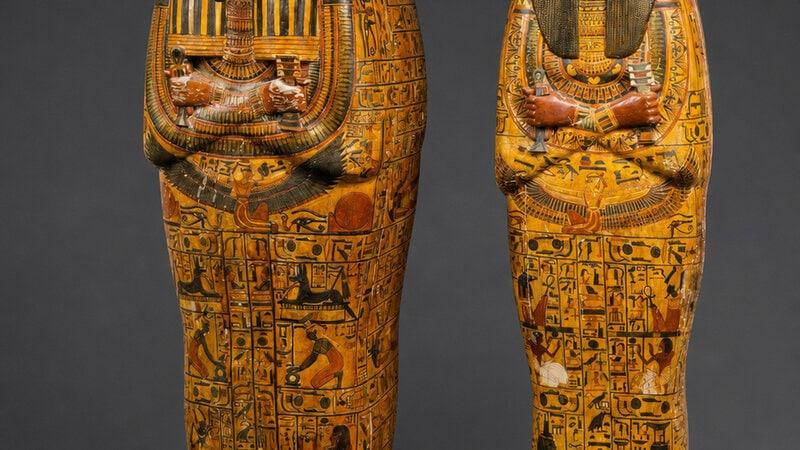

Imagine a tomb worker in roughly 2055 BCE, pressing a lid down onto a freshly painted wooden shell in the darkness of a Theban shaft tomb. He is not closing a box. He is closing a face — calm, golden-eyed, crowned with a gleaming black wig — and that face will spend eternity staring at the ceiling of the earth, waiting for something to come home to it.
A Shape That Was Never Just Decoration

The question most people ask when they first encounter an ancient Egyptian human-shaped coffin is an aesthetic one: why go to all that trouble? Why carve arms, model a chin, paint kohl-dark eyes onto what is, functionally, a container? The answer Egyptologists have assembled over the past two centuries is far stranger and more compelling than artistic preference. The shape was not ornamental. It was theological — a matter of life and death in the most literal sense the ancient Egyptians could manage. Specifically, it was a defense against the second death: the permanent annihilation they feared above all else.
The word anthropoid derives from the Greek anthrōpoeides, meaning “having the form of a human.” When Egyptians began producing anthropoid coffins during the Middle Kingdom, they were not borrowing a Greek philosophical concept. They were independently arriving at a radical conclusion: that the human shape itself was the most powerful possible container for a soul. Understanding why requires stepping back to a time when Egyptian coffins looked nothing like people at all.
Before the Body Shape: Egypt’s Rectangular Past

Through the Old Kingdom — roughly 2686 to 2181 BCE — Egyptian coffins were plain rectangular chests. Some were decorated with a pattern Egyptologists call the “palace façade,” a design of recessed paneling that mimicked the mud-brick walls of elite architecture. This was not laziness or poverty of imagination. It reflected a precise theological belief: after death, the soul did not inhabit the body so much as it inhabited sacred space. The tomb was the eternal house, the coffin was a room within that house, and decorating coffins as architecture made perfect sense within that framework.
To understand what changed, two Egyptian concepts are essential: the ka and the ba. The ka was something like a life-force or spiritual double, created at birth alongside the physical body and sustained after death by offerings of food and ritual attention. The ba was subtler and stranger — closer to what we might call individual personality or soul, depicted in Egyptian art as a human-headed bird, capable of flight and movement, able to travel between the world of the living and the realm of the dead. Every night, according to Egyptian belief, the ba had to return from its wanderings and reunite with the mummified body. If it could not find the body — if the body was destroyed, stolen, or rendered unrecognizable — the deceased suffered the second death: not the death of the physical body, which had already occurred, but the permanent death of the soul. Complete erasure. The end of a person in every sense that mattered.
For much of the Old Kingdom, this system was administered at the state level. Funerary cults sustained by royal decree maintained elite tombs and ensured the rituals that kept the ka fed and the ba oriented. Then, around 2181 BCE, the Old Kingdom collapsed. The First Intermediate Period — roughly 2181 to 2055 BCE — brought political fragmentation and the dismantling of those centralized afterlife systems. Egyptians with pretensions to immortality suddenly needed a portable, personal solution: something that could protect and identify them regardless of whether a royal cult was still functioning three generations later. That need is what turned the coffin from a room into a person.
The Theological Engine: Recognition and the Second Death

The logic underlying the anthropoid coffin is, once grasped, almost shockingly practical. If the ba needed to recognize the body in order to reunite with it, then the safest possible body was one that looked unmistakably like the person who had died. The mummy itself could be damaged — by floods, tomb robbers, or the simple entropy of millennia. But if the coffin was shaped and painted as the deceased, bearing that person’s face, their wig, their hands folded across the chest in the posture of divine rest, then it functioned as a backup body — a guaranteed landing pad. Even if the mummy crumbled to dust, the ba circling in the darkness above the burial chamber would see a human face, recognize it as home, and descend.
An earlier expression of the same instinct appears in Old Kingdom tombs: the “reserve head,” a sculpted portrait head placed near the body, its features calm and individualized, apparently intended to ensure recognition if the actual skull was damaged or displaced. Reserve heads and anthropoid coffins are separated by centuries, but they are driven by the identical fear — that the soul might lose its address — and the identical solution: provide a face it cannot mistake.
What changed with the anthropoid coffin was scale and integration. The face was no longer a supplementary object placed beside the body. It became the body’s container. The coffin did not merely hold the deceased; it became an additional body for the deceased. This is why the faces on these coffins are idealized rather than strictly realistic — serene, smooth-browed, wearing the blue-black wig associated with divine figures. They needed to be legible not only to the returning ba but to the gods of the underworld, who would judge the dead. The painted face had to speak two languages simultaneously: I am this specific human person, and I have already been transformed into something divine.
The Middle Kingdom Revolution: Nesting the Cosmos

By the Middle Kingdom, beginning around 2055 BCE, the first true anthropoid coffins were being produced — inner shells of cartonnage (layers of linen stiffened with plaster and then painted) fitted inside rectangular outer coffins. The body-shaped inner form sat nested inside the architectural outer form like a seed inside a house, the old theology and the new one coexisting in a single burial assemblage.
The colors were not chosen for beauty alone. The blue-black dominant in the wigs painted on these cases was the color of the Nile flood — the annual inundation that turned the desert green and represented renewal and resurrection. To paint the deceased with a blue-black wig was to wrap them in the visual language of rebirth. Every pigment choice was a theological statement.
The Coffin Texts — spells and incantations inscribed inside and sometimes on the exterior of these cases — turned the coffin into a complete cosmological landscape. The base of the coffin represented the earth. The lid represented the sky. The body of the deceased, lying between them, was suspended at the center of the cosmos, participating in the fundamental structure of existence. The coffin had ceased to be furniture. It had become a universe in miniature, with the dead person at its center as its organizing principle.
Inscriptions from this period begin identifying the coffin’s occupant directly with Osiris — “Osiris Amenhotep,” “Osiris Sathathor.” The dead were not merely placed inside a container associated with the god of resurrection. They were declared to be Osiris, and the coffin shaped around them was simultaneously their body and his. The merger of identity between deceased human and resurrected god was encoded into the coffin’s physical form at the most literal level.
New Kingdom Elaboration: Gilded Shells and Nested Identities

The New Kingdom, spanning roughly 1550 to 1070 BCE, took these principles to their most iconic expression. Elite burials now featured multiple nested anthropoid coffins — one inside another, each progressively more elaborate and gilded, each representing a different layer of divine identity for the deceased. The innermost coffin of Tutankhamun, recovered by Howard Carter’s excavation team in 1922, remains perhaps the most famous example: a shell of solid gold weighing approximately 110 kilograms, the young king’s face rendered in a material that does not tarnish and refuses to let the face be forgotten.
Each layer in a nested set carried distinct symbolic meaning. The outermost coffin might represent the body of Osiris at rest within the earth. The middle coffin might represent the sun god Ra traveling through the underworld during the twelve hours of night. The innermost might represent the transfigured spirit — the akh, the luminous and effective soul — on the threshold of rebirth into the eternal dawn. A single mummy held three cosmic identities simultaneously, and three coffins gave each identity its own dwelling.
Across the lids of New Kingdom anthropoid coffins, winged figures spread their arms — the sky goddess Nut, or Isis, whose outstretched wings in Egyptian iconography signified protection, shelter, and divine embrace. The coffin was not merely a container. It was a permanent act of sheltering: the goddess’s arms locked around the dead for eternity, the shape of a human body expressing the care of a cosmic mother holding her child against the dark.
Who Got One: The Gradual Democratization of Immortality

In the Old Kingdom, elaborate coffins were exclusively royal or near-royal. The technology of the afterlife was effectively a state monopoly. By the Middle Kingdom, a rising class of officials, soldiers, scribes, and skilled craftsmen had begun commissioning their own anthropoid coffin cases, and workshops responded by developing something recognizable to any modern consumer: a standardized product with personalization options. Coffin forms were produced with blank cartouches, pre-painted standardized spell sets, and space for the buyer to commission a specific face and add their name and titles. Immortality had become, in a meaningful sense, transactional.
At the lower end of the economic scale, families who could not afford wood or cartonnage sometimes wrapped their dead in painted linen shrouds molded to the contours of the face — a budget anthropoid form, modest in cost but theologically equivalent in ambition. The face, the human shape, the recognizable individual: these were the minimum viable requirements, and Egyptians across every economic tier understood it. The demand was not driven by fashion. It was driven by terror of the second death and faith that the human shape held the answer.
This democratization represents one of ancient Egypt’s most significant social transformations in the funerary sphere. Death became an equalizer not through poverty but through aspiration. Everyone — soldier, scribe, craftsman, minor official — wanted the same divine second body. Everyone wanted the ba to find its way home.
What “Anthropoid” Actually Means — and Why the Name Fits
The term anthropoid is used across multiple disciplines today — in robotics, primatology, and science fiction — but its application to Egyptian coffins carries a precision those other uses rarely match. An anthropoid robot is human-shaped for ergonomic or social reasons. An anthropoid coffin was human-shaped for reasons its makers considered a matter of cosmic survival. The word fits not because the coffin resembles a person incidentally, but because resembling a person was the entire point and the entire function.
It is worth noting that ancient Egyptians had no single word equivalent to our term “anthropoid coffin.” Modern Egyptologists apply the Greek-derived label retrospectively to describe the coffin type by its defining visual characteristic. The Egyptians themselves referred to coffins by terms relating to protection and containment — the coffin as fortress, as womb, as divine body. The Greek label captures the shape; the Egyptian concepts capture the purpose. Both are necessary to understand what these objects actually were.
The Instinct That Never Left
Return to that tomb worker in 2055 BCE, pressing down that golden face in the darkness. He was not finishing a decorating job. He was completing an engineering project — building a body that could not rot, could not be rendered unrecognizable, could not lose its claim on a wandering soul. The anthropoid coffin was a solution to a specific and terrifying problem, and its shape was the answer: look like a human being, and a human being cannot entirely disappear.
We have never entirely stopped believing this. Photographs pressed into headstones, lifelike bronze statues erected over graves, death masks made of famous faces — the instinct that the Egyptians formalized and systematized, the conviction that a recognizable face keeps someone present, has persisted through every subsequent memorial culture. We still build faces over our dead because we still feel, somewhere below conscious reasoning, that the shape of a person is the most powerful argument against their disappearance.
The word anthropoid — human-formed — names exactly what ancient Egyptians built when the stakes were highest. Not human-shaped for beauty’s sake. Human-shaped because the form of a human being was, in their understanding, the universe’s most reliable container for a soul, the one shape a wandering spirit could not mistake and could not pass by. The coffin was a theological instrument, and its blade was a face.
Picture the ba one last time — that human-headed bird, circling in absolute darkness above a painted face, descending, landing, folding its wings. The dead person is recognized. They persist. They have not been lost. That is what the coffin was engineered to make possible, and understanding it changes the way you look at every golden face that has ever stared upward from the floor of a museum display case — not as art, exactly, but as a door, left carefully open.

 English
 Arabic
 French
 Spanish
 Portuguese
 Deutsch
 Turkish
 Dutch
Dutch
 Italiano
 Russian
 Romaian
 Portuguese (Brazil)