


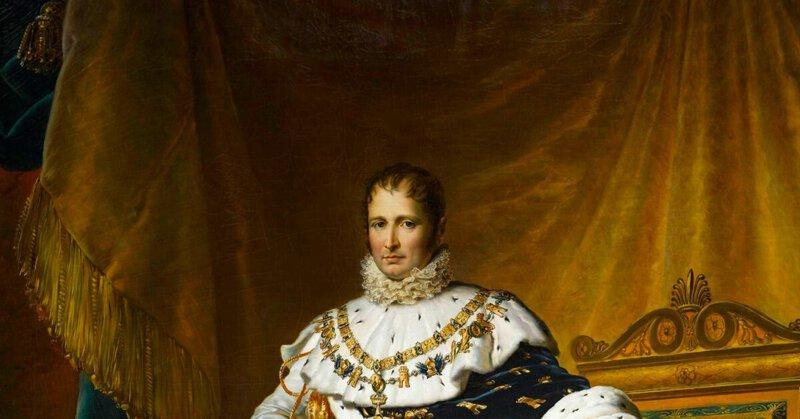
On a muddy road in northern Spain, in the chaos following the Battle of Vitoria on 21 June 1813, soldiers from Wellington’s army cracked open an abandoned baggage train and found themselves staring at a king’s ransom: Spanish royal silverware, paintings attributed to Velázquez and Correggio, crown jewels, and gold plate — the accumulated spoils of a five-year reign, tumbling into the dirt as the man who had called himself King of Spain galloped away into France. The fleeing monarch was Joseph Bonaparte, a Corsican-born lawyer who had never sought a throne and, on the evidence of that desperate flight, was not entirely sorry to be rid of one.
The Elder Brother in Napoleon’s Shadow

Joseph Bonaparte was born on 7 January 1768 in Ajaccio, Corsica, which made him Napoleon’s eldest surviving brother and, by the customs of the time, the nominal head of the Bonaparte family. The irony embedded in that fact never quite dissolved: Joseph held seniority by birth, yet he spent his entire adult life as a satellite orbiting a younger brother who burned with the intensity of a sun.
Where Napoleon channelled his restless ambition into military campaigns and the reshaping of empires, Joseph took a quieter path. He trained as a lawyer in France, developed a genuine love of literature and diplomacy, and showed throughout his early career that he preferred salons to battlefields. He served as a French diplomat in Rome during the late 1790s and played a significant role negotiating the Treaty of Mortefontaine with the United States in 1800 and the Treaty of Lunéville with Austria in 1801 — achievements that demonstrated real diplomatic skill and gave him a measure of independent standing before Napoleon began moving him across the chessboard of European thrones.
He was affable, widely read, and politically moderate: a man of the Enlightenment who believed that reasonable reform, patiently applied, could win over even hostile populations. These were admirable qualities in a statesman and almost entirely the wrong qualities for a king installed by force in an occupied country.
Joseph understood this about himself, at least dimly. He was not without ambition, but his ambitions ran toward comfortable authority, intellectual companionship, and the pleasures of a well-stocked library. Napoleon’s ambitions ran toward remaking the map of Europe, and Joseph, whether he liked it or not, was a piece on that map.
A Dress Rehearsal in Naples (1806-1808)

The first move came in 1806. Napoleon had been systematically placing family members and loyal marshals on the thrones of Europe — a project that would, by 1808, see Bonaparte siblings or their proxies ruling in Holland, Westphalia, and Naples, turning the continent into something resembling a family business. Joseph was handed the Kingdom of Naples, displacing the Bourbon dynasty that had ruled there for decades.
In Naples, something surprising happened: Joseph was genuinely effective. He abolished feudalism, modernized the legal code along French lines, reorganized the tax system, and made serious efforts to improve the administration of a kingdom that had been badly governed for years. He suppressed brigandage that had long plagued the countryside and restructured the university in Naples. He tried to win his subjects over through reform rather than repression, and while Naples never fully embraced its imported monarch, the arrangement achieved a working stability. Joseph found something close to contentment there — which made Napoleon’s next decision feel, to Joseph, like a punishment dressed up as a promotion.
As Britannica’s account of Joseph Bonaparte notes, his Neapolitan reign gave him real administrative experience and a model of reforming kingship he would try, with far less success, to transplant to Spain. The pattern was established: Napoleon imposed kings across Europe, and those kings were expected to make French-style modernity palatable to populations that had not asked for it.
King of Spain and the Indies — A Crown of Thorns (1808)

In the spring of 1808, Napoleon compelled the Spanish Bourbon monarchs — Charles IV and his son Ferdinand VII — to abdicate at Bayonne and transferred Joseph from Naples to Madrid, declaring him King of Spain and the Indies. On paper, it was a spectacular elevation: an empire stretching from the Iberian Peninsula across the Atlantic to vast territories in the Americas. In reality, it was a poisoned gift.
Joseph arrived to find a country already in open revolt. The popular insurrection of 2 May 1808 in Madrid — the Dos de Mayo uprising that Francisco Goya would later immortalize in two celebrated paintings — had ignited the Peninsular War just weeks before Joseph set foot in his new capital. The Spanish people, fiercely Catholic, fiercely proud, and deeply suspicious of French intentions, refused to accept him. They called him Pepe Botella — Joe Bottles — in mocking pamphlets and street songs, a nickname implying he was a drunkard. The charge was not accurate, but it stuck, because it captured something true about how the Spanish viewed him: as an impostor, a French puppet wearing a stolen crown.
Joseph did find supporters. The afrancesados — Spanish liberals and intellectuals who hoped that French-style reform might modernize their country — saw in him a genuine opportunity for change. He promulgated the Statute of Bayonne in 1808, a constitutional document that formally abolished the Inquisition and feudal privileges and established a framework for representative government. He pursued the same reforming agenda that had served him reasonably well in Naples. But collaboration with the occupier tarred the afrancesados as traitors in the eyes of the guerrilla resistance, and Joseph’s association with them became a political liability rather than a source of legitimacy.
From the earliest weeks of his reign, Joseph grasped the impossible arithmetic of his position. He needed Napoleon’s army to hold the country; Napoleon’s army, with its brutal counterinsurgency tactics, guaranteed that the country would never accept him. He wrote to Napoleon laying out this contradiction with considerable clarity, at one point requesting permission to abdicate entirely. Napoleon, occupied with campaigns elsewhere, largely ignored him.
Five Years of War and Humiliation

The Peninsular War that defined Joseph Bonaparte’s years in Spain was fought simultaneously on several axes: Wellington’s British and Portuguese forces pressing relentlessly from Portugal; Spanish regular armies engaging the French across the peninsula; and tens of thousands of guerrilla fighters making every road, supply line, and courier route lethal. Napoleon himself described Spain as his “Spanish ulcer” — a wound that would not close, bleeding France of soldiers and resources throughout the conflict.
Joseph’s authority, in practice, rarely extended beyond the range of French cannon. He held Madrid when French forces were strong enough to hold it for him, but he was driven from his capital twice — first in August 1808 following the French defeat at the Battle of Bailén, and again in 1812 after Wellington captured the city — a humiliation that shredded any remaining pretense of legitimate kingship. A king who cannot remain in his own capital is not, in any meaningful sense, governing.
His letters to Napoleon during these years form a sustained and increasingly desperate argument: send more resources, grant more autonomy, provide a coherent strategy, or allow him to abdicate. Napoleon provided none of these things. The detailed biography at napoleon.org captures how thoroughly Joseph was caught between his brother’s demands and the realities of a country that rejected him at every level — militarily, politically, and culturally.
The reforms Joseph introduced during these years — restructuring the tax system, abolishing the Inquisition in practice as well as in law, attempting to modernize institutions — might, in different circumstances, have been remembered as progressive achievements. In the context of a brutal foreign occupation, they were rendered invisible. No population gives credit for good administration to an invader.
Vitoria, the Flight, and the Scattered Treasure

The end came swiftly and with a particular theatrical humiliation suited to the whole episode. On 21 June 1813, Wellington’s forces met the French army at the Battle of Vitoria in the Basque Country and shattered it decisively. Joseph’s reign ended not with a formal abdication or a negotiated peace but with a cavalry rout and a king fleeing by carriage through the Pyrenees.
The baggage train he left behind told the whole story of his five years in Spain. Soldiers who overran it found paintings from the Spanish royal collections, jewels, gold plate, royal correspondence, and silverware — objects Joseph had accumulated during his reign as custodian of the Spanish royal collections. Wellington’s troops looted the train comprehensively. A number of the paintings that fell into British hands were eventually presented to Wellington himself by Ferdinand VII after the war; they remain at Apsley House in London to this day. A silver chamber pot reportedly recovered from the baggage became a long-running regimental joke in the British army — a fitting emblem of how history remembers the losing side.
Joseph escaped across the Pyrenees into France, where Napoleon stripped him of his Spanish titles. Spain restored the Bourbon Ferdinand VII to the throne, and Ferdinand, with considerable enthusiasm, proceeded to reverse nearly every reform Joseph had introduced. The afrancesados who had collaborated with Joseph were driven into exile. The Inquisition was restored. It was as though the five years had never happened — except that the wounds they left in Spanish political life would take generations to heal.
The Galería de las Colecciones Reales offers a Spanish institutional perspective on Joseph’s complicated relationship with the royal collections and his broader legacy in the country he ruled but never governed.
Exile in New Jersey: A King Becomes a Country Gentleman

After Napoleon’s final defeat in 1815 and his exile to Saint Helena, Joseph Bonaparte faced the question of what to do with the rest of his life. He made the most characteristically Joseph decision available: he moved to the United States, settling in Bordentown, New Jersey, and styling himself quietly as the Comte de Survilliers.
Using wealth he had managed to remove from Europe — including diamonds he had carried out of Spain — Joseph purchased a substantial estate on the Delaware River, eventually expanding it to a sprawling 60 acres. He built a mansion, laid out gardens, stocked a library, and filled the house with European paintings and sculpture. He hosted American politicians, diplomats, and intellectuals, threw excellent dinner parties, and lived as a wealthy, charming émigré who seemed, at least on the surface, entirely at peace with the improbability of his situation. The former King of Spain and the Indies became a notable figure in the early American republic, acquainted with men including John Quincy Adams and Henry Clay.
There is something almost liberating in the image. Joseph had spent decades as Napoleon’s instrument — moved from Corsica to Paris, from Paris to Naples, from Naples to Madrid — and now, for the first time, he was living on terms of his own choosing, in a country that found him interesting rather than threatening. As Shannon Selin’s detailed account of Joseph’s American years explores, his life in Bordentown was genuinely pleasant, and he appeared to cultivate real friendships rather than merely useful connections.
He remained in the United States until 1832, when he returned to Europe — living in London and then Florence — as changing political conditions made a European life feasible again. The Smithsonian has documented how Joseph’s New Jersey estate eventually passed out of his family’s hands and into the care of public preservation efforts — a physical remnant of one of the stranger episodes in the Napoleonic reordering of the world.
Death, Legacy, and What His Life Reveals
Joseph Bonaparte died in Florence on 28 July 1844 at the age of seventy-six, having outlived his younger brother by more than two decades. Napoleon had died on Saint Helena in 1821, a prisoner of the British Empire he had spent his career fighting. Joseph, the reluctant king, the diplomat who twice found himself ruling nations that did not want him, lived on into a very different Europe — one in which the Napoleonic settlement had been dismantled, its thrones redistributed, and its reforms either absorbed or reversed depending on where you looked.
His legacy resists easy summary. In Naples, his administrative reforms laid groundwork that his successor Joachim Murat built upon, and some historians credit the Neapolitan years with genuine, if partial, modernization. In Spain, his record is more contested: the reforms were real, but they arrived wrapped in foreign occupation and military violence, which made them impossible for most Spaniards to accept on their own terms. The afrancesados who had supported him paid for their collaboration with exile and ruin, and their fate cast a long shadow over Spanish liberal politics throughout the nineteenth century.
What makes Joseph Bonaparte’s life instructive is not that he succeeded — he did not, in any conventional sense — but that he understood, with unusual clarity and from very early on, why he was failing. He identified the structural contradiction of his position in Spain with precision: French military force was the only thing keeping him on the throne, and French military force was the primary reason the throne could not be made legitimate. He communicated this analysis to Napoleon repeatedly and was ignored repeatedly. He was a competent administrator placed in a role where administration was beside the point, governed by a brother who needed a loyal placeholder more than he needed an effective king.
He had been born in Corsica, trained as a lawyer, made a king in Naples, made a king again in Spain, driven from his capital twice, chased across the Pyrenees by Wellington’s army, and finally deposited in the American republic that Napoleon had indirectly strengthened by selling it Louisiana. In the long catalogue of improbable lives thrown up by the Napoleonic era, Joseph Bonaparte’s may be among the most instructive: not a story of triumph or unambiguous failure, but of a capable man caught inside forces far larger than himself — and shrewd enough to see it clearly, even when he could do almost nothing about it.

 Arabic
 French
 Spanish
 Portuguese
 Deutsch
 Turkish
 Dutch
Dutch
 Italiano
 Russian
 Romaian
 Portuguese (Brazil)
 Greek
Greek