


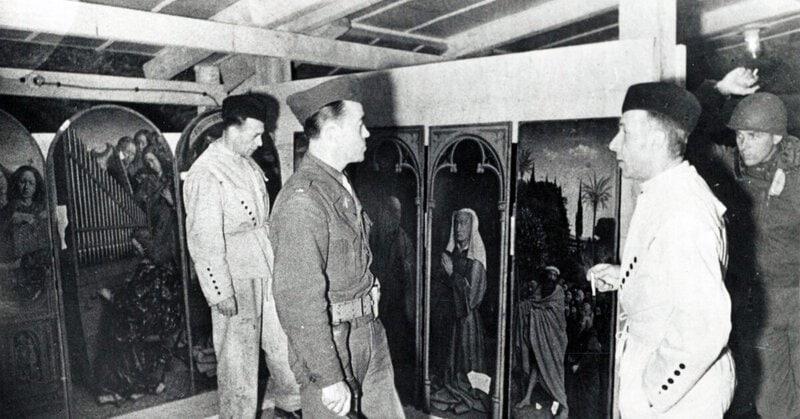
In the final weeks of World War II, deep inside an Austrian salt mine, American soldiers stepped into a chamber stacked floor to ceiling with some of the most important paintings in human history — Michelangelo’s Bruges Madonna, panels from Jan van Eyck’s Ghent Altarpiece, thousands of canvases destined for a museum that would never be built. That they survived at all is one of the war’s most unlikely stories. That most people have never heard the full version is exactly why Robert M. Edsel sat down to write The Monuments Men.
A Question on a Florentine Bridge

Edsel was living in Florence, surrounded by Renaissance masterworks, when a deceptively simple question stopped him cold: how did so much of the world’s greatest art survive the most destructive war in history — and who saved it? It sounds like idle curiosity until you start pulling on the thread. Edsel pulled hard. What followed was years of digging through declassified military records, veterans’ letters, personal diaries, and long-forgotten field reports, eventually producing — with co-author Bret Witter — The Monuments Men: Allied Heroes, Nazi Thieves, and the Greatest Treasure Hunt in History, published in 2009.
The book’s central argument is quietly staggering. A small, chronically underfunded group of curators, architects, and art historians — pulled from museum galleries and university lecture halls and handed uniforms — placed themselves between Hitler’s industrialized machinery of cultural theft and the permanent erasure of Western civilization’s visual memory. They operated with almost no authority, scarce resources, and a mandate that most military commanders considered a distraction from the business of winning the war.
When the 2014 film adaptation arrived, directed by George Clooney, it offered a crowd-pleasing ensemble adventure. Edsel’s book does something harder and more honest: it documents the full, morally tangled truth of what these people actually did, what they failed to do, and why both parts matter.
Hitler’s Dream Museum and the Machinery of Looting
To understand the Monuments Men, you first have to understand the ambition they were racing against. Hitler, who considered himself a serious painter and had nursed that self-image since his rejected applications to the Vienna Academy of Fine Arts, had blueprinted a vast cultural complex called the Führermuseum in Linz, Austria. It was to be a monument to himself and to German civilization, its galleries stocked with the greatest works Europe had produced — regardless of who currently owned them.
Nazi art looting was not opportunistic vandalism carried out by soldiers on the move. It was a bureaucratically organized, ideologically driven program of cultural annexation, administered by dedicated agencies with their own staff, cataloguing systems, and transport networks. Occupied France, Poland, the Netherlands, and Italy were systematically stripped of centuries of accumulated heritage. Entire trainloads of paintings, sculptures, tapestries, and religious artifacts moved into salt mines, medieval castles, and fortified depots — hidden from Allied bombs, carefully catalogued, and reserved for a triumphant future that never came.
Edsel reconstructs this machinery with documentary precision across the book’s early sections, and the effect is visceral rather than statistical. You feel the sheer industrial scale of the theft not as a number on a page but as an accumulation of individual objects, each with its own history, each removed from a place it had occupied for generations.
Six Men Against an Eleven-Month Clock

The book focuses tightly on a core group of six Monuments Men — soldiers and officers drawn from the museum and academic worlds — tracking them across the eleven-month window between D-Day in June 1944 and V-E Day in May 1945. Edsel and Witter follow them across multiple fronts simultaneously, cutting between freezing Belgian villages, bombed Italian hilltowns, and the chaotic final collapse of the Reich. The structure builds genuine narrative tension from the historical record, which is a harder trick than it sounds when readers already know how the war ends.
These men operated largely alone. A typical day might involve driving a jeep into newly liberated territory — sometimes ahead of full Allied control — to assess damage to a church or museum, question locals about what had been taken and where, and secure a building before opportunistic looters could strip what the bombs had spared. Those looters sometimes wore Allied uniforms. Edsel includes that uncomfortable detail alongside the heroism, and the book is better for it.
The book also makes genuine space for the women in the story — researchers, archivists, and intelligence officers whose contributions were systematically minimized in popular memory and largely absent from the film adaptation. Edsel restores each major figure’s distinct biography, professional expertise, and moral weight. By the time you are deep into the narrative, you understand completely why a middle-aged art historian would ship out to a war zone. You understand it in your bones.
For readers who want to go deeper into the documented record, the book’s Wikipedia entry provides a useful overview of its structure and critical reception, and the National WWII Museum has produced supplementary material on the Monuments Men’s mission that complements Edsel’s account.
The Salt Mines: History’s Most Extraordinary Discoveries

The book’s most cinematic sequences — and they are genuinely cinematic on the page in a way the film only partially managed — cover the discovery of Nazi depot caches in the war’s final weeks. The crown jewel was the Altaussee salt mine in Austria, where the humidity of the underground chambers had been preserving some of the most important objects in European art history while Germany burned above ground.
Inside Altaussee: Michelangelo’s Bruges Madonna. Panels from Jan van Eyck’s Ghent Altarpiece. Thousands of paintings destined for the Führermuseum, stacked in cool corridors carved from ancient salt. Edsel builds these discovery scenes with the pacing of a thriller, but he never lets the reader forget the human texture surrounding them. Local Austrian miners — not generals, not liberating armies — had already quietly removed Nazi demolition charges from the stored artworks, defying orders from a fanatical local Nazi official to destroy everything rather than allow it to fall into Allied hands. That detail, compressed almost to invisibility in the film, lands with full force in the book.
These recoveries, extraordinary as they were, represented only a portion of the total plunder. The full accounting of wartime stolen art remains one of history’s largest unsolved property crimes, a fact Edsel does not soften or elide.
What the Book Finds That the Film Leaves Behind

The film collapses the story into a satisfying arc with a clean ending. The book refuses that comfort. Edsel details the agonizing ethical arguments the Monuments Men waged with Allied command over the strategic bombing of culturally significant sites — cathedrals, medieval bridges, ancient town centers — arguments that were never cleanly resolved and that cost lives. There was no formula for weighing a soldier’s life against a Romanesque church. The men who made those calls lived with the results.
Perhaps most importantly, The Monuments Men documents what happened after the guns fell silent: the years-long, still-unfinished process of returning looted art to its rightful owners. The legal and moral architecture of restitution is genuinely complex. Who owns a work taken from a Jewish family murdered in the Holocaust when no heirs survive? What institution has standing to claim an object looted from a country whose postwar borders bear little resemblance to its wartime ones? These are live questions in international courts today, and Edsel’s book is one of the reasons the general public knows to care about them.
A detailed reader review of the book captures well how the narrative balances these heavier themes with propulsive, character-driven storytelling — worth reading alongside the book as a gauge of how the history lands for a non-specialist audience.
Why Robert Edsel’s Research Still Matters

The Monuments Men is one of the most thoroughly sourced popular histories of the war’s cultural dimension, drawing on declassified military records, personal diaries, and direct interviews with surviving witnesses. But its influence extended well beyond the reading public. In its wake, museums accelerated their provenance research programs, and the renewed public attention the book generated contributed to broader momentum around restitution efforts for works with disputed wartime histories.
Edsel went on to found the Monuments Men Foundation for the Preservation of Art, which has continued working to identify and return looted works in the decades since publication. The book was never just a book. It was, from the beginning, an argument that this history had consequences still unfolding — and that getting the story right was itself a form of restitution.
For readers who want a physical copy with additional context, the National WWII Museum’s store carries an edition that connects the book directly to the institution most dedicated to preserving this history.
Who Should Read It
Readers who have found their way into narrative nonfiction through writers like Erik Larson — scene-built, character-driven, historically rigorous without being dry — will find Edsel and Witter working in precisely that tradition. The book rewards anyone curious about the intersection of art history, military ethics, and the genuinely difficult question of what a civilization decides is worth dying to protect.
It is also, quietly, one of the better books about institutional courage ever written: what happens when a small group of people decide that an enormous, unglamorous, bureaucratically thankless task is simply theirs to do, and then go ahead and do it with borrowed jeeps, insufficient authority, and the full knowledge that nobody important is paying attention.
Published in 2009, The Monuments Men has only grown more urgent in the years since. Art restitution battles continue in international courts. Provenance gaps in major museum collections continue to surface. The questions Edsel first encountered on a Florentine bridge have not been answered — they have multiplied. Which makes his book simultaneously a gripping World War II narrative and a live-issue document bound in cloth. That is an unusual combination. For any curious reader, it is also an irresistible one.

 English
 Arabic
 French
 Spanish
 Portuguese
 Deutsch
 Turkish
 Dutch
Dutch
 Russian
 Romaian
 Portuguese (Brazil)
 Greek
Greek