


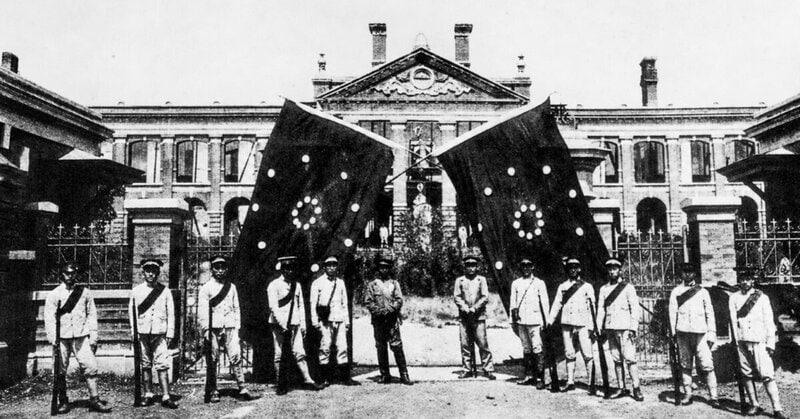
On the morning of October 9, 1911, a careless moment in a rented room in the Russian Concession district of Hankou changed the course of Asian history. A revolutionary preparing explosives intended for an uprising still days away made a critical error. The accidental detonation was small enough that it killed no one — but it was loud enough to bring Qing imperial police running. What they found inside that safe house would set two thousand years of Chinese imperial rule on a countdown to extinction.
The Accident That Triggered a Revolution

The men working in that Hankou safe house belonged to clandestine revolutionary networks preparing to strike against the Qing dynasty — China’s last imperial ruling house, which had governed since 1644. Their uprising had been carefully planned, timed for a moment when sympathetic soldiers inside the imperial garrison at nearby Wuchang would be ready to act from within. The accidental explosion shattered that timeline instantly. When police stormed the building, they recovered something far more dangerous than gunpowder: the membership lists. Names. Addresses. The identities of soldiers inside the imperial garrison who had pledged their loyalty to the revolutionary cause.
For those men on that list, the choice was brutal and binary. Surrender and face almost certain execution, or mutiny immediately — before Qing authorities could arrest them one by one. On the night of October 10, 1911, they chose to fight. Soldiers inside the Wuchang garrison rose up, seized the arsenal, and by dawn had taken control of the city. That date — the tenth day of the tenth month — would become known in Chinese history as the Double Tenth: the birthday of a republic no one had quite planned to found yet.
The dramatic irony is almost too neat for fiction. An imperial system that had weathered centuries of peasant rebellions, dynastic wars, and foreign invasions was not brought down by a mastermind or a manifesto. It was undone, at least in its final hours, by an accident and a membership list left in the wrong place at the wrong moment.
An Empire Already Cracking at Every Seam

To understand why a single garrison mutiny in a mid-sized city could topple an empire, you have to understand how thoroughly the Qing dynasty had already exhausted its authority before that explosion. China’s last imperial rulers — the Manchu Qing — had presided over a cascading series of humiliations across the nineteenth century. The Opium Wars forced open Chinese ports and markets to British commercial power. The First Sino-Japanese War of 1894-95 stripped away Taiwan and shattered the illusion of Qing military competence, exposing the empire’s weakness to a neighbor China had long regarded as a cultural satellite. The Boxer Uprising of 1900, and the punishing Boxer Protocol that followed, left the government indebted to eight foreign powers and its capital briefly occupied by foreign troops.
Each defeat deepened a dangerous resentment. The ruling Qing were Manchu — an ethnic minority from the northeast who had conquered China in 1644 — and by the early twentieth century, Han Chinese reformers and revolutionaries increasingly framed imperial failure in ethnic terms. The Manchu rulers, in this telling, were foreign usurpers who had sold China’s dignity to Western and Japanese powers. Han nationalism was not merely a political movement; it was becoming a gut-level grievance that cut across class and region.
At court, the situation was no less precarious. The formidable Empress Dowager Cixi, who had dominated Qing politics for decades through a combination of political cunning and ruthless pragmatism, died in 1908 — leaving on the throne a child emperor named Puyi, who was not yet three years old at his accession. Reformers and conservatives were locked in institutional paralysis. A constitutional monarchy had been promised but not delivered. Revolutionary networks, many of them inspired by the nationalist and democratic ideals of Sun Yat-sen, had already attempted uprisings across southern China before 1911, each one failing but each one tightening the coil of what was coming.
As Britannica’s account of the Chinese Revolution of 1911-1912 describes it, the revolt that finally succeeded was a nationalist uprising that ended more than two millennia of autocratic imperial rule — but its success owed as much to imperial exhaustion as to revolutionary strength.
The Revolutionaries — Including the One Who Wasn’t There

No figure looms larger over the Xinhai Revolution than Sun Yat-sen, the physician-turned-revolutionary whose vision of a Chinese nationalist republic had inspired a generation of activists across China and among overseas Chinese communities worldwide. Sun had spent years in exile — fundraising, organizing, and surviving assassination attempts. He had failed repeatedly. He had kept going anyway, and his Three Principles of the People (nationalism, democracy, and people’s livelihood) gave the fractured opposition something resembling a shared ideological framework.
And on the night the Wuchang garrison mutinied, Sun Yat-sen was in the United States, reading about the uprising in a newspaper.
The revolution’s symbolic father missed its opening act entirely. The real decisions on the ground in those frantic October hours were made by local military officers and ordinary soldiers — men motivated by Han nationalist ideology, personal survival, and the particular electricity of a moment when the impossible suddenly seems not only possible but necessary. One of the most striking figures to emerge from the chaos was Li Yuanhong, a Qing brigade commander who, according to accounts of the uprising, was found hiding during the mutiny. He was brought forward and, precisely because he was not a committed radical and was therefore acceptable to competing factions, declared a leader of the rebel forces. The revolution elevated men not by design but by circumstance.
The 1911 Revolution was never one unified movement. It was a coalition of military men, secret society networks, overseas Chinese donors, and reformist intellectuals who agreed on almost nothing except that Qing rule had to end. That fractured quality would define everything that came after.
The Empire Dissolves Province by Province

What followed the Wuchang Uprising was less a military conquest than a political avalanche. Within weeks, province after province declared independence from the Qing. Local gentry, military commanders, and provincial elites — the people who actually administered China day to day — looked at the momentum of the rebellion, looked at the hollowed-out imperial court in Beijing, and made their calculations. They switched sides.
The speed of provincial defection stunned even the revolutionaries. It reflected not their organizational genius but the depth of the Qing dynasty’s collapse. Legitimacy, once it drains away quietly over decades, can disappear visibly in weeks.
The Qing court made what looked like a rational last gamble: recalling Yuan Shikai, a powerful general with a modern, well-trained army whom the court had previously forced into retirement, to crush the southern rebellion. Yuan accepted the commission — and then proceeded to negotiate with both sides simultaneously, dangling military force over the revolutionaries while making clear to the imperial court that he alone stood between them and oblivion. He was playing kingmaker, and everyone in the room knew it.
By late 1911, a north-south military stalemate had settled over China. Neither the remaining Qing forces nor the southern republican armies could deliver a decisive blow. The endgame, it became clear, would not be won on any battlefield.
For context on how foreign governments watched — and quietly calculated their own interests — as the old order crumbled, the U.S. State Department’s historical overview of the Chinese Revolution of 1911 offers a useful diplomatic perspective on the period.
The Republic Is Born — Already Under Strain

On January 1, 1912, Sun Yat-sen was inaugurated as provisional president of the Republic of China in Nanjing. After millennia of emperors, China had, at least on paper, a president. New political institutions were being assembled from scratch. For the republicans who had risked — and in many cases lost — everything for this moment, it was an extraordinary rupture with the past.
It was also, almost immediately, a compromise. The deal that formally ended the dynasty was transactional rather than triumphant. Sun agreed to step aside and hand the presidency to Yuan Shikai if Yuan could deliver the imperial court’s abdication. Yuan delivered. On February 12, 1912 — just over one hundred days after the accidental explosion in Hankou — the young Emperor Puyi’s abdication was announced, bringing the Qing dynasty to a formal close. China’s last imperial chapter, closing more than two thousand years of continuous imperial rule, ended not with a battle but with a negotiated document.
Yuan Shikai became president. And within years, he made unmistakably clear that he had no commitment to republican democracy. He moved to dissolve the parliament, suppress opposition, and in 1915 attempted to declare himself emperor of a new dynasty. The effort collapsed amid widespread military opposition, and Yuan died in 1916, leaving China to fracture into the warlord era — a period of regional military fragmentation that would grind on for the better part of two decades.
What the Revolution Broke, and What It Left Intact

The Xinhai Revolution — also known as the 1911 Revolution or the Chinese Revolution of 1911 — shattered something no previous Chinese rebellion had quite managed to break: the Confucian-imperial idea that heaven itself mandated one dynasty’s rule over all under heaven. The concept of popular sovereignty, however imperfectly realized in practice, replaced the mandate of heaven as the theoretical basis of legitimate government. That was a genuine rupture, philosophically and politically profound, and it permanently altered what Chinese political authority was understood to rest upon.
Han nationalism surged in the revolution’s wake. The uprising had been framed in significant part as the Han majority reclaiming China from Manchu Qing rule, and that ethnic framing reshaped Chinese political identity in ways that still echo — in debates about minority rights, about what “Chinese” means as a category, and about the relationship between ethnicity and national belonging.
What the revolution did not deliver was stable democratic governance. Sun Yat-sen’s republican ideals were overwhelmed almost immediately by warlordism, foreign pressure, and the ambitions of men with armies and no democratic commitments. The landlord class survived largely intact. Imperial bureaucratic culture persisted in new institutional clothing. The social hierarchies that had structured Chinese life for centuries did not dissolve because a republic was declared.
Historians continue to debate whether 1911 should be understood as a genuine revolution or primarily a regime collapse — a question examined in depth in academic analyses of the Xinhai Revolution’s democratic aspirations and their structural limits. The imperial system fell, but the deeper social and economic structures it rested on proved far more durable than the dynasty itself.
Why One Accidental Explosion Still Echoes
The fall of the Chinese empire set in motion consequences that run directly into the present. The Republic of China established in 1912 is the same government that today administers Taiwan, which claims 1911 as its founding revolution and observes Double Tenth Day as its national holiday. The People’s Republic of China on the mainland also claims the Xinhai Revolution as a necessary — if incomplete — precursor to the revolution that Mao Zedong’s Communist Party declared complete in 1949. The same historical event is read through entirely opposite political lenses by governments that each insist on representing the legitimate China.
And then there is Puyi — arguably the most haunted figure the revolution produced. After his abdication as a young child, he lived one of history’s most surreal lives: briefly and controversially restored to the throne in 1917 during a short-lived monarchist coup, later installed by Japanese forces as the puppet emperor of Manchukuo in the 1930s, captured by Soviet forces in 1945, and eventually imprisoned and subjected to re-education in the People’s Republic before being released to live as an ordinary Beijing citizen in his later years. His trajectory reads like an allegory for an entire world that ceased to exist.
The deeper lesson the Xinhai Revolution offers is about the nature of institutional fragility. The Qing dynasty appeared, from the outside, to be one of the world’s great permanent structures — an imperial system commanding the most populous nation on earth, with roots in a governing tradition stretching back more than two millennia. It dissolved in weeks, not because a master revolutionary outmaneuvered it, but because its legitimacy had quietly drained away over decades of military defeat, foreign humiliation, and failed reform until almost nothing structural remained.
Sometimes all it takes to bring down an empire is one accident at the wrong moment — and a membership list left where the wrong people can find it. For a broader exploration of these events and their historical context, Alpha History’s overview of the 1911 Xinhai Revolution provides an accessible and well-sourced starting point for further reading.

 English
 Arabic
 Spanish
 Portuguese
 Deutsch
 Turkish
 Dutch
Dutch
 Italiano
 Russian
 Romaian
 Portuguese (Brazil)
 Greek
Greek