


She was 71 years old, nearly deaf, and so frail she had to be helped to her feet — and on the morning her neighbors signed a petition swearing to her goodness, 39 of them put their names on paper in her defense. It did not matter. On July 19, 1692, Rebecca Nurse was led to Gallows Hill and hanged, and the town of Salem Village was left to reckon with what it had just done to one of its most beloved souls.
A Woman the Village Could Not Afford to Lose — and Lost Anyway

To understand why Rebecca Nurse’s execution struck Salem Village like a stone dropped into still water, you have to understand who she was before the accusations found her. She was not an outcast. She was not a quarrelsome widow living at the margins of respectability. She was a devout Puritan wife and mother of eight, a woman who had spent decades embodying the very virtues the community publicly worshipped: piety, steadiness, godly order, a quiet and unimpeachable life.
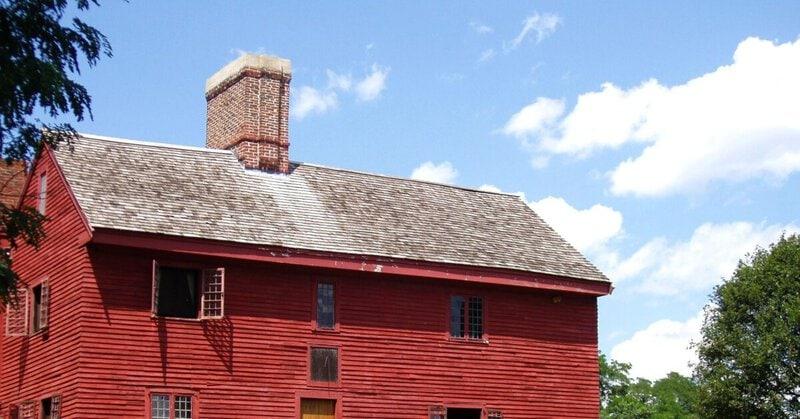
Francis and Rebecca Nurse had moved onto their farm on Pine Street in 1678, the same year the colonial house that still stands was built. The property originally stretched across roughly 300 acres — substantial land for the era, the kind of holding that marked a family as rooted, established, and serious. They were not newcomers. They were not strangers to anyone. They were neighbors in the fullest sense of the word.
But Salem Village in the 1690s was a community pulling apart beneath its outward piety. Land disputes simmered between prominent families. Smallpox had passed through. Political instability shadowed the Massachusetts Bay Colony following the revocation of its original charter. Underneath everything ran the Puritan theology of spiritual warfare — the sincere, bone-deep belief that the Devil was a real actor in the world, constantly seeking purchase in human souls. It was a community primed for paranoia, stretched thin between faith and fear, waiting for a spark.
The Accusation: When the Specter of a Saint Is Called Evil

The spark came in late February 1692, when a circle of young women in Salem Village began suffering fits — convulsions, visions, and screaming episodes that no one could medically explain and that the Puritan framework immediately translated as diabolical attack. The accusations started with the socially marginal: an enslaved woman from the Caribbean named Tituba, a homeless beggar named Sarah Good, and an elderly woman named Sarah Osborne. These were people the community could, with some mental effort, imagine as witches.
Then the circle widened. On March 23, 1692, Ann Putnam Sr. named Rebecca Nurse, claiming that Nurse’s specter had come to her in the night and tormented her. The accusation landed with particular force because of who was making it: the Putnam family and the Nurse family sat on opposite sides of some of the most bitter land and leadership disputes in Salem Village’s recent history. Personal grievance and supernatural accusation had merged into something nearly impossible to untangle, and in that merged state, it carried the full legal weight of evidence.
When Rebecca was brought before the magistrates for examination, the scene was almost unbearable in its injustice. She was barely able to hear the charges read against her. She struggled to follow the proceedings. When the afflicted girls performed their fits in the courtroom — crying out that her specter was tormenting them even as she stood there visibly unable to harm anyone — she could do little but protest her innocence in anguished, confused terms. The invisibility of the alleged crime was also its perfect defense against rebuttal. How do you disprove what no one else can see?
The community’s immediate response was, by the standards of the hysteria, remarkable. Thirty-nine of Rebecca Nurse’s neighbors signed a petition affirming her good character — a number that speaks to how morally destabilized her arrest made even people living inside the collective panic. These were not radicals or skeptics. They were Salem Village residents operating within the same Puritan framework as everyone else. They simply could not square what they knew of this woman with what they were being asked to believe about her.
The Trial That Should Have Ended Everything

The trial itself produced one of the most stunning moments in the entire history of the Salem witch trials: the jury returned a verdict of not guilty. For a brief instant, the machinery of accusation had broken down. Reason had, astonishingly, held.
It did not hold for long. The afflicted girls erupted in fresh fits at the announcement of the verdict. The presiding judge, clearly unwilling to accept the outcome, sent the jury back to reconsider a statement Rebecca had made during testimony — an ambiguous phrase that, under sufficient pressure, the jury reinterpreted as a confession of complicity. They returned a guilty verdict. The reversal illustrated with terrible clarity what the Salem witch trials were actually about: spectral theater had become more legally persuasive than character, community standing, and a jury’s own conscience.
Reverend Samuel Parris — whose own household had been the origin point of the entire crisis, and whose niece and daughter were among the first afflicted girls — read Rebecca Nurse’s excommunication from the church before her execution. That private doubt about her guilt, expressed by contemporaries to no one with the power to stop what was happening, represents one of the great moral failures of the episode: knowing something is wrong and remaining silent because the cost of speaking feels too high.
On July 19, 1692, Rebecca Nurse was hanged on Gallows Hill alongside four other condemned women. Historians of the Salem witch trials return to this day again and again as a turning point — the moment when the executions became too grotesque, too obviously unjust, for even the true believers to fully absorb. The machinery had consumed someone it could not plausibly justify consuming, and some part of the community knew it.
That night, her family did something that required enormous courage. Under cover of darkness, at personal risk in a community still gripped by fear, they recovered her body from the burial site on Gallows Hill and brought her home to the farm on Pine Street. They buried her there, in secret, on the land she had lived on for fourteen years. That act — quiet, defiant, and tender — is still commemorated at the homestead today.
The Rebecca Nurse Homestead: Where History Refuses to Be Abstract

There are historical sites that feel like museums, and then there are historical sites that feel like arguments. The Rebecca Nurse Homestead at 149 Pine Street in Danvers, Massachusetts belongs firmly to the second category. It sits on more than 25 acres of what remains of the original farm, located in what was historically known as Salem Village — the community that is now the town of Danvers, a distinction that matters because it separates the actual geography of the witch trials from the tourist-saturated modern city of Salem.
The circa-1678 colonial farmhouse at the center of the property is one of the oldest and most authentically preserved 17th-century house museums in New England. Step inside and the physical world reasserts itself with quiet insistence: low ceilings that speak to shorter lives and harder winters, wide-plank floors worn smooth by generations of feet, spare furnishings that leave no room for sentimentality about how difficult and disciplined this way of life actually was. This is the house Rebecca Nurse walked through every morning. This is where she prayed.
A granite monument on the grounds marks the approximate location of her burial — the secret grave her family dug for her while Salem Village slept. The Nurse family occupied this property from 1678 until 1798, generations of continuous family history embedded in the same soil, which gives the land a biographical density that most historical sites cannot match.
The homestead is owned and operated by the Danvers Alarm List Company, a local historical organization dedicated to keeping this story in full human focus rather than allowing it to flatten into myth. Guided tours of the house are available seasonally, along with access to the burial site, the memorial, and grounds that still carry the shape of a 17th-century New England farmstead. Visitor information, hours, and admission details are available at the homestead’s official website. Traveler reviews and practical planning resources can be found on the site’s TripAdvisor listing. For those mapping a broader journey through Salem witch trials history, the homestead serves as a natural anchor point for the region’s colonial geography. The homestead also maintains an active presence on Instagram for updates on events and programming.
Planning Your Visit

The Rebecca Nurse Homestead is located at 149 Pine Street, Danvers, Massachusetts, roughly a 20-minute drive from downtown Salem. The site is open seasonally, with guided house tours typically available from late spring through early fall. Visitors are encouraged to confirm current hours and admission fees directly through the official homestead website before making the trip, as programming and access can vary by season and special event schedules.
The grounds, burial site, and memorial are accessible during open hours without an interior house tour, making even a brief visit meaningful. Comfortable walking shoes are recommended, as the property encompasses more than 25 acres of historic New England farmland. The site draws visitors interested in colonial history, the Salem witch trials specifically, and 17th-century domestic architecture — and it rewards unhurried exploration far more than a quick stop on the way to Salem’s busier attractions.
For those pairing the homestead with other regional sites, the Salem Witch Museum also provides context on the homestead’s place within the broader trials geography, making it a useful starting point before the drive to Danvers.
Why We Keep Coming Back to Rebecca Nurse

Among all the Salem witch trial victims, Rebecca Nurse’s case has attracted sustained historical attention precisely because it revealed something the other cases allowed people to rationalize away. You could, if you were determined to believe in the proceedings, convince yourself that the earlier accused fit some profile of the diabolical. You could not do that with Rebecca Nurse. Her condemnation exposed the trial process as fundamentally broken — not flawed at the edges but rotten at the center. If a woman of her stature, her reputation, her documented community standing, and her obvious frailty could be condemned, then the system had abandoned any pretense of justice and become something else: a machine for confirming whatever the afflicted girls chose to accuse.
Massachusetts formally exonerated Rebecca Nurse and other victims over a process that stretched across generations, culminating in a 2001 act of the state legislature that cleared the names of all accused individuals. It was a symbolic reckoning — meaningful, overdue, and 309 years late.
Arthur Miller understood what Rebecca Nurse’s story contained. In The Crucible, his 1953 dramatization of the Salem witch trials, she appears as a figure of conscience and dignity — an embodiment of what the community destroyed in itself when it destroyed her. The play found in her case the clearest possible illustration of its central argument: that accusation is not proof, that fear is not justice, and that communities are capable of turning against the best among them when conformity to panic matters more than commitment to truth.
That argument has not aged. It keeps finding new occasions to be relevant. Which is perhaps why people still make the drive to 149 Pine Street in Danvers, walk the quiet acres, and stand in front of a granite marker bearing a name that the Commonwealth of Massachusetts once decided was an enemy of God. Standing there, on the land where she lived and where her family buried her by night with their hands and their grief, the history stops being a collection of dates and becomes what it always actually was: a story about a person who deserved better than what she got, a community that knew it, and hanged her anyway.

 Arabic
 French
 Spanish
 Portuguese
 Deutsch
 Turkish
 Dutch
Dutch
 Italiano
 Russian
 Romaian
 Portuguese (Brazil)
 Greek
Greek