


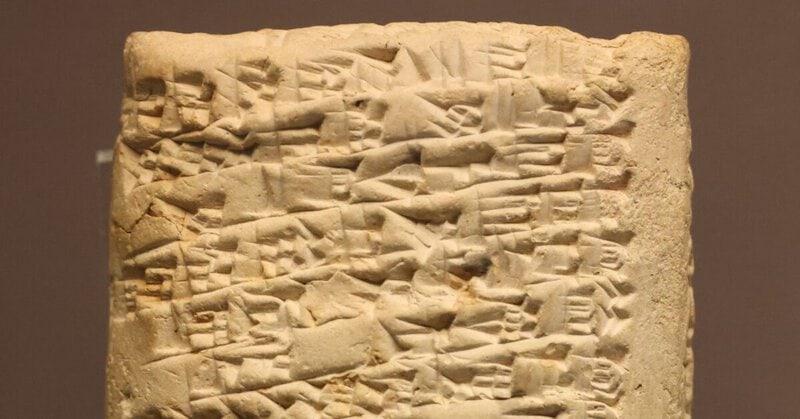
Somewhere around 1750 BC, a man named Nanni sat down in the ancient Mesopotamian city of Ur, picked up a reed stylus, and proceeded to write what may be the most satisfying piece of hate mail in all of human history — pressing his fury, word by meticulous word, into wet clay that would harden into permanence and survive nearly four millennia to make the rest of us feel deeply, immediately understood.
The Angriest Letter Ever Baked into Clay

The object in question is small enough to hold in one hand. Unassuming, sand-colored, covered in the wedge-shaped marks of cuneiform script — it looks, at first glance, like any of the thousands of administrative tablets the ancient Near East left behind. But this tablet, now held at the British Museum, is something far more extraordinary than a temple inventory or a king’s boast. It is the oldest known written customer complaint in human history, and it reads with a heat that 38 centuries have done absolutely nothing to cool.
Among all the things the ancient world chose to preserve — epic poetry, astronomical records, royal genealogies, hymns to gods — one man’s blistering grievance about substandard copper has become one of the most relatable artifacts ever pulled from the earth. Nanni’s words, pressed into clay nearly 3,800 years ago, read less like ancient history and more like a one-star review written in white-hot fury at two in the morning. The target of his wrath was a copper merchant named Ea-nāṣir. And Ea-nāṣir, it turns out, absolutely had it coming.
Meet Ea-Nāṣir: Bronze Age Merchant, Eternal Villain
Ea-nāṣir was an established copper merchant operating out of Ur during the flourishing commercial world of Bronze Age Mesopotamia, around 1750 BC. His name, in Akkadian, means ‘Ea (is his) warden’ — which carries a certain cosmic irony for a man who would become history’s most infamous bad supplier. Grand name. Questionable business ethics.
His trade was genuinely impressive in scale. Ea-nāṣir sourced copper from Dilmun — the ancient trading hub corresponding to modern Bahrain — ferrying ingots across the Persian Gulf to supply palaces and workshops back in Ur. This was high-stakes, long-distance commerce in an era when a sea crossing represented real danger, real investment, and the kind of trust that could only be built over repeated successful transactions. It was not a trade for amateurs, and Ea-nāṣir was no amateur. He was a known quantity, an established player in a sophisticated mercantile network.
Nanni was not a stranger who wandered in off the street. He was one of Ea-nāṣir’s business associates — a man who had reason to trust him, which is precisely what made what happened next so infuriating. Betrayal always cuts deepest when it comes from someone who knew exactly what they were agreeing to.
The Deal That Went Wrong on the Gulf

The transaction itself was straightforward enough, at least in theory. Nanni commissioned copper ingots from Ea-nāṣir, expecting a specific, agreed-upon grade of metal — the Bronze Age equivalent of a signed purchase order with quality specifications attached. What arrived, after a long gulf voyage, was inferior material that fell far short of what Nanni had paid for and, critically, what he needed.
To modern ears, a copper delivery dispute might sound like a minor commercial inconvenience. In 1750 BC Mesopotamia, it was nothing of the sort. Copper was among the most essential materials of the age — indispensable for weapons, tools, and the kind of palace commissions that defined a craftsman’s reputation and livelihood. Receiving substandard metal wasn’t an annoyance to be shrugged off; it was a potentially ruinous business failure, the kind that could cascade into broken contracts and damaged relationships with clients far more powerful than either Nanni or Ea-nāṣir.
What elevated the situation from bad to unforgivable was what happened next. Nanni, attempting to resolve the matter through proper channels, had already sent a messenger to deal with the issue in person. Ea-nāṣir’s response to that messenger was contemptuous — a dismissal that transformed a quality dispute into a personal insult. Whatever chance Ea-nāṣir had of quietly resolving the matter, he squandered it. And so Nanni reached for his stylus.
What the Tablet Actually Says — And Why It Still Stings
The letter Nanni composed is a masterwork of controlled, devastating fury. He opens by invoking what a proper gentleman merchant should be — a man who honors his agreements, who respects those he does business with — and then systematically measures Ea-nāṣir against that standard and finds him catastrophically wanting. He makes clear he will not accept the copper. He demands a full refund or proper replacement. And he warns, in terms that need no translation across the centuries, that Ea-nāṣir has made an enemy of someone with a long memory.
What is remarkable, beyond the emotional temperature of the thing, is its structural sophistication. The complaint follows a logic that maps almost perfectly onto a modern consumer dispute: here is the problem, here is the evidence that I tried to resolve it through proper channels, here is the damage your conduct has caused me, and here is what I require to make it right. Nanni wasn’t just venting. He was building a case.
The physical object reinforces this reading. A palm-sized clay tablet inscribed in cuneiform, pressed with precision and baked into permanence — Nanni created, perhaps without fully intending to, a document that would outlast every palace Ea-nāṣir ever supplied. His grievance, committed to imperishable clay, is now older than most of the world’s great religions. Ea-nāṣir probably expected the letter to resolve the dispute or be discarded. Instead, it became immortal.
The City of Ur: A World Where Commerce Ran on Clay
To understand why Nanni wrote a letter instead of simply fuming in private, it helps to understand the city he lived in. Ur, around 1750 BC, was a prosperous, cosmopolitan port city — a place where merchants, palace officials, and scribes conducted sophisticated long-distance trade across the ancient Near East. It was a world of contracts and accountability, where serious business was committed to clay rather than settled on a handshake.
Cuneiform tablets functioned as the commercial infrastructure of Mesopotamia. Contracts, receipts, shipment records, debt agreements — all of it was pressed into clay because clay, once fired, does not lie and does not disappear. A written complaint letter, in this context, was not merely emotional expression. It was a legally meaningful document, the kind of record that could be presented before authorities or a merchant assembly in a formal dispute. Nanni wasn’t just angry. He was building an evidentiary record.
This matters for how we understand Ea-nāṣir, too. He wasn’t operating in a lawless frontier. He was an established merchant within a regulated trade network, known to palace officials, working a recognized route between Dilmun and Ur. His bad behavior wasn’t the chaos of an unregulated market — it was a deliberate choice made by someone who knew the rules and decided, for whatever reason, that they didn’t apply to him this time. That is precisely what made it so scandalous, and so worth documenting.
A Pattern of Complaints: Nanni Was Not Alone

Here is where the story acquires a deeply satisfying historical footnote. Archaeologists have found not one but multiple complaint letters addressed to Ea-nāṣir. Nanni, it turns out, was far from the only victim of his shoddy dealings. This man had a pattern — a documented, durable, multi-complaint pattern that makes him ancient history’s most thoroughly evidenced bad-faith businessman. He wasn’t just someone who made one mistake. He was, apparently, a repeat offender who inspired repeat documentation from multiple aggrieved customers.
The existence of these additional tablets changes the story in an important way. It means that Ea-nāṣir’s conduct was not an isolated lapse in an otherwise honorable career. It was a recurring practice — a systematic willingness to under-deliver and then dismiss those who complained. Each new letter found by archaeologists adds another count to an indictment that has now been building for nearly four thousand years. History has not been kind to his reputation, and history has had an unusually large amount of primary source material to work with.
How a Bronze Age Grievance Went Viral
The tablet made its way, across centuries of burial and excavation, to the British Museum, where it now sits as one of the collection’s most quietly beloved objects. And then, in the way that genuinely resonant things sometimes do, it went viral. When the tablet gained wider internet attention, readers around the world recognized Nanni’s frustration with an immediacy that required no historical context whatsoever.
The humor was instant and universal. Mock Yelp reviews appeared for “Ea-Nasir Copper Co.” Memes cast him as the Bronze Age equivalent of a shady online marketplace seller. Earnest threads debated whether Nanni ever got his refund. Social media users who had never thought twice about ancient Mesopotamia found themselves firmly on Team Nanni, indignant on behalf of a man dead for nearly four millennia. The story continues to circulate widely, finding new audiences who respond to it with the same immediate recognition every time.
The humor is genuine, but so is the deeper recognition underneath it. Human frustration with shoddy goods and dishonest suppliers is not a modern pathology, not a symptom of consumer culture or digital review platforms. It is a universal constant woven into the very origins of commerce — as old as the first time one person trusted another with their resources and had that trust violated.
Why a 3,800-Year-Old Grudge Still Matters
Zoom out far enough, and the Nanni tablet becomes something more than an amusing historical curiosity. It is evidence that written accountability, the expectation of fair dealing, and the concept that a customer deserves what they paid for are not inventions of modernity. They are foundational human ideas, present at the very beginning of recorded commerce, pressed into clay by a man who understood — instinctively, furiously — that he had been wronged and that the wrongdoing should not simply disappear into silence.
Monuments tell us what kings wanted posterity to believe about them. Royal annals record victories and divine favor. But a man’s letter to a bad copper merchant tells us something more intimate and more durable: that people in 1750 BC worried about their livelihoods, their reputations, their relationships with business partners, and their ability to deliver on their own commitments downstream. Nanni’s anger collapses 38 centuries in an instant because it is the anger of a person, not an inscription.
Every one-star review left after a package arrives damaged. Every carefully worded email to a customer service department. Every “this is not what I ordered” return — all of it descends, in a direct and unbroken cultural line, from a man in ancient Ur pressing a reed into wet clay because someone had the audacity to send him the wrong grade of copper and then treat his messenger with contempt.
Somewhere in the British Museum, on a shelf among the grandeur of empires and the debris of civilizations, a small clay tablet keeps Ea-nāṣir’s name alive across four millennia. Not as a hero. Not as a king. As history’s original cautionary tale about what happens when you shortchange a customer — and as proof that some things, written in enough anger and pressed hard enough into the right material, simply refuse to be forgotten.

 Arabic
 French
 Spanish
 Portuguese
 Deutsch
 Turkish
 Dutch
Dutch
 Italiano
 Russian
 Romaian
 Portuguese (Brazil)
 Greek
Greek