


Paris, 1751. In a cramped printer’s workshop somewhere in the tangle of streets on the Left Bank, a stack of freshly inked pages sits under armed guard — not to protect them, but to seize them. Royal inspectors are looking for evidence of philosophical crimes. The man responsible for those pages, a butcher’s son from the provinces with ink-stained hands and an almost pathological refusal to quit, is already calculating how to keep printing anyway.
The Man Who Dared to Write Everything Down

Denis Diderot was born on 5 October 1713 in Langres, a modest town in the Champagne region of eastern France. His father was a master cutler — a craftsman who made surgical instruments and knives — and the household was one where skill with your hands carried genuine dignity. That upbringing left a permanent mark. When Diderot eventually set out to build the greatest intellectual project of the eighteenth century, he made sure it had room for the knowledge of weavers, glassblowers, and pin-makers alongside the theories of philosophers. He never forgot that making things was thinking made visible.
His path to that project was anything but straight. He arrived in Paris as a young man intending to pursue a clerical or legal career, promptly abandoned the idea, and spent years scraping by — tutoring, translating, writing for anyone who would pay. He contracted a secret marriage to Antoinette Champion in 1743, against his father’s wishes. He ran up debts. And in 1749, he was arrested and imprisoned at the Château de Vincennes for writing works the authorities deemed dangerous to public morals and religion, most notably his Lettre sur les aveugles (Letter on the Blind). The imprisonment lasted roughly three months, but it did something important: it clarified, beyond any remaining doubt, exactly what kind of philosopher Diderot was. Not the kind who retreated. The kind who came back angrier and with a larger plan.
He was a singular figure even in an age of singular figures. Where Voltaire — his great contemporary and sometime collaborator — was the wit who punctured kings with perfectly aimed sentences, Diderot was a builder. His genius was synthesis, pulling threads from art, science, trade, literature, and philosophy into a single coherent fabric before anyone had a name for that kind of thinking. He wrote novels, plays, and art criticism that still repay close reading today. But his life’s defining work was something else entirely: an attempt to write down, organize, and distribute everything humanity knew.
The Radical Idea at the Heart of the Encyclopédie

The project began modestly enough. In 1745, a Paris publisher named André Le Breton commissioned Diderot to oversee a French translation of Ephraim Chambers’ English reference work, the Cyclopaedia. Diderot, together with the mathematician Jean le Rond d’Alembert, almost immediately recognized that a straight translation was far too small an ambition. What they saw instead was an opportunity to build something the world had never quite seen: a comprehensive, rationally organized map of all human knowledge, written in French rather than Latin, accessible to any educated reader, and organized not by the hierarchy of the Church but by the operations of human reason.
The editorial philosophy was quietly revolutionary. In most reference works of the era, theology determined the relative importance of every other subject. The Encyclopédie replaced that arrangement with a tree of knowledge rooted in three human faculties — memory, reason, and imagination — a scheme adapted from Francis Bacon’s earlier classification. The implication, without ever quite stating it directly, was that no divine authority was required to validate what people could discover for themselves. The cross-referencing system was particularly subversive: readers following the internal links would find orthodox definitions gently undermined by other entries a few hundred pages away.
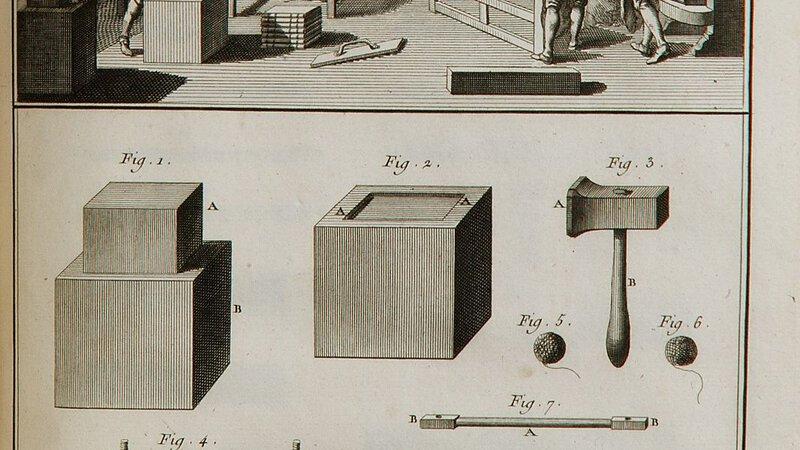
Diderot assembled a contributor network that reads like a roll call of European intellectual life: Voltaire wrote on literature and taste, Jean-Jacques Rousseau contributed articles on music, the Baron d’Holbach covered chemistry and related sciences. In its structure, it was a collaborative, multi-authored project two and a half centuries before the internet made that model commonplace. But the articles Diderot cared most deeply about were the ones on trades and crafts — accompanied by detailed copper-plate engravings showing exactly how a stocking loom operates, how glass is blown, how a printing press works. This was a deliberate democratic statement: the knowledge of workers belongs on the same pages as the knowledge of kings, and the people who make civilization’s objects deserve to be recorded in civilization’s books.
By the time the project reached completion, it ran to 28 volumes, roughly 72,000 articles, and thousands of engraved plates. Diderot served as chief editor for the entire duration — from 1745 to 1772, a span of twenty-seven years that consumed his middle decades entirely.
France Tries to Kill It

The authorities were not slow to understand what they were looking at. The royal council moved to suppress the first two volumes in 1752, citing subversive theology. Diderot kept publishing. In 1759, the Paris Parlement condemned the Encyclopédie outright, the royal publishing privilege was revoked, and — in the blow that hurt most personally — d’Alembert resigned as co-editor, frightened by the escalating legal exposure. Diderot was left alone as the project’s sole captain, navigating a sea that was actively trying to sink him.
He managed it through a combination of stubbornness, tactical flexibility, and well-placed sympathizers. Lamoignon de Malesherbes, the official responsible for overseeing the book trade, was quietly sympathetic to the Enlightenment project and is reported to have provided Diderot with informal warnings when inspections were imminent. Manuscripts were moved. Publications were timed to outmaneuver censors. The project lurched forward.
And then came the betrayal that Diderot described, when he finally discovered it, as among the most devastating moments of the entire enterprise. His own publisher, Le Breton, had been secretly excising passages from the later volumes before they went to press — removing material he feared would trigger prosecution — without telling Diderot. By the time Diderot found out, the volumes were already bound and distributed. He could not fix them. The Encyclopédie that reached readers was, in those later volumes, a silently censored version of itself, and its editor never fully recovered from the knowledge.
The suppression had one consequence no one in the royal council had anticipated: it made the book irresistible. Banned books were precisely the books Parisian salons most urgently wanted, and underground distribution networks carried the Encyclopédie across France and into the drawing rooms of exactly the educated class the crown most needed to keep on its side. By trying to kill the project, the authorities gave it a mythology that money could not have bought.
Why the Church and Crown Were Right to Be Afraid
The fear was not irrational. Follow the Encyclopédie‘s cross-references carefully enough and you find a subversive architecture hidden in plain sight. Articles on political authority traced power to the consent of the governed rather than to divine right. Articles on superstition positioned it as the enemy of reason in terms that were unambiguous even to a casual reader. And the entire work was written in French — not the scholarly Latin of theological dispute, but the living language of the street, the salon, and the coffee house. For the first time, a large-scale publication was making the argument, systematically and accessibly, that existing institutions could be rationally examined, found wanting, and replaced.
Historians of the French Revolution have returned repeatedly to the Encyclopédie as part of the intellectual groundwork for 1789. The project did not cause the Revolution — causation in history is never that clean — but it did something arguably more significant: it normalized the habit of mind that made revolution thinkable. If everything can be examined, everything can be questioned. If everything can be questioned, nothing is beyond challenge. The Bastille fell thirty-eight years after the first volume appeared.
Scholars have long noted that Diderot and Voltaire together shaped the French Enlightenment more profoundly than any other figures — but their methods were complementary rather than identical. Voltaire demolished. Diderot built. The Encyclopédie was the most consequential thing either of them made.
The Writer Beyond the Encyclopedia

It would be a distortion to let the Encyclopédie swallow the rest of Diderot whole. He was, alongside the editorial grind, one of the most formally adventurous writers of his century. His novel Jacques the Fatalist and His Master, written in the 1770s though not published in full during his lifetime, anticipates the narrative self-consciousness of modern fiction by well over a century, with its narrator constantly interrupting the story to argue with the reader about storytelling itself. His dialogue Rameau’s Nephew, which Goethe later translated into German, offers one of the period’s most psychologically acute portraits of moral ambiguity — a brilliantly unscrupulous man who is also, infuriatingly, often right.
His art criticism — the Salons he wrote reviewing the biennial exhibitions at the Louvre from 1759 onward — effectively invented the genre of sustained, opinionated art writing in French. He had views, he expressed them without apology, and he expected his readers to engage rather than defer. That approach was itself a form of Enlightenment practice: treating aesthetic judgment as something a reasoning person could argue about, not a verdict handed down by authority.
What makes Diderot unusual even among the philosophes is the quality of his intellectual restlessness. He held positions, revised them publicly, changed his mind, and remained interested in being wrong. His philosophical writing moves between materialism, determinism, and a genuine fascination with biology and natural science that puts him closer in spirit to Darwin’s century than his own. He was not building a system so much as conducting an extended, lifelong argument with himself — and leaving the transcripts for others to read.
The Human Cost of Twenty-Seven Years

The scale of what Diderot personally contributed to the Encyclopédie is staggering. He wrote thousands of articles himself — on philosophy, art, craft, science, literature — while simultaneously managing contributors, fighting censors, negotiating with publishers, and nursing the project through every crisis. He did this through his thirties, forties, and into his fifties, decades that another writer might have spent building a literary reputation or securing comfortable patronage.
The recognition he received in France was meager. The official academies and royal institutions that honored lesser figures largely ignored him. It was Catherine the Great of Russia who came to his rescue when his finances were desperate, purchasing his personal library in 1765 for a generous sum and then paying him a salary to remain its nominal keeper — a gracious fiction that allowed him to keep the books and receive an income without surrendering his dignity. He traveled to her court in St. Petersburg in 1773, and the two engaged in the kind of wide-ranging intellectual conversation Diderot generated wherever he went. His own country never offered anything comparable.
He died on 31 July 1784, five years before the Revolution he had spent his life making intellectually possible. The manner of his death — reportedly while finishing a meal at the Paris apartment that Catherine’s generosity had finally allowed him to afford — was characteristically untheatrical for a man who had spent decades making the grandest possible arguments about the nature of knowledge, authority, and human dignity.
The ironies surrounding his death carry a dark poetry. The man who organized all human knowledge left almost no substantial personal archive. He was buried in the church of Saint-Roch, despite holding atheist convictions he had never been shy about expressing. And the precise location of his remains was eventually lost — Denis Diderot, who fought his entire adult life to make remembering possible, was forgotten even in death.
The First Wikipedia — and Why It Still Matters
The parallel is not perfect, but it is not trivial. Both the Encyclopédie and Wikipedia rest on the same foundational premise: that knowledge belongs to everyone, that it should be built collaboratively, and that no single authority — royal, ecclesiastical, or corporate — should control what gets written down or who gets to read it. Diderot was working without digital search, without global networks, without any of the infrastructure that makes modern collaborative knowledge-building possible. He did it anyway, with contributors writing by candlelight and manuscripts carried across France under cloaks.
The Encyclopédie‘s true legacy is structural as much as intellectual. It came closer than anything before it to realizing the idea of a living, cross-referenced, crowd-contributed knowledge base as a democratic instrument rather than an elite luxury. Every open-access database, every collaborative reference project, every initiative to put expert knowledge in the hands of ordinary people carries some echo of what Diderot was assembling in that printer’s workshop.
The lesson his enemies grasped and tried to prevent still holds. Organized, accessible, cross-referenced information is one of the most politically potent forces in human history. Every authoritarian government since Diderot’s time has confirmed this by attempting to suppress it. The instinct of the Paris Parlement in 1759 and the instinct of modern governments that block reference websites or filter search results come from exactly the same place: the correct recognition that people with organized access to knowledge become very difficult to govern against their own interests.
The Encyclopédie is now available in digitized form, freely accessible to anyone with an internet connection. The forbidden pages that royal inspectors once seized from a Paris print shop, that were smuggled across France in the dead of night, that a frightened publisher secretly cut to make them safer — those pages load in milliseconds now, anywhere on earth. You can explore Diderot’s philosophy and its lasting legacy, or browse his own words to hear the mind behind the project speak for itself. Denis Diderot would have found the current situation either hilarious or entirely predictable. Most likely both.

 English
 Arabic
 French
 Spanish
 Portuguese
 Deutsch
 Turkish
 Dutch
Dutch
 Italiano
 Russian
 Portuguese (Brazil)
 Greek
Greek