


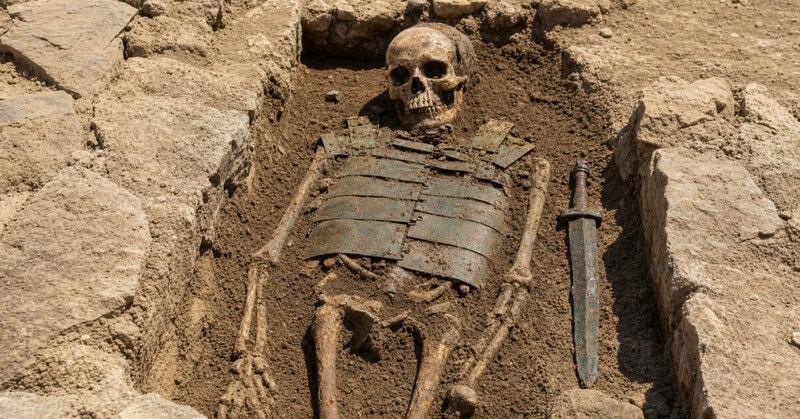
A dagger lay beside human bones in the dirt — and the archaeologists crouching over it knew, almost immediately, that something extraordinary had happened in this place twice: once roughly 5,000 years ago, when people of the Copper Age raised massive stone walls on the plains of Extremadura, and again some 1,800 years ago, when a man who may have been a Roman soldier was lowered into the ancient earth they had shaped.
The Find at Almendralejo

The discovery came to international attention on February 5, 2025, when El País reported on the excavation at Almendralejo, a town in the Spanish province of Badajoz, in the heart of Extremadura. Inside a Chalcolithic fortress already millennia old at the time of the burial, excavators uncovered a skeleton accompanied by a dagger — a burial that specialists cautiously identified as that of a possible Roman legionary dating to roughly 1,800 years ago. The weapon, the burial posture, and the placement within the ancient stonework all pointed toward Rome. Yet the walls enclosing the grave had been built by a civilization Rome never knew, in an era that predated Julius Caesar by approximately 2,800 years.
That collision — a Roman-era burial inside a 5,000-year-old fortress — stopped researchers cold. Who was this man? Why here? What does it mean that roughly 2,500 years separated the fortress’s founders from the person now resting within their walls? These are the questions that make Almendralejo one of the most layered archaeological discoveries reported in early 2025.
A Fortress Born in the Copper Age

Travel back to roughly 3000 BCE and the communities living across what is now Extremadura were already, by any fair measure, sophisticated. This was the Chalcolithic period — the Copper Age — a moment when Iberian societies were experimenting with metallurgy, organized agriculture, and increasingly complex social hierarchies. They were also building fortifications of a scale that still commands the attention of modern researchers.
The fortress at Almendralejo was not a simple earthwork. It required coordinated quarrying, transport, and construction — the kind of sustained communal effort that implies organized authority and deliberate planning. To raise such a structure centuries before the Bronze Age, long before the first Greek city-states appeared around the Aegean, is to place these Copper Age communities in their proper context: they were not primitive precursors to later civilizations. They were fully realized societies, and their fortress was enduring proof of that.
As Live Science has reported, the fortress represents one of the more significant Copper Age finds in Iberia, a region already dense with prehistoric remains. Badajoz and the broader Extremadura province are landscapes where civilizations did not so much replace one another as accumulate, each layer pressing down on those beneath without ever quite erasing them. By the time the Roman-era burial took place within the fortress walls, the structure had already stood abandoned for more than 2,500 years. To put that span in perspective: 2,500 years is longer than the entire interval between Julius Caesar and the present day.
When Rome Arrived in Iberia

Rome did not come to Hispania gently. The Punic Wars of the late third century BCE pulled Roman legions onto the Iberian Peninsula as a strategic counter to Carthaginian power, and what began as military intervention slowly became occupation and transformation. The pacification of Iberia’s interior was a grinding, generation-long process — the Celtiberian and Lusitanian wars of the second century BCE were among the most grueling campaigns Rome fought anywhere in the Mediterranean world. By the mature imperial period, Hispania had become one of Rome’s most productive provinces, a source of emperors, writers, olive oil, and silver.
But soldiers serving in Hispania during the second and third centuries CE — the period to which the Almendralejo burial is tentatively assigned — were not conquerors of freshly seized territory. They moved through a landscape already centuries deep in Roman roads, towns, temples, and administration. They also moved through a landscape thick with older ruins: pre-Roman hillforts, megalithic tombs, ancient enclosures whose original builders had been forgotten even then.
Those old stones were not invisible to Roman eyes. Roman writers occasionally recorded ancient ruins with curiosity and a measure of reverence, treating them as evidence of deep time and sometimes as sites charged with a kind of numinous power. A massive stone fortress rising from the Extremaduran plain — even a ruined one, abandoned for more than two and a half millennia — would have been an unmistakable presence in that landscape. Whether that presence influenced the decision to bury a man within its walls is one of the site’s most compelling open questions.
Inside the Tomb: What the Grave Tells Us

Archaeology Magazine’s coverage of the discovery reflects both the excitement and the caution of the excavating team: a human skeleton, identified on the basis of burial style and grave goods as a possible Roman legionary, laid to rest approximately 1,800 years ago within the Chalcolithic fortress’s stone walls.
The dagger is the detail that sharpens the picture most dramatically. Roman soldiers maintained a close relationship between personal identity and military equipment. While burial customs varied across the empire’s centuries and provinces, interring a man with weapons or symbols of his military role was not uncommon, particularly among soldiers whose adult lives had been defined by their service. A dagger in the grave is not conclusive proof of legionary status, but it is a meaningful indicator — the kind of object that speaks to how a man understood himself even at the moment of death.
Researchers have been appropriately careful to describe this as a possible Roman legionary burial rather than a confirmed one. Without additional bioarchaeological analysis — isotope studies, ancient DNA, inscriptions, or further grave goods — the identification remains a well-supported hypothesis rather than a settled conclusion. That caution is responsible science, and it matters: the questions left open by that careful language are precisely the ones that will drive the next phase of research. Was this man Roman-born, or a provincial recruit from Hispania itself? What unit did he serve? Was the fortress chosen deliberately, for reasons practical or ritual, or simply because its walls happened to form the most convenient enclosure nearby?
Why Bury a Soldier Inside an Ancient Fortress?

This is the question that gives the Almendralejo discovery its intellectual edge. The practical explanation is not unreasonable: even after 2,500 years of abandonment, the Chalcolithic fortress’s stone walls would still have formed one of the most visually imposing structures for miles in any direction. A burial party — soldiers, local civilians, people who had known this man — might simply have used the most solid and enclosed space available. The pragmatic reuse of ancient structures was common across the Roman world, and if the walls offered a ready boundary for a grave, that alone might have sufficed.
But the ritual possibilities are harder to dismiss. Roman burial practice showed persistent interest in liminal spaces — edges of settlements, crossroads, boundaries between the known and the unknown. Ancient ruins occupied a special category of liminal space: they belonged to no living community, owed allegiance to no present power, and their age lent them a quality that Romans, like most ancient peoples, associated with accumulated spiritual force. A fortress built by forgotten people in a forgotten age might have felt, to a Roman mourner standing in its shadow, like exactly the kind of threshold between worlds where the dead belonged.
Coverage of the site has emphasized the researchers’ genuine surprise at the combination — not because layered sites are unheard of in Iberian archaeology, but because each new instance of a Roman-era burial inside a prehistoric monument unsettles the assumption that history moves in clean, sequential chapters. The pragmatic and the symbolic explanations for the burial’s location are not mutually exclusive. Both may have been true simultaneously. That ambiguity is itself historically revealing: it shows how Roman soldiers and communities navigated a landscape saturated with pre-Roman memory, making decisions that blended the practical with the deeply human need to make death meaningful.
Two Civilizations, One Site

Step back from the grave and what the Almendralejo site offers is a physical record of how human societies inhabit, forget, rediscover, and reuse the traces of those who came before them. The fortress was not a museum when the Roman-era burial took place. It was a ruin — old beyond any cultural memory then living, its builders unknown, its original purpose perhaps guessed at but not understood. And yet it retained enough power, utility, or sheer physical presence to become the site of a significant act: the burial of a man with his weapon, inside walls that bound together two civilizations separated by an almost incomprehensible span of time.
Roman-era burials at pre-Roman monuments are documented at other sites across Spain and the broader Mediterranean. They are not unprecedented. But they never quite lose their capacity to compel attention, because each one is a reminder that the past is not a sequence of sealed chapters but a continuous accumulation — a landscape in which the old and the new are perpetually in contact, whether or not the living participants fully understand the conversation they have entered.
For Almendralejo itself, the discovery is a significant one. This is a modern Spanish town not typically found in the opening lines of history books. It is now home to one of the more resonant archaeological stories of 2025: a site where a Copper Age community built something intended to endure, where that structure did endure — far beyond anything its builders could have imagined — and where a Roman soldier eventually came to rest inside it, connecting two worlds across nearly five millennia with the simple, irreducible fact of his bones and the blade beside them.
What Comes Next
The Almendralejo discovery is, in archaeological terms, a beginning rather than a conclusion. The next steps are likely to be painstaking and revealing in roughly equal measure. Isotope analysis of the soldier’s teeth and bones can determine where he spent his childhood, potentially identifying him as born in Italy, in Hispania, or in any of the dozens of other provinces that supplied men to the Roman military. Further excavation of the fortress interior may reveal whether this was a solitary burial or whether additional Roman-era graves lie nearby. The dagger and any other recovered grave goods will undergo detailed study that may refine the dating and sharpen the identification of the burial.
Each of those findings would add resolution to a picture that is currently vivid but incomplete. If isotope analysis shows the soldier was locally born — a Hispanian recruit rather than an Italian legionary — the story becomes one of a man buried in the landscape of his own distant ancestors, separated from them by a gulf of time no living person could have measured. If he came from elsewhere, it shifts: a man from far away, laid to rest inside a stronghold built by people he never knew, in a land he arrived at as a soldier and left only in death.
Either way, what the site offers is something rarer than a headline. It offers a correction to the abstraction that tends to distort how we think about Roman history — that habit of seeing legions and emperors and administrative systems rather than individual men who lived and died in specific places, buried by specific people who made specific choices about where to put them. This man, whoever he was, was placed inside walls raised by people who had been dead for more than 2,500 years, in a country his civilization had occupied for centuries, on a plain where the ancient stone still stood against the sky.
Somewhere in the earth of Extremadura, he lay down with his dagger, inside walls that were already ancient when Rome was young — and 1,800 years later, archaeologists knelt beside him, and the long story of one small fortress became, for a moment, audible again.

 English
 Arabic
 French
 Spanish
 Portuguese
 Deutsch
 Turkish
 Italiano
 Russian
 Romaian
 Portuguese (Brazil)
 Greek
Greek