


The wooden chair outside Box 7 at Ford’s Theatre was empty. It should not have been — but the man assigned to sit in it had slipped away, and in that absence, the course of American history turned on a single unguarded door.
Washington, April 14, 1865: A City Exhaling

Washington D.C. on the night of April 14, 1865, was a city still dizzy with relief. General Robert E. Lee had surrendered to Ulysses S. Grant at Appomattox Court House just days earlier, and the long, catastrophic arithmetic of the Civil War — four years of slaughter, roughly 620,000 dead — had finally reached its conclusion. The gas lamps burned brightly on Tenth Street. Inside Ford’s Theatre, an audience of some 1,700 people was laughing at a comedy called Our American Cousin, settling into the first real exhale the nation had taken in years.
In the presidential box — Box 7, draped with patriotic bunting and a Treasury Guard flag — Abraham Lincoln sat beside his wife Mary Todd. Their guests that evening were Major Henry Rathbone and his fiancée Clara Harris. Lincoln leaned forward in his rocking chair, watching the stage, as relaxed as anyone had seen him in years. Outside the box, in the narrow corridor of the dress circle, sat a single wooden chair: the post of Lincoln’s bodyguard for the evening. At the moment it mattered most, that chair was vacant.
The end of the war, the collective relief, the sense that the worst was behind the country — these were the psychological conditions that made the most dangerous night in American presidential history feel, to almost everyone present, like a celebration. One question would haunt the decades that followed: where was the man who was supposed to be sitting in that chair?
John Parker: The Wrong Man for a Grave Responsibility

His name was John Frederick Parker, and his personnel file read like a chronicle of near-dismissals. A Washington D.C. Metropolitan Police officer, Parker had been assigned to the newly established White House security detail in 1865 — one of four officers who rotated shifts protecting the president. On paper, the assignment represented a serious responsibility. In practice, Parker had spent years accumulating disciplinary complaints that would have ended most careers: insubordination, conduct unbecoming an officer, and sleeping on duty. He had faced multiple hearings before a police board. Each time, he had survived. Each time, he had kept his badge.
Parker drew the night shift for April 14, 1865, making him the answer to one of the most uncomfortable questions in Lincoln assassination history — who was supposed to guard the president that night? He escorted the Lincoln party to Ford’s Theatre and took his position in the corridor outside Box 7. What happened next is not entirely settled by the historical record, but the evidence points in one direction: at some point during the performance, Parker left his post. He almost certainly made his way to the Star Saloon, a bar located next door to the theatre. Whether he was absent for minutes or for the bulk of the evening is debated, but the consequence was the same — the chair was empty when it needed to be occupied.
John Wilkes Booth: Ambition Curdled Into Conspiracy

Lincoln was barely a month into his second term when he settled into Box 7 that night. He had delivered his second inaugural address on March 4, 1865 — calling for malice toward none and charity for all — and had guided the country through its bloodiest trial. Now, with the Confederacy collapsed and the guns falling silent, he was turning his attention toward reconstruction. By almost any measure, this should have been a moment of cautious triumph.
John Wilkes Booth had a different view of the moment entirely. A celebrated stage actor who had performed at Ford’s Theatre many times — who knew its corridors and shadows as well as he knew any stage — Booth was a passionate Confederate sympathizer whose fury at the South’s defeat had hardened into something far darker than grief. He was not merely angry. He had a plan. The conspiracy Booth had assembled targeted not just Lincoln but Vice President Andrew Johnson and Secretary of State William Seward on the same night — a coordinated attempt to throw the Union government into chaos at its most vulnerable moment.
When Booth learned on the afternoon of April 14 that Lincoln would be attending the theatre that evening, the plan accelerated. He moved through the building that night with the unhurried confidence of a man who belonged there — because, by professional reputation, he did. He knew where the presidential box was. He knew which corridors led there. And when he arrived at the dress circle and looked down the hallway toward Box 7, he saw exactly what Parker’s absence had created: no officer, no challenge, no barrier between himself and the president of the United States.
Nine Steps Down an Unguarded Corridor

Booth had visited the theatre earlier that day and prepared his approach with deliberate care. He arranged to wedge a wooden bar against the corridor door from the inside, ensuring no one could follow him through once he had passed. He had also fashioned a small peephole in the outer door, allowing him to observe Lincoln’s position before making his final approach.
What he could not have reliably planned on was the cooperation of Parker’s absence. Yet there it was. No officer sat in the corridor. No one demanded to know his business. No one stood between Booth and the latched inner door of Box 7. The institutional failure that Parker embodied — the disciplinary record ignored, the post abandoned — had removed the single human obstacle in Booth’s path.
At approximately 10:15 p.m., Booth entered the box and fired a single .44-caliber ball from a derringer pistol into the back of Abraham Lincoln’s head. Lincoln slumped forward in his chair, losing consciousness immediately. He would never regain it.
The chaos that followed was immediate. Booth dropped the pistol and waved a dagger. Major Henry Rathbone lunged at him with remarkable speed, and Booth slashed him across the arm — a wound that bled severely and left Rathbone psychologically scarred for the rest of his troubled life. Booth then vaulted over the box railing toward the stage below, but his spur caught in the decorative bunting and he landed hard, breaking his leg on the boards. He nevertheless fled through a back door, mounted a waiting horse, and rode into a manhunt that would last twelve days before he was cornered and killed in a Virginia barn.
The Long Night at the Petersen House
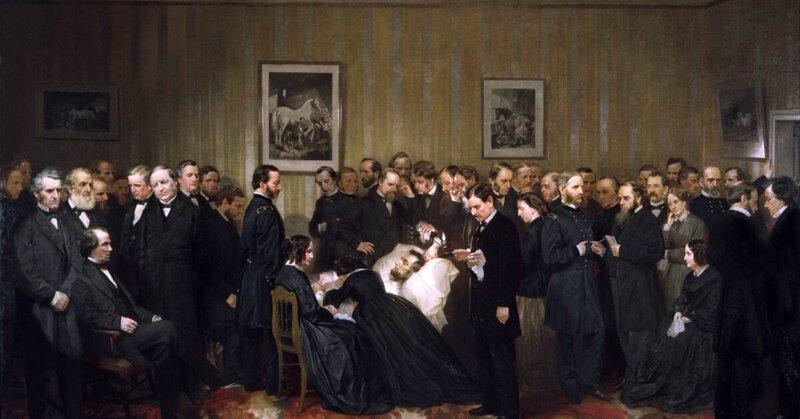
Lincoln could not be moved far. Soldiers and bystanders carried him across Tenth Street to the Petersen House, a boarding house directly opposite the theatre, and laid him diagonally across a bed in a small rear room — his frame was too tall for the bed to accommodate him straight. Army surgeons examined the wound and understood immediately that it was fatal. The ball had passed through his brain. What remained was the waiting.
Mary Todd Lincoln, cabinet members, and military officials cycled through that cramped room through the night. Lincoln died on the morning of April 15, 1865, never having regained consciousness. Secretary of War Edwin Stanton, standing at the bedside, is reported to have said that Lincoln now belonged to the ages — a sentiment that captured, in its compressed grief, the immediate understanding that history had just pivoted on a single night.
The ironies are almost too painful to catalogue. The man who had held the Union together through four years of catastrophic war died in the first days of peace. The president who had fought to end slavery did not survive to see its legal abolition ratified in the Thirteenth Amendment. He died in a rented bed across the street from a theatre, with the guns of the Civil War barely cold.
Parker’s Ghost: An Absence That History Never Forgave

John Parker reappeared at the White House in the early hours of April 15. A police board convened weeks later to hear charges of neglect of duty against him. In one of history’s quieter institutional outrages, the case was dismissed. Parker returned to the Washington Metropolitan Police force and continued working. He served for three more years before finally being dismissed in 1868 — not for his absence on April 14, 1865, but for the same recurring offense: sleeping on duty. The very failure that had marked his career for years, and should have disqualified him from guarding anyone, eventually cost him his position long after the worst damage had been done.
Parker lived in relative obscurity until his death in 1890. The historical record offers almost nothing about his inner life in those intervening years — whether guilt followed him, whether the events of that night revisited him in the small hours. History does not grant him the dignity of a reckoning we can observe.
Mary Todd Lincoln, by some accounts, confronted Parker directly in the aftermath of the assassination, expressing that he had no right to be alive and should have been at his post. This account should be treated carefully, as the historical documentation is imperfect, but it reflects the moral verdict that history assigned to his absence with quiet, unrelenting consistency. He was the man who was supposed to be in the chair. He was not in the chair. Everything else followed from that.
Systemic Failure, Not Just One Man’s Dereliction
It would be too simple to assign the entire weight of that night to Parker alone. Lincoln himself was famously philosophical about the threat of assassination, reportedly treating the idea of heavy security as incompatible with the life he wanted to live. The culture of presidential protection in 1865 was informal, under-resourced, and poorly conceived. The failure was systemic before it was personal. Parker was a demonstrably flawed officer placed in a role that demanded something better — but the system that placed him there, and that had repeatedly excused his misconduct, deserves its share of the accounting.
What the Lincoln assassination most clearly exposes is the danger of institutional complacency: warning signs dismissed, standards unenforced, and collective relief mistaken for genuine safety. The Confederacy had lost the war, but the ideological fury that animated men like Booth had not surrendered with Lee at Appomattox. That fury found its opening not through any elaborate breach of security but through the simplest possible failure — a man who walked away from his post.
What Changed — and What the Empty Chair Built
The assassination of Abraham Lincoln is most often told as a story about Booth’s murderous ambition, Confederate rage, and the fragility of great men in history’s sightlines. All of those framings are accurate. But it is equally a story about what happens when warning signs are ignored, when a flawed officer survives hearings he should have lost, and when a nation’s collective exhale of relief lowers its guard on precisely the wrong night.
The system did eventually change. Lincoln’s death — along with the later assassinations of Presidents Garfield in 1881 and McKinley in 1901 — drove the creation of a permanent, professional presidential protection apparatus within the United States Secret Service. The layers of security that now surround any American president, the protocols and redundancies and advance threat assessments, all trace a long institutional lineage back through those failures toward a simple, terrible lesson learned at a catastrophic price.
History pivots on enormous forces — the ideologies of nations, the outcomes of wars, the ambitions of movements. But sometimes it pivots on something far smaller: a man who left his post, a corridor that no one was watching, and a door that stood between an assassin and the president of the United States, with no one on the other side of it to turn him away.

 Arabic
 French
 Spanish
 Portuguese
 Deutsch
 Turkish
 Dutch
Dutch
 Italiano
 Russian
 Romaian
 Portuguese (Brazil)
 Greek
Greek