


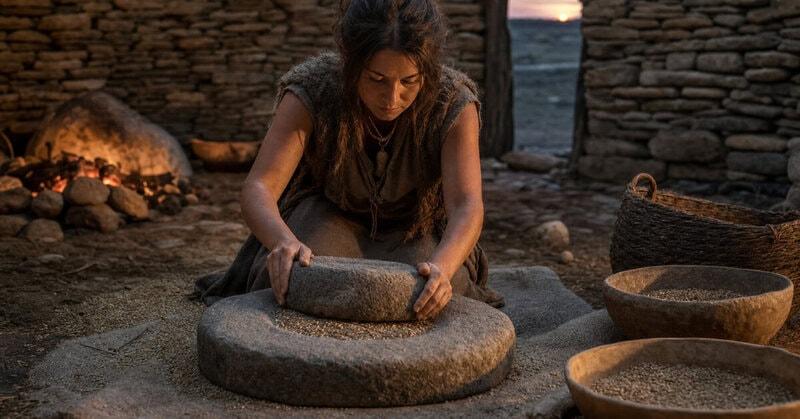
She kneels before the quern stone before the sun has cleared the horizon, her hands already finding the rhythm they will keep for hours. The grain is emmer wheat, the hearth behind her still glowing from the night, and the walls around her are dry-stacked stone — solid enough, it turns out, to last five thousand years. When archaeologists first uncovered the buried settlement of Skara Brae on the Orkney Islands in the mid-nineteenth century, they found this woman’s world almost intact: her stone bed, her stone shelves, the central hearth she cooked over around 3100 BC. The Great Pyramid of Giza would not be built for another five centuries.
A Village That Predates the Pharaohs

Skara Brae is the gut-punch that resets everything we casually assume about prehistoric life. The word “primitive” dies on the tongue when you stand in one of those low stone rooms and realize that the dresser — a stone shelf arranged to face the doorway, perhaps to display objects of significance — may be the oldest surviving act of deliberate interior decoration in human history. These were not shuffling figures lost in fog. They were people who cared how their homes looked.
We know the monuments, of course. Stonehenge. The megalithic passage tombs of Newgrange and Carnac. The standing stones that march across moorlands and hillsides from Portugal to Scandinavia. They have become the visual shorthand for an entire era. But the daily texture of Neolithic life — what people ate, feared, built, and argued about — is far stranger and more recognizable than the rocks. The monuments are the headline. The lives behind them are the story.
What the Neolithic Actually Was — And When It Happened

The word Neolithic derives from the Greek néos (new) and líthos (stone) — making it, literally, the New Stone Age. It was the final phase of prehistoric technological development before metalworking, defined not merely by the presence of stone tools, which humans had fashioned for hundreds of thousands of years, but by a specific refinement: tools shaped by grinding and polishing rather than only by chipping. A Neolithic axe head has an almost surgical edge. It is, by any reasonable measure, a precision instrument.
But the Neolithic was defined by far more than toolmaking. It was the era when human beings first stopped following food and started growing it — when the long, restless movement of our hunter-gatherer ancestors finally paused long enough to plant a seed and wait. That pause changed everything: how we organized families, how we understood ownership, how we related to the dead, how we conceived of time itself.
The timeline of this transformation reads less like a date on a wall and more like a fire spreading unevenly across damp ground. The Neolithic Revolution ignited around 10,000 BC in the Fertile Crescent — that arc of the Middle East where wild wheat and barley practically volunteered to be farmed, and where wild ancestors of sheep and cattle grazed within reach. From there it moved in pulses: agricultural societies emerged across Asia from approximately 7000 BCE onward, while farming pushed into Europe through millennia of cultural contact, trade, and migration. In Denmark, the Neolithic did not fully arrive until around 3900 BC — meaning a farmer breaking ground outside Jericho and one clearing a field in Jutland were separated not just by distance but by thousands of years of accumulated history, yet working the soil with strikingly similar tools and intentions.
The Neolithic, in other words, was not a single moment but a slow wave. Different cultures rode it centuries or millennia apart, which means it was less an invention than an idea whose time kept arriving, again and again, at different latitudes and under different skies.
The Revolution Nobody Voted For

Here is the part that should unsettle us: farming was not obviously better. Early Neolithic skeletons, when forensic anthropologists read them closely, tell a story of people who were on average shorter than their hunter-gatherer predecessors, whose bones show evidence of nutritional stress, and whose teeth were damaged by the decay that accompanies a carbohydrate-heavy diet. They worked longer hours for less varied food. Living in close quarters with domesticated animals exposed them to zoonotic diseases — infections jumping the species barrier in ways that nomadic life had largely prevented. From the inside, the Neolithic Revolution may have felt less like progress and more like a trap that kept closing.
The Danish case is quietly instructive here. The hunting and fishing peoples who had lived along Denmark’s coastlines and forests for millennia were not ignorant of farming. They had traded with, and absorbed ideas from, agricultural societies in central Europe for generations before finally making the transition themselves around 3900 BC. This was cultural osmosis, not sudden invention — a slow accumulation of contact, curiosity, and eventually necessity. The shift took not a year but generations of reluctant converts, people who had to unlearn the freedom of movement and learn instead the discipline of the field.
Imagine it: families whose grandparents had followed seasonal herds across open landscape, who knew every edible plant and fishing ground for fifty miles, now fixed to a single plot of earth. They watched their grain stores attract vermin. They watched their permanent settlements attract raiders who knew exactly where the food was kept. Permanence came freighted with vulnerability on a scale nomadic life had rarely produced. And yet they stayed. And built. And planted again the following spring.
What Daily Life Actually Looked Like

Strip away the monuments for a moment and enter the house. It is small — in many Neolithic settlements, a single room serves as kitchen, bedroom, and shelter for animals when winter closes in. The smell is woodsmoke, animal warmth, and the yeasty scent of stored grain. Before dawn, there are animals to tend. By mid-morning, grain to grind. The quern stone is never cold for long.
At Çatalhöyük in Turkey, one of the most extensively excavated Neolithic sites in the world, the relationship between the living and the dead was taken to its most intimate extreme: people entered their homes through openings in the roof, descending ladders into the interior — and beneath the floors where they slept and cooked and raised children, they buried their dead. Skulls were sometimes exhumed and re-plastered with clay, given new modeled faces, then kept close within the home. The boundary between the living and the ancestral was not a wall. It was a floor you walked on every day.
Neolithic diets were less monotonous than we might assume. Emmer wheat and einkorn, lentils and peas, domesticated cattle, sheep, and goats formed the agricultural backbone — but hunting and gathering never fully stopped. Early farmers supplemented their fields with whatever the surrounding landscape offered. They produced early forms of fermented drink. They processed milk, probably first as a means of preservation. The Neolithic larder was improvised, adaptive, and on a good harvest year, surprisingly varied.
For women, the evidence etched into bone is particularly direct. Female skeletons from Neolithic sites across Europe show pronounced wear in the spine, knees, and toe joints consistent with hours spent kneeling at grinding stones. The labor of turning grain into flour — essential, unceasing, performed daily for decades — literally reshaped the female skeleton. This is not abstract prehistory. It is a physical transformation written into the architecture of the body, legible to any forensic specialist who examines the remains.
The Belief System Behind the Stones

Once you understand how completely survival depended on planting at exactly the right moment, the monuments begin to make sense. When your dead are buried beneath your floors and your harvests depend on celestial timing, tracking the sun is not mysticism — it is agricultural engineering applied to cosmic forces.
Passage tombs aligned with the winter solstice sunrise, such as Newgrange in Ireland, were not built to impress distant visitors. They were built to confirm, year after year, that the sun was returning, that the cycle had not broken, that planting season would come again. Standing stone arrangements tracked celestial movements with a precision that required sustained communal observation across generations. These were technologies for managing a terrifying new dependency on forces nobody fully controlled.
Stonehenge, begun around 3000 BC by Neolithic communities on the Salisbury Plain, is the most famous expression of this impulse — and it rewards closer attention than its postcard image suggests. Archaeological evidence indicates it functioned simultaneously as a solar calendar, a cremation cemetery, and almost certainly a site of pilgrimage. The cremated remains of hundreds of individuals have been found there, with isotopic analysis of some suggesting they traveled from considerable distances — from Wales, from Scotland, from places that required deliberate, sustained journeys. People were brought here, or carried here, to be interred at the center of something that mattered to their world.
What words were spoken at these sites, what names were given to whatever forces the stones were meant to honor, what the rituals looked like at their heart — all of this remains silence. We are still excavating, still reading the ground, still learning to hear what the stones are almost saying.
Trade, Hierarchy, and the Long Shadow of Inequality

Neolithic villages were not sealed bubbles. Obsidian from Anatolia moved thousands of miles along trade networks before any empire existed to coordinate them. Amber from the Baltic reached the Mediterranean. Polished stone axes crafted from Alpine rock appeared in graves in Britain. These objects traveled because people traveled — talking, bargaining, and forming relationships across distances that should, by any comfortable assumption, have been impassable.
But trade also generated hierarchy, and hierarchy left clear marks in the ground. Not all Neolithic burials are equal. Some individuals were interred with polished axes, fine pottery, and cuts of meat — grave goods that speak of accumulated status and social weight. Others were buried with nothing. The structures of inequality were sown alongside the first deliberately planted wheat, and the Neolithic period gave them fertile ground in which to grow.
Violence, too, demands honest acknowledgment. Massacre sites such as Asparn-Schletz in Austria and Talheim in Germany preserve the skeletal remains of communities killed in what appear to be organized raids — men, women, and children whose bones bear the marks of deliberate, systematic violence. The Neolithic was not a pastoral idyll. Permanent settlements concentrated resources, and concentrated resources gave people new and urgent reasons to fight over them. The same stability that built Stonehenge also built the logic of organized warfare.
And yet — and this matters — Neolithic communities also buried individuals who could not possibly have fed or defended themselves without sustained support from others. People with severe physical disabilities, and elderly individuals whose bones show long survival after incapacitating injuries, were kept alive by conscious communal effort. Compassion is not a modern invention. It is, the archaeology quietly insists, deeply and stubbornly old.
Why the Neolithic Still Lives Inside Us
Almost everything that defines what we call civilization — cities, organized religion, writing, institutionalized warfare, social inequality, bread, fermented drink, the concept of owning land — has its deepest roots in the Neolithic period. These were not remote ancestors performing incomprehensible rituals. They were the architects of the world we inhabit, making foundational decisions without a plan, without a safety net, and without any way to know that what they were building would still be structuring human life ten thousand years later.
Return, one final time, to Skara Brae. The stone dresser in the main room faces the doorway — the most visible spot in the house, the first thing a visitor would see upon entering. Archaeologists have noted that this placement suggests the shelf held objects of deliberate significance: possessions chosen to be seen, arranged to communicate something about the people who lived there. If that reading is right, it is among the earliest known examples of a human being deciding that how their home looked was worth caring about — that the arrangement of objects in a space could carry meaning beyond pure function.
The woman at the quern stone knew nothing of Stonehenge’s future fame. She did not think of herself as living through a revolution, or as a prehistoric subject worth studying, or as an ancestor worth remembering. She thought about the grain, and the warmth, and what needed doing before the light failed. The next time you bake bread, or dispute a property boundary, or arrange something on a shelf so that it looks right rather than merely sits there — you are performing a gesture with roots ten thousand years deep. Somewhere in the arc of the Fertile Crescent, a farmer who never knew your name made that possible.

 Arabic
 French
 Spanish
 Portuguese
 Deutsch
 Turkish
 Dutch
Dutch
 Italiano
 Russian
 Romaian
 Portuguese (Brazil)
 Greek
Greek