


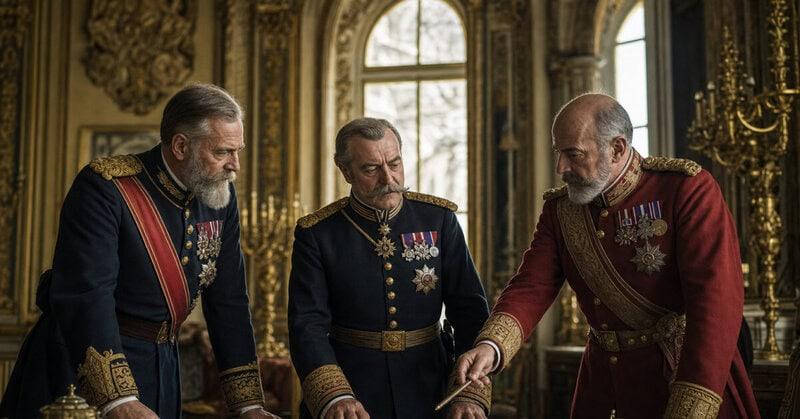
In the summer of 1914, as Europe lurched toward the most destructive war it had ever seen, the fate of millions rested on a diplomatic arrangement so deliberately vague that its own members could not agree on what it actually obligated them to do. The Triple Entente — the partnership between Britain, France, and Russia that became the backbone of the Allied war effort — was, in the strictest legal sense, barely an alliance at all. Understanding why reveals as much about the limits of diplomacy as it does about the origins of the First World War.
A Partnership Built on Handshakes, Not Treaties

Where the rival Triple Alliance bound Germany, Austria-Hungary, and Italy in a web of contractual obligations, the Triple Entente carried no equivalent legal weight. No member was required by treaty to fight if another was attacked. The entire arrangement rested on mutual goodwill and shared interest — nothing more enforceable than that.
The word “entente” is French for “understanding,” and that was precisely the point: it described an attitude, not a commitment. This deliberate vagueness made the grouping diplomatically flexible in peacetime, but in the summer of 1914 it produced a terrifying uncertainty. Britain’s entry into the war remained genuinely in doubt right up to the final hours, leaving France and Russia to wonder whether their most powerful partner would show up at all. The informality that had made the Entente easy to build made it agonizing to rely upon.
Three Separate Deals Stitched Together Over a Decade

The Triple Entente did not spring into existence at a single conference table. It grew in three distinct stages: the Franco-Russian Alliance, then expanded by the Entente Cordiale between Britain and France, and finally completed by the Anglo-Russian Entente of 1907. Each agreement addressed its own specific frictions, and no single founding document ever bound all three powers together simultaneously.
The phrase “Triple Entente” itself only gained wide currency after 1907, once the final bilateral piece was in place. What historians discuss as a coherent grouping was, in practice, a patchwork of shifting European anxieties assembled piecemeal — three separate answers to three separate problems that happened, in retrospect, to point in the same direction. The coherence was largely retrospective, imposed by crisis rather than design.
The Anglo-Russian Entente Was Really About Central Asia, Not Europe

The agreement that completed Europe’s most consequential alignment had almost nothing to say about Europe itself. The 1907 deal between Britain and Russia was primarily concerned with carving up spheres of influence in Persia, Afghanistan, and Tibet — territories the two empires had been competing over for decades in what strategists called the “Great Game.” It contained no military clauses and no pledge of mutual defense.
The 1907 Anglo-Russian Entente was, on paper, a piece of imperial housekeeping that nominally did nothing more than defuse mutual tensions in Asia. Its architects were careful not to dress it up as anything more — which meant that when the European crisis erupted seven years later, Russia could not point to it as a binding British war guarantee. The document that closed the loop on the Triple Entente was, by design, among the least committal of all.
Britain’s Joining Was a Revolution in Its Own Foreign Policy

For most of the nineteenth century, Britain had practiced what statesmen called “splendid isolation” — a calculated refusal to entangle itself in the binding continental alliances that kept European armies on permanent alert. Signing the Entente Cordiale shattered that tradition, though even joining the Entente stopped short of a formal alliance treaty. The immediate driver was alarm at Germany’s rapid naval buildup, a program explicitly designed to challenge British naval supremacy.
Yet even as Britain broke with a century of foreign-policy habit, its statesmen were careful to avoid the word “alliance.” The Entente was framed as a friendly understanding, preserving legal flexibility for future governments. That distinction, so useful in diplomatic salons, became agonizing in 1914, when Cabinet ministers debated whether Britain had any obligation to stand by France — and discovered that, strictly speaking, it did not. The deliberate ambiguity that had made the Entente politically acceptable at home now threatened to unravel it at the worst possible moment.
Germany’s Rise Was the Glue That Held Three Rivals Together

Britain and Russia had spent much of the nineteenth century as imperial antagonists, their interests clashing from the Balkans to the Hindu Kush. Britain and France had fought each other as recently as the Napoleonic era and had come close to armed confrontation at Fashoda in 1898. On almost any other question, the three powers might have remained suspicious competitors indefinitely.
What overcame those deep frictions was a shared and growing unease about Germany — a nation that had unified in 1871 and within a single generation transformed itself into the continent’s dominant land power, with an industrial economy and military machine to match. Scholars who study the formation of the Triple Entente often describe it as the process by which divergent national quarrels were fused into one overarching contest for the European balance of power. Germany’s ambition did not create the Entente on its own — the three powers’ own strategic choices did — but it was the common pressure that made cooperation feel, to each of them, like a condition of survival.
Britain’s Entry in August 1914 Depended on a Belgian Technicality, Not the Entente

When German forces crossed into Belgium on August 4, 1914, the British government cited the 1839 Treaty of London — a decades-old multilateral guarantee of Belgian neutrality — as its formal justification for war. The Entente was not invoked as a legal basis. That detail reveals everything about the arrangement’s true nature: Britain required a separate legal hook to enter a war that its partners France and Russia were already fighting.
Without the German invasion of Belgium, significant numbers of the British Cabinet were prepared to stay out entirely. The Belgian violation was not merely a convenient pretext; for many ministers it was the only justification they could conscientiously accept. The episode exposed the Entente’s weakness as a security guarantee in the starkest possible terms. France had spent a decade cultivating British friendship, only to discover in its hour of need that the friendship carried no enforceable promise. It took a treaty Britain had signed sixty-five years earlier, with a country that was not even a member of the Entente, to bring the partnership into the war.
Italy Exposed the Mirror-Image Weakness of the Triple Alliance — Then Switched Sides

The contrast with the rival Triple Alliance is instructive, though not in the way contemporaries expected. Italy had been a formal, treaty-bound member of the Triple Alliance with Germany and Austria-Hungary since 1882. When war came in 1914, Italy’s government declared the conflict an offensive rather than a defensive war — which, under the alliance’s own terms, relieved Italy of any obligation to fight — and remained neutral. A legally binding alliance had failed to deliver at the critical moment, for reasons that were ultimately political rather than legal.
The story went further. In 1915 Italy signed the secret Treaty of London and entered the war on the Entente side, drawn by territorial promises in the Adriatic and South Tyrol. The episode illustrated that even a real, written alliance could fracture under the pressure of competing national interests — which made the Entente’s studied informality look, in hindsight, almost pragmatically shrewd. The handshake arrangement had never promised more than it could deliver, and it had held where a formal treaty had not.
France Pursued the Entente as an Explicit Counterweight to German Power

Of the three Entente powers, France brought the most visceral motivation. The trauma of 1870-71, when Prussia crushed France in the Franco-Prussian War and annexed the provinces of Alsace and Lorraine, shaped an entire generation of French strategic thinking. By the early twentieth century, Germany outpaced France in both population and industrial output — the arithmetic of military power was moving in the wrong direction, and Paris knew it acutely.
France’s calculation was straightforward: survival required powerful friends, and powerful friends required the patient settlement of old grievances. The Entente Cordiale resolved long-standing Franco-British colonial friction — most acutely over Egypt and Morocco — specifically so that France could count on London’s moral and potentially military weight against Berlin. France had concluded its part of the Triple Entente in response to the threat of German imperialism across the continent. The Entente was, more than anything else, a French project.
The Entente Became the Nucleus Around Which the Allied Powers Formed
Whatever its legal limitations, the Triple Entente performed one function with remarkable effectiveness: it gave the broader Allied coalition a core around which to crystallize. Britain, France, and Russia entered the war together in 1914, and the Entente framework provided the diplomatic identity and initial shape of what would become the Allied Powers.
Over the course of the conflict, additional nations joined the Allied side — Japan in 1914, Italy in 1915, and the United States in 1917 among the most consequential. What had begun as an informal three-way understanding became the scaffolding for the largest military coalition the world had yet seen. The gravitational pull of even an unofficial alignment, once war begins, proved far greater than its founders had anticipated or its critics had credited.
Ambiguity as Instrument — and as Liability

The Triple Entente’s architects prized vagueness because vagueness was what made the arrangement politically possible. A formal alliance between Britain and France would have alarmed Parliament; a formal alliance between Britain and Russia would have alienated Liberal opinion suspicious of tsarist autocracy. The deliberate informality was not an oversight — it was a solution to a domestic political problem in each of the three capitals.
But the same quality that made the Entente easy to build made it dangerous to depend upon. Historians examining the pre-war diplomatic record have noted the persistent gap between what French and Russian planners assumed the Entente guaranteed and what British ministers believed they had actually committed to. That gap was never honestly confronted in peacetime, because confronting it might have forced a renegotiation that none of the governments wanted. The crisis of July 1914 forced the reckoning instead, at a cost measured in the tens of millions.
The Triple Entente’s story is ultimately a lesson in how great events can hinge on deliberate ambiguity — how an arrangement that was never quite an alliance nonetheless reshaped the world, and how the gap between a handshake and a treaty very nearly determined which side would survive the catastrophe the Entente had conspicuously failed to prevent.

 English
 Arabic
 French
 Spanish
 Portuguese
 Deutsch
 Turkish
 Dutch
Dutch
 Italiano
 Russian
 Romaian
 Portuguese (Brazil)