


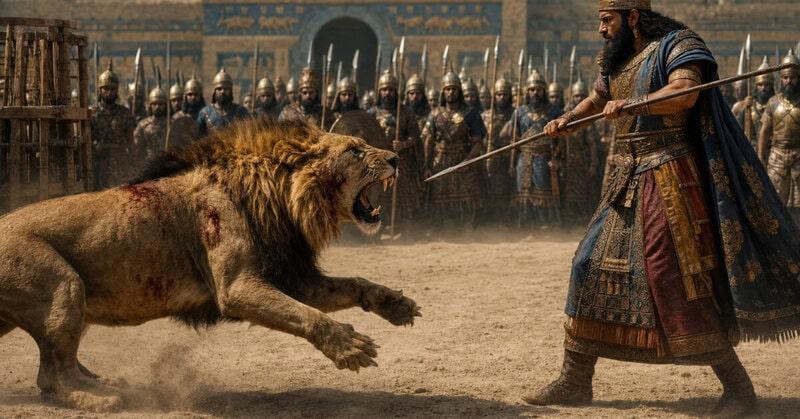
The lion does not hesitate. Released from its wooden cage into the dust-choked arena at Nineveh, already wounded by the hunt underway, it charges directly at the king — and Ashurbanipal, ruler of the greatest empire on earth, raises his spear and does not move an inch.
That single frozen moment, carved into limestone around 645 BCE, encodes an entire political theology. To understand why a king would stage it — and then commission sixty meters of palace relief so every foreign ambassador could walk past it — you have to start with the landscape, the animals that lived in it, and the civilization that decided both needed to be controlled.
A Landscape That Fed Civilizations — and Lions

Mesopotamia, the ancient territory sprawling across what is now Iraq and parts of Syria and Turkey, was not the arid, sun-bleached plain many imagine. Along the Tigris and Euphrates, dense reed marshes and riparian forests created one of the most productive ecosystems in the ancient world. They fed the first cities. They also fed lions.
The Asiatic lion — Panthera leo persica — was not a marginal presence in this region. Faunal remains and ancient written records confirm these animals were abundant across Mesopotamia from at least 3000 BCE, prowling river margins where wild prey was plentiful and human settlements were expanding fast. For the farmers and herders building the world’s first cities, lions were not a distant wonder. They were a genuine operational problem: raiding livestock pens at night, occasionally killing people, pressing against the fragile agricultural order that Mesopotamian civilization depended on.
That practical menace was real. But the Mesopotamians did something more ambitious than simply fear lions. They made them into a cosmological category. In ancient Mesopotamian belief, the lion symbolized the destructive forces of chaos and untamed nature, threatening order and civilization. Lion imagery appears on cylinder seals, temple gates, and ceremonial objects stretching from the Sumerian period around 3000 BCE all the way through the height of the Neo-Assyrian Empire around 700 BCE. This was not a passing royal fashion. It was cultural bedrock: the symbolic architecture that every Mesopotamian king inherited and was obligated to perform.
The breadth and continuity of this tradition — from small cylinder seals to monumental palace sculpture — is documented across this gallery of lions in Mesopotamian art and history, which traces the lion image across thousands of years of artifacts and shows just how central these animals were to the civilization’s self-understanding.
The Goddess, the Hero, and the King’s Cosmic Job Description

To be a Mesopotamian king was to hold a cosmic office, not merely a political one. The gods had established an order — a set of divine principles the Sumerians called me — and the king’s fundamental responsibility was to maintain it against the forces perpetually working to unravel it: floods, enemies, famine, and lions.
Ishtar, the great goddess of war and love, made the connection explicit. Her sacred animal was the lion. Ancient imagery shows her standing atop lions, leading them on her leash, becoming lion-fierce in battle. When Ishtar went to war, she went with the power and ferocity of a lion. For a king to hunt and kill a lion was therefore not to oppose the goddess — it was to channel her, to demonstrate that he shared her ferocity and her divine mandate. The lion hunt was a performance of divine endorsement, staged in flesh and blood before it was carved in stone.
The template had legendary roots that every literate person in the ancient Near East would have recognized. The Epic of Gilgamesh, written down in its most complete surviving form around 1200 BCE but drawing on oral and written traditions stretching back centuries earlier, depicts the hero-king of Uruk killing lions as one of his defining acts of semi-divine strength. Gilgamesh does not hunt lions for food. He hunts them to demonstrate what he is — something more than ordinary, something the gods have marked out. Real Assyrian kings read those texts. They knew the script. By the time Ashurbanipal staged his hunts at Nineveh, he was participating in a narrative tradition nearly two thousand years old.
The political logic was circular in the way that effective political theology often is: only someone chosen by the gods could kill a lion; the king killed a lion; therefore the king was chosen by the gods. Performed repeatedly, carved in palace walls, announced in royal annals, the ritual became self-reinforcing proof of divine selection. The kill count mattered. Tiglath-Pileser I, ruling around 1100 BCE, boasted in his annals of killing enormous numbers of lions on foot and from a chariot — figures that tell us more about the role of accumulated kills as a divine résumé than about precise hunting records. The numbers were stacked high enough to be unmistakable.
Ashurbanipal’s Theater of Dominance: The Nineveh Reliefs

Between roughly 645 and 635 BCE, the artists working in the North Palace at Nineveh produced something that has no real equivalent in the ancient world. The lion hunt reliefs — now housed in the British Museum in London — stretch across approximately sixty meters of carved limestone panels, depicting the royal hunt in detail so precise and emotionally charged that modern visitors routinely stop in front of them, unable simply to move on.
The mechanics of the staged hunt are visible in the carvings themselves. Lions were captured alive in the wild, transported in wooden crates, and then released one by one into a walled arena where the king waited on horseback or on foot. This was not a wilderness hunt. It was controlled chaos — engineered so that the king could face genuine danger within carefully managed parameters and emerge triumphant on cue. The outcome was never really in doubt. The meaning was everything.
What makes the reliefs extraordinary — and unexpectedly affecting — is that the Assyrian sculptors were not content to show triumphant kings standing over anonymous beasts. They gave the lions faces, postures, and something that reads unmistakably as inner states. One image, arguably the most haunting in all of ancient art, shows a lioness whose hindquarters have been paralyzed by arrows. She drags herself forward, her back legs useless, her front legs still pushing, her mouth open. The craftsmen who carved this image understood something about political iconography that pure triumphalism misses: the lion’s dignity in defeat is precisely what makes the king’s victory meaningful. A small or feeble enemy proves nothing. A magnificent, terrifying animal brought down by the king’s own hand proves everything.
The reliefs were never intended for private contemplation. Foreign dignitaries, tributaries, and ambassadors from rival kingdoms walked the corridors of the North Palace. The carved panels they passed were a permanent advertisement: Assyria’s king was stronger than nature itself, stronger than chaos, stronger than the most dangerous animal the ancient world had produced.
Blood, Prayer, and the Ritual Completion

The hunt did not end when the lion died. Cuneiform texts describe Ashurbanipal pouring libations of wine over the bodies of slain lions before the gods — a ceremony that completed the ritual loop, transforming an act of killing into an act of worship. The lion’s death was an offering. The king functioned as priest as much as hunter.
The language of the royal annals reinforces this insistence on personal ownership of the kill. Assyrian kings consistently write in the first person: I killed, I hunted, even in contexts where royal attendants clearly played significant supporting roles. The linguistic claim was integral to the theological argument. Temples to Ishtar and to Ninurta — god of hunting and war — received portions of the ritual observances connected to the hunt. This was not a royal hobby conducted alongside religious life. It was embedded in the liturgical calendar, sanctioned and shaped by priesthoods who understood precisely what was being performed and why.
What the Lions’ Disappearance Reveals About Empire

There is a quiet irony at the heart of the Mesopotamian lion tradition that the kings themselves never lived to register. The very success of Mesopotamian civilization — its expanding irrigation networks, its growing cities pressing outward along the river valleys, its centuries of targeted royal hunting — was systematically destroying the habitat and populations that made the ritual possible in the first place.
By the time the Assyrian Empire fell to the Babylonians and Medes in 612 BCE, wild lion populations in Mesopotamia were already in serious decline. The Asiatic lion retreated steadily across subsequent centuries, shrinking to remnant populations in Persia and the Levant, and eventually persisting only in the Gir Forest of northwestern India, where a small and closely monitored population survives today. The last confirmed Asiatic lions in Iran were killed in the early twentieth century — the final chapter of a population collapse rooted in the Bronze Age, in the reed marshes of the Tigris and Euphrates, in the logic of a civilization that had made chaos into an enemy it was cosmologically required to destroy.
The disappearance of lions from Mesopotamia is a quiet ecological coda to the fall of the Assyrian Empire — two collapses, one cultural and one biological, bound together by the same historical forces and unfolding across the same centuries.
Stone, Symbol, and a Dying Lioness

The lion hunt reliefs came to light in the 1850s during British excavations at Nineveh, arriving in London at the height of another empire entirely. Victorian audiences required little explanation of the iconography. A powerful state using the conquest of nature as proof of its right to rule was not an alien concept to them. It was, in many ways, entirely familiar.
In the century and a half since, the dying lioness has stopped visitors in the British Museum in a way that few ancient images manage. Scholars have written about her at length. Artists have copied her. She appears in essays about empathy, about the cost of power, about what it means to render suffering with precision and beauty. She does this not because the Assyrian artists intended to produce a critique of violence — they did not. She does it because the sculptors were skilled enough and observant enough that the truth of what they were depicting leaked through the political purpose they were serving.
From Gilgamesh to Ashurbanipal, across nearly two thousand years of ancient Mesopotamian history and symbolism, lions were never simply animals. They were the empire’s necessary dark mirror — the embodiment of everything civilization claimed to have conquered, the proof that order had defeated chaos, the required enemy without which the king’s divine mandate could not be demonstrated or renewed. To kill a lion was to perform the original bargain at the heart of every early civilization: we will build order here, in this difficult and dangerous world, and we will keep building it.
The Nineveh lion hunt reliefs are among the oldest and most sophisticated pieces of sustained narrative art that human beings have ever produced. They were designed to answer a question that every civilization eventually has to face — carved in limestone, repeated in cuneiform, poured in wine over the bodies of magnificent dead animals — which is this: what separates order from chaos, and who gets to decide?
Three thousand years later, standing in front of a paralyzed lioness dragging herself across a palace wall in London, the question still has not entirely settled.

 English
 Arabic
 French
 Spanish
 Portuguese
 Deutsch
 Turkish
 Dutch
Dutch
 Italiano
 Romaian
 Portuguese (Brazil)
 Greek
Greek