


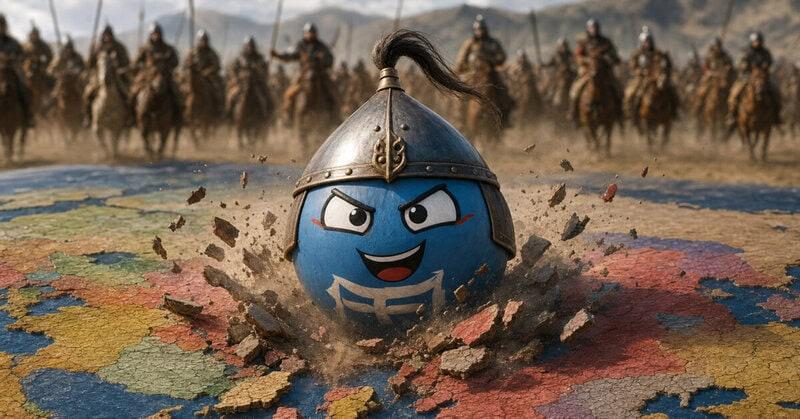
Picture a small, perfectly round cartoon sphere — barely bigger than a fist — wearing a conical Mongol helmet and an expression of absolute, cheerful determination. It charges across a digital map of Eurasia, and nation after nation disappears beneath it. This is the Mongol Empireball, and somewhere between historical fact and internet absurdism, it has become one of the most recognized characters in online historical culture.
The Ball That Conquered the Internet

The paradox is almost too good to be true: one of history’s most devastating empires, responsible for campaigns that reshaped civilizations from Beijing to Budapest, has been reborn as an enthusiastic cartoon sphere with an insatiable appetite for conquest. The Mongol Empireball does not appear in any textbook, yet it has introduced more curious people to genuine Mongol history than many mandatory school curricula ever managed. And the secret to its appeal begins with a single, almost impossible number.
At its peak, the Mongol Empire stretched across roughly 24 million square kilometers — the largest contiguous land empire in human history. That figure is so staggering it sounds fabricated, like something a student might invent to win an argument. It is not fabricated. It is documented, and it is precisely the kind of jaw-dropping fact that the internet was built to transmit. When a YouTube animation shows that territory ballooning across a map in under thirty seconds, the visceral shock lands in a way that a paragraph in a history textbook simply cannot replicate.
What Is a Countryball? A Quick Crash Course
For the uninitiated, countryballs are hand-drawn or digitally rendered circular characters representing nations — each given distinct personality traits, speech quirks, and storylines drawn from real geopolitics and history. The format emerged from internet forums in the late 2000s and grew into a sprawling global subculture producing webcomics, animated YouTube series, and galleries of detailed fan art. At first glance, the whole enterprise looks like nonsense. Look closer, and it is grassroots history education hiding inside absurdist humor.
The format carries a built-in reward system: the jokes only land if you already know something, or become curious enough to find out. Why is the Mongol Empireball always knocking on someone else’s door? Why does it interact differently with the Chinese dynasties than with the European kingdoms? Answering those questions sends viewers into genuine history rabbit holes — Wikipedia articles, documentary queues, forum debates — all triggered by a cartoon sphere in a funny hat.
The community takes cultural specificity seriously. DeviantArt artist ChairmanHarris created a Mongol Empire Countryball rendered with careful attention to detail, its traditional hat immediately recognizable as a marker of Mongol identity rather than generic medieval costuming. That specificity signals something important: even in meme form, accuracy matters to creators and the audiences who follow them. The Mongol Empireball, as documented on the Polandball Wiki, is understood as a historical countryball that conquered most of East Asia, Central Asia, and a part of Eastern and Central Europe — a description that doubles as a thumbnail sketch of actual history.
The Empire That Was Almost Too Big to Believe

To understand why the Mongol Empire dominates the internet’s historical imagination, it helps to spend a moment with the actual story — because the actual story is extraordinary enough to require no embellishment.
In 1206, a man named Temüjin was proclaimed Genghis Khan on the Mongolian steppe, having unified warring nomadic tribes through military brilliance, strategic alliance-building, and a command structure that rewarded ability over ancestry. What followed was an expansion so rapid that contemporary observers on multiple continents struggled to explain it without invoking the supernatural. Within decades, the empire had swallowed the Jin Dynasty in northern China, dismantled the Khwarazmian Empire across Central Asia, and sent cavalry columns probing deep into Eastern Europe — forces that appeared, devastated, and withdrew before most kingdoms had time to mount a coordinated response.
Those 24 million square kilometers meant the empire covered approximately 16 percent of Earth’s total land area, connecting the Pacific coast of China to the edges of Central Europe under a single administrative system. The Mongol achievement was not merely vast — it was categorically different in scale from almost anything that preceded or followed it.
What surprises many first-time readers is the sophistication behind that expansion. The Mongols were not simply mounted raiders overwhelming sedentary populations through sheer brutality. They were military innovators who absorbed and deployed the best siege engineering, communication systems, and logistical methods available in the medieval world. They recruited skilled administrators, engineers, and craftsmen from conquered territories. Their armies operated across distances that would have been logistically ruinous for most contemporary forces. The countryball’s cheerful charge across the map is funny partly because the real story underneath it is so improbably competent.
Genghis Khan: The Man Behind the Meme

Genghis Khan himself seems almost engineered for internet mythology. Born into hardship and taken captive as a young man, he rose through betrayal, alliance, and battlefield ingenuity to reshape the world in a single lifetime. The arc from an obscure boy on the steppe to ruler of the largest contiguous land empire ever assembled is the kind of origin story that online communities obsess over — an underdog narrative told at continental scale.
The facts that keep resurfacing in comment sections and forum threads are often the counterintuitive ones. His legal code, the Yasa, promoted religious tolerance across the empire’s vast territories, meaning Buddhist monks, Christian priests, Muslim scholars, and shamans all operated under a framework of official protection. The resulting Pax Mongolica — the period of relative stability across the Mongol domains — allowed goods, ideas, and people to move along the Silk Road in volumes not seen before or after for centuries. Technologies and crops traveled west; artistic influences traveled east. The countryball conquering everything in sight is also, in a historically complicated way, the countryball enabling one of the medieval world’s great eras of cross-cultural exchange.
None of this erases the destruction, and the better corners of countryball culture do not try to. The Mongol campaigns produced catastrophic death tolls across Central Asia and China. Cities such as Merv and Nishapur were devastated so thoroughly that their populations took generations to recover — if they recovered at all. The internet’s engagement with the Mongol Empire is genuinely interesting partly because it tends to grapple with this complexity rather than flattening it. Comment sections under countryball videos regularly erupt into surprisingly substantive debates about how to weigh conquest against the Pax Mongolica, destruction against connectivity. A cartoon sphere in a cone hat has somehow become a starting point for moral and historical reckoning.
The YouTube Rabbit Hole: Animation as a Gateway to History
Perhaps the clearest demonstration of how countryball culture transforms passive entertainment into active historical curiosity is the animated YouTube video The Return Of The Mongol Empire, which imagines a resurgent Mongol Empire interacting with modern countryballs including Mongolia, North Korea, Japan, the European Union, and the United Nations. It is a mashup of historical memory and contemporary geopolitics that treats its audience as intelligent enough to catch the references — and curious enough to look up the ones they miss.
The animated format does something that written history often struggles to accomplish: it compresses centuries of cause and effect into minutes of visual storytelling, triggering the same narrative engagement as a well-made documentary but in a format native to the scroll culture of YouTube and social media. The viewer who starts watching because a thumbnail is funny often finishes because the story is genuinely gripping, then finds themselves reading about the Battle of Mohi or the Siege of Zhongdu before they have consciously decided to do so.
The comment sections under these videos function as impromptu history seminars. Viewers correct each other’s dates, debate the empire’s legacy, recommend books and documentaries, and occasionally argue with impressive specificity about medieval siege tactics or the administrative structures of the Yuan Dynasty. This is countryball culture’s underrated superpower: it creates self-sustaining communities of curious learners out of people who arrived looking for entertainment and stayed for the history.
Why the Mongol Empire Wins the Internet’s Historical Imagination

The Mongol Empire sits at the intersection of several internet obsessions simultaneously, which helps explain why it outcompetes so many rivals in online historical discourse. Extreme scale. Underdog origin story. Military innovation. Multicultural complexity. The sheer audacity of a landlocked steppe civilization reshaping an entire hemisphere. Each of those elements would sustain internet interest on its own. Together, they produce something close to an irresistible subject.
Consider the comparisons. The British Empire was enormous but assembled gradually over centuries through trade, colonialism, and naval power — a process that, however historically significant, does not translate easily into the explosive visual drama of a countryball comic. The Roman Empire is familiar to the point of cultural saturation; it has been the subject of countless films, novels, and documentaries, and its meme presence, while substantial, lacks the element of surprise. The Mongol Empire retains its capacity to astonish precisely because it remains underrepresented in mainstream Western popular culture relative to its actual historical importance. For many viewers, the countryball is genuinely their first encounter with the story — which means the first impression is shock, which means engagement.
There is also an identity dimension that resonates across cultures. Mongolia today is a small, landlocked nation of roughly three million people, quietly bordered by two of the world’s largest countries. The Mongol Empireball represents something that transcends national pride — it is the historical memory of a moment when a small, resource-limited people rewrote the rules of what was geopolitically possible. That resonance is not lost on audiences around the world who understand, from their own histories, what it means for a small place to have once mattered enormously.
The meme format democratizes access to that story in ways that institutional history education rarely achieves. A teenager in Brazil, a commuter in Seoul, a student in Lagos — any of them can encounter the Mongol Empireball, find it funny, get curious, and within an hour be reading genuinely substantive history. No enrollment required, no textbook budget necessary. Just a small sphere in a traditional hat, charging across a digital map, doing what the real empire did eight centuries ago: refusing to be contained by any border anyone thought was final.
Memes as History’s New Front Door
Every era gets the historical education it can metabolize. The nineteenth century had epic poetry and vast oil paintings of cavalry charges. The twentieth century had documentary film and the illustrated history textbook. The twenty-first century has a tiny ball in a cone hat absorbing half the known world one pixel at a time — and the evidence suggests it is working.
The real measure of the internet’s Mongol obsession is not the memes themselves but what happens after them. The searches that follow a funny video. The Wikipedia spirals that begin with a single question about why the empire fragmented. The documentary queues, the forum arguments about the Pax Mongolica’s moral ledger, the first-time readers picking up books on the steppe empires because a cartoon made them curious enough to want the full story. The Mongol Empireball is not trivializing history — it is translating history into a visual language that a generation raised on social media actually speaks fluently.
Eight hundred years after Genghis Khan’s death, his empire still refuses to stay contained. Not by steppe, not by desert, not by the passage of centuries, and certainly not by the edges of a search result. The ball rolls on.

 Arabic
 French
 Spanish
 Portuguese
 Deutsch
 Turkish
 Dutch
Dutch
 Italiano
 Russian
 Romaian
 Portuguese (Brazil)
 Greek
Greek