


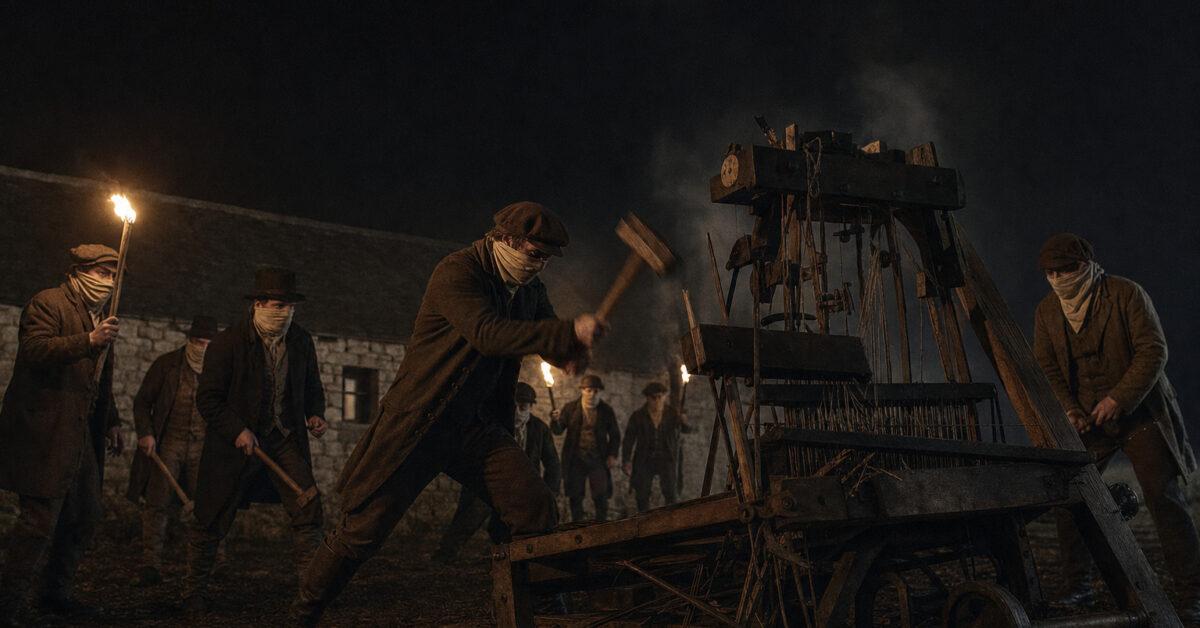
On a bitter November night in 1811, masked men moved through the darkness outside Nottingham, torches low, hammer handles slick with cold. They called themselves Luddites, and by dawn they had beaten several textile frames to splinters — not because they feared the future, but because the future had already arrived and left them with nothing.
The Pattern Nobody Warned Them About
Every industrial revolution in recorded history has followed the same brutal sequence: the promise arrives first, in pamphlets and parliamentary speeches and the gleaming pages of scientific journals, and the devastation arrives second, in the bodies and bank accounts of workers whose skills the new machines simply no longer need. The gap between promise and devastation — measured in decades, not years — is where the social crisis lives. And it is always longer, and always uglier, than the people driving the revolution predict.
In January 2016, Klaus Schwab described a Fourth Industrial Revolution already underway — one driven by artificial intelligence, advanced robotics, and biotechnologies that blur the boundaries between the physical, digital, and biological worlds in ways no previous revolution had attempted. He called it unlike anything humanity had previously experienced in its velocity, scope, and systemic impact. History, examined honestly, suggests he was not exaggerating. It also suggests we already know, with uncomfortable precision, what tends to happen next.
The First Revolution: Steam, Soot, and Children in the Mines
Britain in the 1760s smelled like the inside of a forge. Coal smoke turned city skies the color of old pewter. In Manchester, child laborers worked fourteen-hour shifts in conditions that would later be called, with Victorian understatement, “unsanitary.” Life expectancy in industrial cities fell even as national wealth climbed — a statistical portrait of an economy moving at machine speed while its institutions still moved at human speed.
The mechanism that produced this crisis — and that would go on to produce every subsequent one — is worth naming precisely: new energy sources and new production methods destroy existing economic equilibria faster than the laws, social structures, and safety nets governing those equilibria can adapt. The result is a gap. Sometimes that gap lasts a generation. In the case of the First Industrial Revolution, it lasted roughly seventy years before meaningful reform arrived in the form of child labor laws, the Factory Acts, and the first recognizable labor unions — none of which existed at the revolution’s start, and all of which were bitterly resisted by those profiting from the existing disorder.
The Luddites who smashed those Nottingham frames were not, as history has often portrayed them, ignorant men afraid of progress. They were skilled textile workers making a rational calculation: the new stocking frames would produce cheaper goods, their expertise would become worthless overnight, and no institution existed to manage that transition or share the resulting gains. They were right on all three counts. They simply lost anyway, because you cannot hammer a general-purpose technology to death, no matter how justified your grievance.
The Second Revolution: Electrification, Mass Production, and the Birth of Modern Anxiety

In September 1882, Edison’s Pearl Street Station flickered on in lower Manhattan, pushing direct current through copper wire to a cluster of buildings in the financial district. Thirty-one years later, Ford’s Highland Park plant had reduced the time needed to assemble a Model T from around twelve hours to ninety-three minutes. The Second Industrial Revolution — electrification and mass production, roughly 1870 to 1914 — did not just change what factories made. It changed what cities were, what work meant, and what political systems were supposed to do.
The social crisis this time struck not just craftsmen but entire urban social structures. Rapid industrialization pulled millions from agricultural communities into cities that had no adequate plumbing, no labor protections, and no political representation designed for their circumstances. Populist and socialist movements surged across Europe and North America. The first serious debates about monopoly power — Standard Oil, U.S. Steel, the railroads — forced political systems designed for agrarian societies to suddenly govern industrial megacities. The turbulence lasted roughly forty to fifty years before antitrust law, progressive-era reform, and eventual labor protections produced a new equilibrium.
The crucial detail here is velocity. The Second Revolution moved faster than the First, compressed both the boom and the crisis, and forced institutional adaptation to accelerate accordingly. This compression is not incidental — it is structural, baked into the nature of each successive revolution’s technologies. Schwab would later identify this accelerating velocity as one of the Fourth Revolution’s most dangerous characteristics, and the historical record gives that concern considerable weight.
The Third Revolution: The Digital Disruption Nobody Fully Understood in Time

The Third Industrial Revolution — computing and the internet, roughly the 1960s through the 2000s — was the first one whose architects explicitly promised it would be relatively painless. “Information wants to be free,” the tech optimists declared. The network would democratize everything. Knowledge would flow freely to everyone. And in some genuine senses, it did. It also, simultaneously and less visibly, hollowed out manufacturing employment across the Western world in ways that took decades to register as a crisis rather than mere structural adjustment.
The communities built around those manufacturing jobs — in Ohio, in Michigan, in northern England, in the German Ruhr — experienced rising mortality, political radicalization, and the collapse of civic institutions that researchers are still mapping. The social crisis of the Third Revolution was quieter than its predecessors, less visible in terms of dramatic confrontation, but more visible in the political earthquakes it eventually produced.
The Third Revolution also introduced something new to the pattern: platform power. For the first time, a handful of firms could restructure entire economies with software rather than steel, and the benefits of their productivity gains concentrated far faster than any retraining program or social safety net could distribute them. This is the most instructive prologue to the Fourth Revolution, because the Fourth will operate on the same logic — only faster, and in domains far more intimate than commerce or communication.
What the Fourth Revolution Actually Is — And Why It Is Different

The Fourth Industrial Revolution is not simply “more computers.” As described across the technology and policy literature, it is the convergence of artificial intelligence, advanced robotics, biotechnology, and other emerging fields in ways that simultaneously blur the lines between the physical, digital, and biological worlds. It is, in that specific sense, categorically different from its predecessors — not merely in degree but in depth. Every previous revolution changed what humans made, or how they made it. The Fourth threatens to change who — or what — does the making, and potentially what humans are at a biological level.
The World Economic Forum has noted that the Fourth Revolution carries genuine potential to raise global income levels and improve quality of life for populations worldwide — just as steam power eventually raised living standards and electrification eventually created the modern middle class. But the word “eventually” is doing enormous work in that sentence. History consistently shows that the interval between a revolution’s arrival and its broadly shared benefits is measured in generations, not product cycles. As analysts have framed it, the Fourth Revolution’s social, political, cultural, and economic upheavals are likely to unfold across much of the twenty-first century.
The velocity problem is where the historical comparison becomes most alarming. Each previous revolution moved faster than the last. The Fourth is moving faster still — in some domains, at an exponential rate. And history’s consistent finding is that the faster a revolution moves, the longer the social crisis that precedes stabilization tends to feel to the people living through it, because institutions adapt at roughly the same human speed they always have, while the technology does not wait.
The Pattern, Applied Honestly to the Present

Three revolutions produce a clear framework, even if it offers more discomfort than reassurance:
- A new general-purpose technology arrives and begins destroying existing economic equilibria.
- The destruction moves faster than institutions — laws, unions, safety nets, educational systems — can adapt.
- A social crisis emerges: sometimes violent, always politically destabilizing, and frequently misdiagnosed in real time as something other than what it is.
- New institutions eventually close the gap — but only after decades of friction, and usually only after significant political pressure from below forces the issue.
Apply that framework to the mid-2020s and the fit is uncomfortably precise. AI-driven automation is already measurable in legal work, accounting, creative industries, and entry-level software development. The political instability that historically follows economic dislocation is already visible across multiple democracies. The institutional responses — AI regulation frameworks, universal basic income proposals, workforce retraining programs — remain embryonic, roughly where the First Revolution’s Factory Acts were in 1790: discussed seriously by reformers, resisted by those profiting from the status quo, and not yet real in any enforceable sense.
What is genuinely new this time — what has no clear historical precedent — is that the Fourth Revolution’s disruptions extend beyond labor into questions about human biology itself. Who gains access to gene-editing therapies? Who governs autonomous weapons systems? Who sets the rules for surveillance at scale? These are not variations on what the Luddites faced. They are new categories of crisis, and the institutional frameworks to govern them do not yet exist in any meaningful form. Researchers examining the revolution’s governance challenges have repeatedly noted that the gap between technological capability and regulatory capacity is wider, in these domains, than at any previous moment in industrial history.
What History Says Works — And What to Watch For
History is consistent on what does not work: attempting to halt a general-purpose technology. The Luddites lost. Every subsequent effort to stop an industrial revolution at the gate lost. The technology, once it exists and generates profit, continues. The question has never been whether the revolution proceeds, but who bears its costs and who captures its gains — and that question is answered entirely by institutions, by law, by political will, and by the timing of their arrival.
History is equally consistent on what does work: aggressively front-loading institutional adaptation rather than waiting for crisis to force it. The Factory Acts mattered enormously — but they would have mattered far more in 1790 than in 1833. Labor law mattered enormously — but it would have mattered more before the First World War than after the Depression. The lesson from three revolutions is not that reform is impossible. It is that reform delayed is crisis extended, and the people who pay for that delay are invariably those who had the least to begin with.
The signals that a revolution’s social crisis is peaking — and that reform is finally imminent — have been historically consistent: mass political mobilization that crosses traditional party lines, elite defection from the status quo as its costs become undeniable, and a visible institutional failure too large to explain away. All three patterns have clear precedent. All three are worth watching for now, across multiple countries simultaneously.
History has also been unfair to the Luddites, and it is worth saying so plainly. They were not anti-technology. They were pro-negotiation — they wanted new technologies introduced alongside protections for the workers whose livelihoods those technologies displaced. That demand looks less irrational and considerably more prescient with every passing decade. It is, in essence, the argument that today’s AI governance advocates are making when they call for regulatory frameworks, algorithmic transparency, and distributional mechanisms to accompany AI deployment. Educators and workforce researchers are raising the same demand in the context of preparing the next generation of workers: the technology will not slow down, so the preparation must accelerate. The vocabulary has changed across two centuries. The underlying argument has not.
The Long War That Has Barely Begun
Return, then, to Nottingham in 1811. The frames are smashed. The mills are still running by morning. The masked men are back in their cold houses, knowing they have lost this particular battle, and not knowing that the war — the long, grinding political struggle to build the institutions that would eventually make industrial capitalism survivable for ordinary people — has barely begun. The Factory Acts are still decades away. Unions are still illegal. Child labor laws do not exist.
Every generation that lived through an industrial revolution thought its disruption was uniquely terrible and possibly unsurvivable. Every one of them was both right about the pain and wrong about the endpoint. The Fourth Revolution puts a sharper version of the same question to the present generation: not whether we will survive it, but whether we can finally learn to build the Factory Acts before the crisis fully peaks — before the mills have been running for seventy years and the cost of waiting has been paid, as it always is, by the people who could least afford the bill.
Three revolutions suggest the answer is probably no. The same three revolutions suggest that asking the question loudly, early, and repeatedly is precisely what eventually makes the answer yes.

 English
 Arabic
 French
 Spanish
 Deutsch
 Turkish
 Dutch
Dutch
 Italiano
 Russian
 Romaian
 Portuguese (Brazil)
 Greek
Greek