


sawarin pakdeephon/Shutterstock
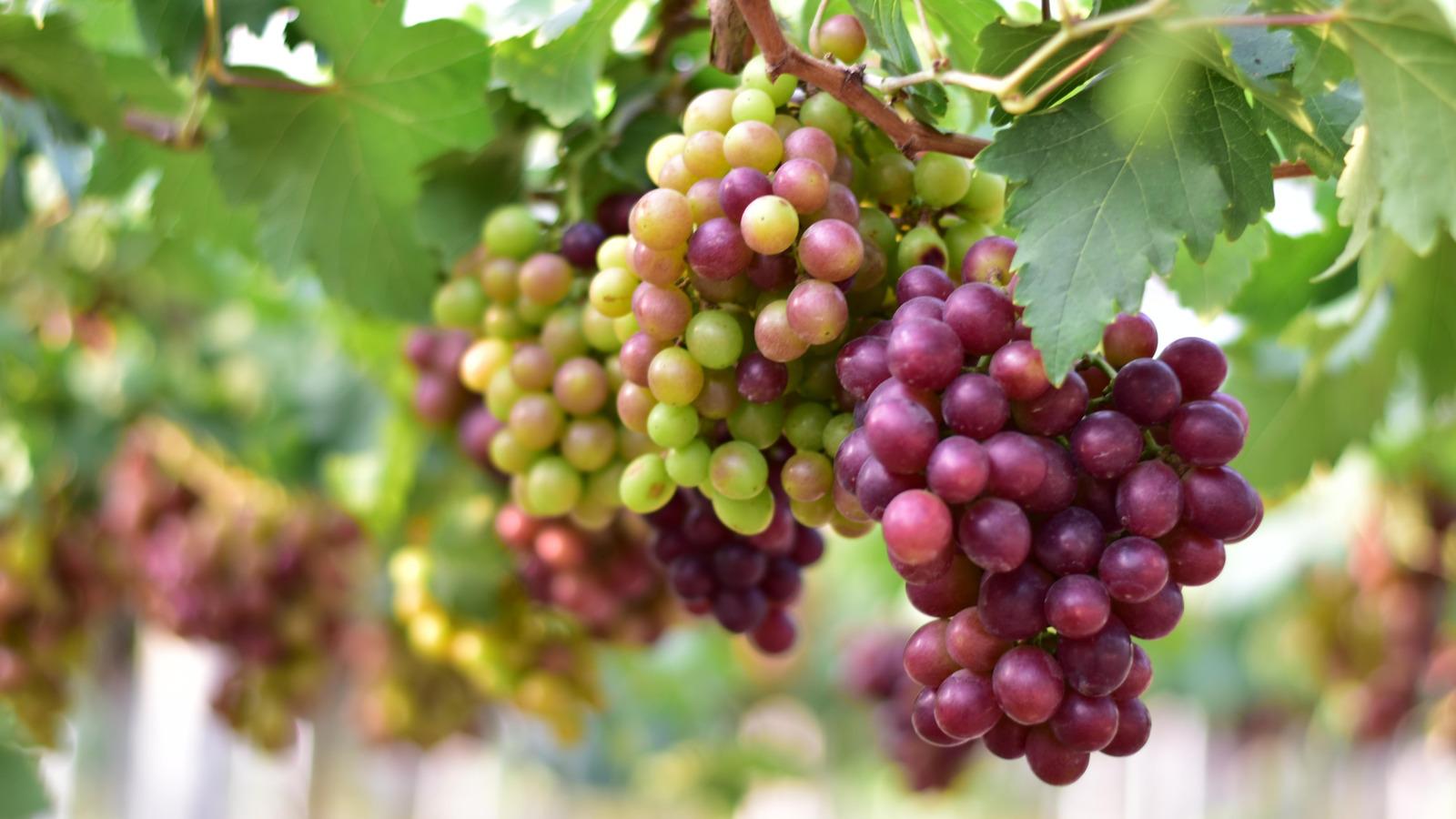
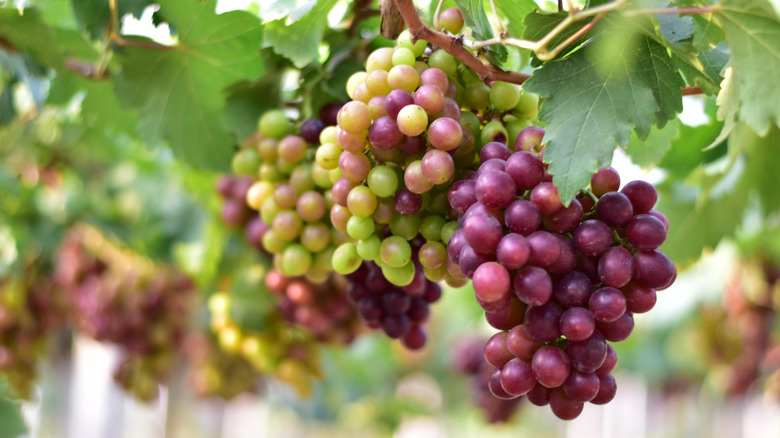
Have you ever glanced at the grapes on a cheese plate and glass of wine in your hand, and wondered how grapes turn into the delicious elixir you are gently sipping? Yes, you may know wine is essentially fermented grape juice, and the grapes used to make wine are not your normal store-bought variety. However, do you know how many grapes go into making a bottle of wine? As with many things that involve a vast number of variables from growing to processing, the answer is, it depends.
An estimated range would be between 600 and 800 grapes per bottle. With an average weight of 1.6 grams per berry (around 0.05 ounces), we can safely guesstimate each bottle of wine contains 736 grapes. To arrive at this reasonable answer, we need to use several averages. One typical bottle contains 750 milliliters of wine (a little under 30 fluid ounces). For every ton of grapes, the average yield is 150 gallons of wine (ranging between 120 to 180 gallons), which works out to 756 bottles — that's roughly 2.5 pounds of grapes per bottle or seven to eight clusters of berries (when averaging 100 grapes in one cluster). This, of course, varies between grape varietals, types of wine they become, how the grapes were pressed, climate conditions, and many more factors.
Different types of wines use different types of grapes
Carlo Prearo/Getty Images
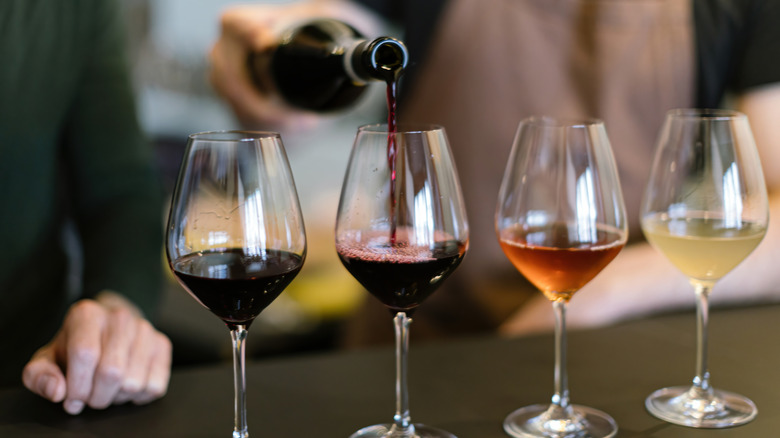
As we mentioned, wine grapes are different from table grapes. Wine grapes are essentially eponymous, meaning the name of the grape corresponds to the type of wine they make. For example, white riesling grapes are used to make riesling wine, red merlot grapes are used to make red merlot wine, and so on (and this is not the only difference between red and white wine.) Riesling grapes are small, weighing an average of 1.66 grams per berry, while merlot grapes are slightly heavier at 1.92 grams per berry. And that's just the grapes. What about the untold truth of wineries, including how they process the grapes? (Hint: It's more industrialized than you think.)
Various methods for pressing grapes yields different amounts of liquid. Some wineries do what is called whole-cluster pressing, which is exactly what it sounds like: Placing whole bunches of grapes into the press. Some wineries remove the stems first before adding the berries into the press. Then there is the actual pressing itself. For example, juice comes out from the initial press. Then there is juice that comes from spinning the grapes (imagine a washing machine!). There is even juice that seeps out from the weight of the berries before the press is switched on. Climate is another factor to consider since an abundance of rain could cause the grapes to swell or conversely, a lack of rain can result in dehydrated grapes, changing the number of grapes that create one bottle of wine.

 Arabic
 French
 Spanish
 Portuguese
 Deutsch
 Turkish
 Dutch
Dutch
 Italiano
 Russian
 Romaian
 Portuguese (Brazil)
 Greek
Greek