


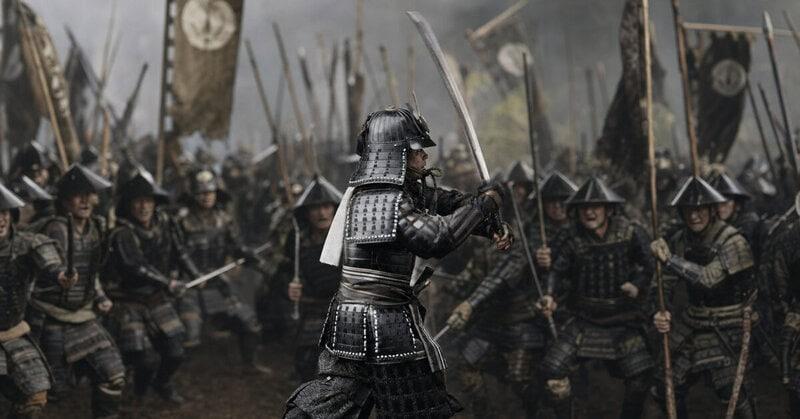
The soldier is outnumbered. Hundreds of armored enemies press in from every direction, their banners snapping in a wind that exists only in code, their war cries swallowed by a thundering orchestral score. Then the player hits one button — one — and the screen erupts. Bodies fly. The crowd thins. The warrior stands alone in a circle of the fallen, breathing hard, impossibly alive. Pull back from the monitor and you will find not a 16th-century killing field but a suburban living room in 2004, a PlayStation 2 controller warm in someone’s hands, the television casting blue light across a face wearing an expression of pure, uncomplicated joy. That moment, repeated across millions of households over two decades, is the foundation on which an entire franchise was built.
The Historical World the Franchise Borrows From

Before there was a game, there was a century of blood. The Sengoku period — Japan’s age of warring states, running roughly through the 16th century — was an era in which the country fractured into competing fiefdoms, each governed by a warlord willing to burn everything his rivals had built. Oda Nobunaga rose from a minor clan in Owari Province to nearly unify Japan through a combination of tactical innovation and terrifying ruthlessness, deploying firearms on a scale Japanese commanders had not seen before. Tokugawa Ieyasu played a longer, colder game and ultimately won it, founding the shogunate that would govern Japan for more than two and a half centuries. Between those two poles stretched a web of shifting alliances, spectacular betrayals, and battles — Nagashino, Sekigahara, the siege of Osaka Castle — whose body counts and political consequences still occupy historians today.
That material is the secret engine running beneath Samurai Warriors and every piece of media connected to its name. The historical figures are real. The settings are drawn from actual Japanese geography. What the franchise layers on top is a kind of fantasy armor: the notion that a single exceptional warrior, blessed with superhuman stamina and a spectacular special attack, could personally tip the outcome of these conflicts. History provides the bones. The game provides the muscle, and the muscle is deliberately, cheerfully enormous.
The anime adaptation available on Crunchyroll narrows the franchise’s wide historical lens onto something more intimate. It follows the Sanada brothers — two real men who navigated the chaos of the late Sengoku period and wound up on opposite sides of Japan’s defining civil conflict. That is not dramatic invention; that is simply what the historical record shows. The anime takes that material seriously in ways the games, by their structural nature, are not designed to.
2004: Omega Force Transplants a Formula

By the early 2000s, Koei’s Omega Force development studio had already built something unusual: a devoted, almost cultish audience for Dynasty Warriors, a hack-and-slash series set in the chaos of ancient China’s Three Kingdoms period. The formula was counterintuitive by the standards of prestige gaming — no cover mechanics, no branching moral choices, no sprawling open world. Just a single warrior dropped into a battlefield swarming with enemies, and the deeply satisfying business of clearing them out. It worked. It kept working. And in 2004, Omega Force made the logical pivot: same engine, different civilization.
Samurai Warriors launched on PlayStation 2 and Xbox as a direct spinoff of the Dynasty Warriors series, transplanting the musou combat system into feudal Japan and building a roster of historical samurai, each carrying a distinct weapon and a moveset that rewarded players willing to invest serious time mastering it. The controls were accessible enough for a newcomer within minutes — light attack, heavy attack, jump, special — but the ceiling for skilled play was genuinely high. That combination, a low floor and a surprisingly elevated ceiling, is harder to engineer than it appears, and it explains much of why the series found an audience that outlasted the hardware generation it launched on.
The Japanese title, 戦国無双 (Sengoku Musou), translates roughly to “Warring States Unrivaled.” The word musou — unrivaled, without equal — did double duty from the start: it named a genre and it made a promise. On this battlefield, you are the unrivaled force. Everything else is a target. In 2004, when much of the industry was chasing cinematic realism and environmental storytelling, that counterintuitive swing toward gleeful, consequence-free excess landed harder than outside observers predicted.
What Makes the Formula Work — and Where It Earns Its Criticism

The musou mechanic sits at the center of everything the franchise does. As a player fights, a special meter fills. When released, the warrior explodes into a crowd-clearing attack that is, by design, spectacular beyond any reasonable military justification — spinning blades, columns of fire, shockwaves rippling outward like a stone dropped in still water. The meter empties, the crowd reassembles, and the player does it again. This loop, repeated across dozens of stages and hundreds of enemies, is what detractors have called a corridor of bodies, and they are describing something real.
The honest version of the criticism is that repetition is structurally baked into the design. Stage ten in any given entry will feel mechanically recognizable to anyone who played stage one. Reviewers have documented this in every generation of the franchise, and the franchise has survived every generation of reviewers. Something else is clearly keeping players around, and that something is worth naming precisely.
Devoted players point to several layers beneath the obvious surface. There is character mastery — learning the full depth of a specific warrior’s moveset until execution becomes fluid and almost meditative. There is stage routing, the tactical puzzle of which objectives to prioritize to prevent allied officers from collapsing before the player reaches them. And there is the social dimension: local co-op play, two people working through impossible odds together on the same couch, which transforms a repetitive single-player experience into something closer to a shared running joke that never stops being funny. These are real pleasures, and they do not appear in most reviews written on deadline.
The historical dimension adds a layer that is harder to quantify but difficult to dismiss. A meaningful number of players report that Samurai Warriors was their first serious introduction to the Sengoku period — that fighting as Oda Nobunaga sent them down a research spiral that ended in historical nonfiction, documentary viewing, and library holds. A video game that teaches history by making its players feel briefly invincible inside it is a strange achievement by any standard, and it is an achievement the franchise has consistently, if inadvertently, delivered.
Seven Years of Silence, Then a Soft Reboot
The gap between mainline entries was long enough to make dedicated fans genuinely nervous. After a 7-year wait since the previous installment in the series, Samurai Warriors went quiet for several years while the gaming landscape shifted underneath it. Cloud gaming emerged as a credible distribution model. Subscription services changed how players thought about ownership and discovery. The audience that had bought the early entries on PlayStation 2 was now older, more deliberate with its spending, and intermittently skeptical that the series had anything new to offer. Reasonable questions circulated about whether the franchise would return at all, or whether it would remain a fondly remembered artifact of a particular early-2000s sensibility.
Samurai Warriors 5 arrived as something close to a reboot in spirit. The art style was redesigned — cleaner, more stylized, leaning into the visual vocabulary of Japanese woodblock prints and ink wash painting in ways that felt like a genuine aesthetic commitment rather than a budget compromise. The story refocused tightly on Nobunaga Oda and his complex relationship with Mitsuhide Akechi, the general who would ultimately betray him at Honnō-ji in 1582, giving the narrative an emotional architecture that earlier entries had not always prioritized. Crucially, the game was engineered as a genuine entry point. No prior knowledge of the franchise’s accumulated lore was required. You needed to understand only that you were about to swing a sword at an unreasonable number of soldiers, and that this was going to feel satisfying.
The platform strategy signaled ambition beyond nostalgia. Samurai Warriors 5 came to Steam, to Nintendo Switch, and to additional platforms including Xbox, broadening access well beyond the console-only audience of the original release. The same game became playable on a living room television, a handheld device on a commute, or a gaming PC. The sword, in other words, had learned to travel, and the franchise was clearly thinking about who it wanted to reach next.
The Anime Adaptation: Where Vulnerability Replaces Invincibility
Where the games hand players invincibility, the Samurai Warriors anime on Crunchyroll hands its characters vulnerability. The Sanada brothers move through the same late Sengoku period the games mythologize, but here the chaos carries genuine weight. Loyalty costs something measurable. The bond between the brothers strains under the pressure of political allegiance that pulls them toward opposite sides of a conflict neither fully chose. The conflict that ultimately separates them is not a stage to be cleared but a wound the story keeps returning to examine. The swords are the same as the ones in the games. The emotional register is entirely different.
This tonal contrast is not a contradiction in the franchise — it is one of its genuine strengths. The anime can do things the games are structurally unable to do: dwell in consequence, in grief, in the texture of a world where landing on the wrong side of a battle means something irreversible. Positioned on Crunchyroll, the series reaches a global audience of anime viewers who may have no prior connection to the games whatsoever — viewers for whom Samurai Warriors is not a PlayStation memory but a streaming discovery made through a recommendation algorithm. The franchise’s footprint grows with each subtitle file served to a viewer who found the show and stayed for the brothers.
The adaptation also functions as a low-pressure introduction to the historical period itself. A viewer unfamiliar with the Sengoku era will absorb enough context through the story to feel oriented, and curious viewers will find the real history rewarding to pursue further. That same pathway — franchise as entry point to genuine historical interest — has been one of Samurai Warriors’ most consistent unintentional contributions across its entire run.
Why the Franchise Keeps Finding New Audiences

The durability of Samurai Warriors across two decades is not an accident, and it is not reducible to nostalgia alone, though nostalgia does real work in sustaining any long-running franchise. The series succeeds because it operates on multiple registers simultaneously and serves genuinely different audiences through each of them. It is a game with real mechanical depth for players willing to locate it. It is a history primer — imperfect, theatrical, but genuinely infectious. It is an anime drama capable of emotional stakes the games deliberately avoid. It is a power fantasy for anyone who has ever wanted, briefly and safely, to be the unrivaled force in the room. Different audiences arrive through different doors and tend to find something worth staying for.
The Sengoku period itself remains evergreen source material, which is the quiet structural advantage the franchise has always held. Historians continue debating its pivotal battles and the decisions that shaped them. Filmmakers keep returning to Nobunaga, to Ieyasu, to the men who served and betrayed them across four turbulent decades. The cultural gravity of that era keeps pulling new readers, viewers, and players into its orbit, and Samurai Warriors has spent twenty years positioning itself as a welcoming entry point rather than a demanding destination that requires prior expertise.
The result is a franchise built on a 16th-century civil war that is, in the mid-2020s, still generating new content, new arguments, and new fans. That is, by any reasonable measure, its own kind of unrivaled achievement — and the battlefield, it turns out, never really ends.

 English
 Arabic
 French
 Spanish
 Portuguese
 Turkish
 Dutch
Dutch
 Italiano
 Russian
 Romaian
 Portuguese (Brazil)
 Greek
Greek