


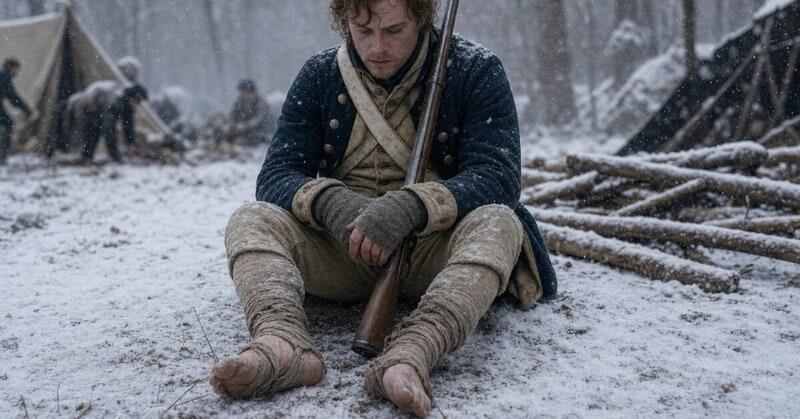
Picture a Continental soldier in the winter of 1777-78, feet wrapped in rags because his boots gave out weeks ago, pressing bare skin against frozen Pennsylvania ground while snow falls on Valley Forge. He holds a musket he hasn’t fired in days. The Revolution that began with pamphlets and grand speeches has come down to this: survival, inch by inch, in the dark. It is one of the most dramatically charged moments in the history of the modern world — and it has almost never appeared on a major movie screen.
The War That Built a Nation, Mostly Ignored by Hollywood

The American Revolution gave the world the Declaration of Independence, permanently altered the theory of legitimate government, and set in motion two centuries of democratic upheaval across every inhabited continent. It also produced, by Hollywood’s account, almost nothing worth watching. Cinephiles who can rattle off a dozen great Civil War films — Glory, Gettysburg, Lincoln, Cold Mountain — or a shelf of World War II classics from Saving Private Ryan to The Thin Red Line, draw a near-blank when asked about the Revolutionary War. The absence is so complete it starts to feel like a clue. Is it the subject matter? Studio economics? Or something stranger and more uncomfortable — a cultural reluctance to dramatize the founding myth that Americans are still actively arguing over?
What’s Actually Out There: A Thin and Uneven Canon

An honest survey of existing films is a humbling exercise. The IMDB list of American Revolutionary War movies surfaces titles like Drums Along the Mohawk (1939), The Scarlet Coat (1955), Revolution (1985), April Morning (1988), and The Crossing (2000) — a lineup that most modern viewers, even history enthusiasts, would struggle to identify. That a 1939 John Ford frontier picture represents something close to a high point of the genre tells you everything about where the genre has been stuck for decades.
The genuine outlier is 1776, the 1972 film adaptation of the Tony Award-winning Broadway musical. It does something almost no other production has attempted with full seriousness: it dramatizes the Second Continental Congress in the sweltering Philadelphia summer of 1776, as delegates from thirteen fractious colonies argue, bargain, and rage their way toward a decision that would make them all traitors under British law. According to the American Battlefield Trust’s guide to Revolutionary War films, the musical’s wit and emotional intelligence give it a peculiar staying power that many more expensive productions have never approached. Its central dramatic engine — the brutal negotiation required to keep Southern delegates in the coalition, specifically the decision to strike anti-slavery language from the Declaration — remains one of the most morally serious sequences in American historical cinema.
Television and streaming have done better than film. All Things Liberty ranks John Adams (2008) at the very top of all Revolution-era screen productions, with Mary Silliman’s War (1994) and The Crossing (2000) close behind. These are smaller, quieter, more character-driven works — a pattern that turns out not to be coincidental.
Then there is The Patriot (2000), the genre’s biggest commercial entry and its most instructive failure. Mel Gibson’s Revolutionary War action film exists in the conversation mainly as a cautionary tale: a spectacle built on invented heroics, significant historical distortions, and a sanitized treatment of slavery in colonial South Carolina that historians found somewhere between embarrassing and infuriating. It made money. It was not a good film. And its poor critical reception almost certainly chilled studio enthusiasm for the subject for years afterward.
Why Historians Respect Mary Silliman’s War and The Crossing

Blogger Roger Launius, writing a frank assessment of the genre, places Mary Silliman’s War, Sweet Liberty, All for Liberty, and The Crossing among films that genuinely tell viewers something useful about the period rather than using it as a costume backdrop for generic action sequences.
Mary Silliman’s War (1994) is particularly striking — and particularly telling. It is a Canadian production that does a better job humanizing a Connecticut woman’s wartime ordeal than most American-made films manage with the entire conflict. Mary Silliman’s husband, Gold Selleck Silliman, was kidnapped by Loyalist raiders in 1779; the film follows her efforts to survive economically and emotionally while navigating a community torn apart by the war. It is small, domestic, and almost entirely without battlefield spectacle. It is also more illuminating about what the Revolution actually felt like from the inside than almost anything Hollywood has produced.
The Crossing (2000), starring Jeff Daniels as Washington, takes on the famous Delaware River crossing on Christmas night 1776 — a desperate gamble by a commander whose army was dissolving around him, whose soldiers were deserting, whose Revolution was days from dying in the cold. The film maintains enough military detail and psychological tension to satisfy serious history buffs while remaining accessible to general viewers. What both productions share is a willingness to sit with ambiguity, to show the Revolution as a dangerous, improvised, frightening thing rather than an inevitable triumph marching toward its preordained conclusion.
The Myth Problem: Founding Fathers as Marble Statues

The central creative obstacle is cultural, not logistical. The Founders have been so thoroughly mythologized — reduced to the solemn faces on currency and the resonant sentences in schoolbook quotations — that dramatizing them as complicated, flawed, sometimes petty human beings feels almost transgressive to American audiences and to nervous studio executives calibrating risk.
HBO’s John Adams (2008) broke this pattern with remarkable results. The seven-part miniseries, based on David McCullough’s biography, showed Adams as irritable, insecure, occasionally wrong, and politically clumsy — a man who was also principled, brave, and essential. Those very imperfections made him human and made the series riveting. It is consistently ranked first among all Revolution-era screen productions precisely because it refused to polish its subject into marble.
The Revolutionary War also lacks the clean moral binary that Hollywood’s traditional hero-villain structure requires. Patriots enslaved people; many of them knew that “all men are created equal” was a sentence their own lives contradicted, and some of them said so privately. Loyalists were not simply villains — they were often neighbors, family members, people with entirely coherent reasons to believe that independence was a catastrophic gamble led by wealthy elites pursuing their own interests. Roughly one-fifth of the white colonial population remained loyal to the Crown throughout the war, a fact that most Hollywood treatments have chosen to ignore entirely rather than dramatize with any complexity. Indigenous nations like the Haudenosaunee Confederacy were not passive bystanders but active geopolitical players trying to survive between empires, a story of devastating complexity that no major film has yet told with adequate seriousness.
There is also the structural problem that the Revolution’s most consequential moments are literary and political rather than visual. Pamphlets. Committee debates. Diplomatic correspondence. The passage of a resolution. These are the hinges on which the story actually turns, and they are extraordinarily difficult to render cinematically without either falsifying them or losing an audience raised on kinetic action sequences. The fact that 1776 found a way to make congressional debate genuinely suspenseful — through music, wit, and character — remains one of the most underappreciated achievements in American historical film.
The Economics of Tricorn Hats

Cultural obstacles aside, the math is also unfriendly. Period films set in 18th-century America are ferociously expensive to mount: handmade costumes, meticulously recreated locations, no vehicles, no electricity, no shortcuts borrowed from the contemporary world. Every frame costs more than a comparable modern thriller, and the built-in audience — people who will buy a ticket specifically because a film is about the Revolutionary War — is genuinely uncertain in size.
The Revolution’s geography compounds the problem. The war was fought largely in the American Northeast: in cities, farms, river crossings, and forested valleys that, however historically significant, do not offer the visual grandeur of the American West or the instantly iconic imagery — Normandy beaches, Pacific island assaults — that anchors World War II films in the popular imagination. The Revolution’s landscapes are beautiful. They do not announce themselves to a movie audience the way Monument Valley or the cliffs of Pointe du Hoc do.
The Patriot‘s underwhelming critical reception despite a reported budget of roughly $72 million almost certainly chilled studio appetite for a generation. Executives read reviews and domestic box-office returns and draw conclusions that outlast the specific film by years. The lesson the industry took — however unfairly — was that the Revolutionary War does not sell.
Smaller productions have paradoxically benefited from these same constraints. Mary Silliman’s War and All for Liberty succeeded partly because limited budgets forced their filmmakers toward intimacy and character rather than spectacle, and intimacy turns out to be exactly what the subject rewards.
What a Great American Revolution Film Would Actually Look Like

Historians and critics who have thought seriously about this gap tend to agree on where the untold stories live. Deborah Sampson disguised herself as a man and enlisted in the Continental Army in 1782, serving in the Fourth Massachusetts Regiment and being wounded in action before her sex was discovered — a story that has attracted occasional television interest but never a serious theatrical treatment. The Siege of Savannah in 1779 included the Chasseurs-Volontaires de Saint-Domingue, a unit of free Black and mixed-race soldiers from Haiti fighting alongside American and French forces — a fact that opens an entirely unexplored dimension of the Revolution’s Atlantic world. The Sullivan-Clinton Campaign of 1779 devastated Haudenosaunee communities across what is now upstate New York, destroying roughly forty towns in a scorched-earth campaign ordered by Washington himself, a brutal episode that shaped Indigenous-American relations for generations and remains almost entirely absent from popular historical memory.
The Revolution’s street-level chaos also offers the kind of visceral, ground-up storytelling that resonates with modern prestige television audiences. The Boston Massacre of 1770 was a confused, terrifying street confrontation in which the truth was immediately contested and politically weaponized — it is less a clean martyrdom than a media event, which makes it urgently contemporary. Loyalist families being attacked by their neighbors. Colonial economies collapsing under trade disruptions and inflation. Soldiers at Valley Forge debating whether the cause was worth their suffering. These are the textures of a revolution as it actually happens, messier and more human than the mythology allows.
Benedict Arnold: A Question of Honor (2003), ranked highly by reviewers at All Things Liberty, demonstrates that the treason narrative retains its power when given room to breathe. Arnold as a genuinely tragic figure — a brilliant, wounded, repeatedly overlooked officer who convinced himself that his betrayal was principled — is a story barely touched by Hollywood despite being one of the most psychologically rich in American history.
The most likely vehicle for all of this may be television rather than film. John Adams proved definitively that the Revolution’s complexity fits the long-form series format better than a two-hour movie ever could. The streaming era has made prestige limited series commercially viable in ways that simply did not exist when Revolution flopped in theaters in 1985. The infrastructure for a great Revolutionary War story now exists in a way it never quite did before. What remains missing is the willingness to use it.
Why America Struggles to Film Its Own Birth
There is a psychological dimension to Hollywood’s avoidance that goes beyond logistics, economics, or the practical difficulties of dramatizing committee debates. The American Revolution is the story Americans are most likely to have strong, competing, and politically charged feelings about. It is the founding myth. It is also the document of a broken promise — a declaration of universal human equality made by men who held other human beings as property, who violently dispossessed Indigenous nations, who defined “liberty” in ways that excluded most of the people living in the colonies they claimed to liberate.
Unlike World War II — a conflict whose moral verdict American culture ratified across decades of film, memorial, and living memory — the Revolution raises questions that still sting and still divide. What did the Founders actually mean? Who did the Revolution actually serve? What is owed to the people it excluded? These are not comfortable questions for a studio trying to market a film to a polarized national audience, and the commercial instinct has been, consistently, to avoid them or to bury them under action choreography.
The films and series that endure — John Adams, Mary Silliman’s War, The Crossing — survive precisely because they do not try to resolve those tensions. They hold them open. They trust the audience to sit with the discomfort of a story that is genuinely, irresolvably complicated. The full landscape of what exists, and what remains missing, can be explored through resources like the Wikipedia list of films about the American Revolution — a page whose relative brevity is itself an argument, and the All Things Liberty ranking of Revolution-era film and television, which remains the most thorough critical survey of the canon available online.
The great American Revolution film may still be waiting to be made. The irony is that the very complications that have kept Hollywood away — the moral ambiguity, the flawed heroes, the revolution that declared liberty while practicing enslavement — are exactly what would make it unforgettable. The gap between the ideals a nation declared and the reality it built is not a reason to avoid the story. It is the story.

 Arabic
 French
 Spanish
 Portuguese
 Deutsch
 Turkish
 Dutch
Dutch
 Italiano
 Russian
 Romaian
 Portuguese (Brazil)
 Greek
Greek