


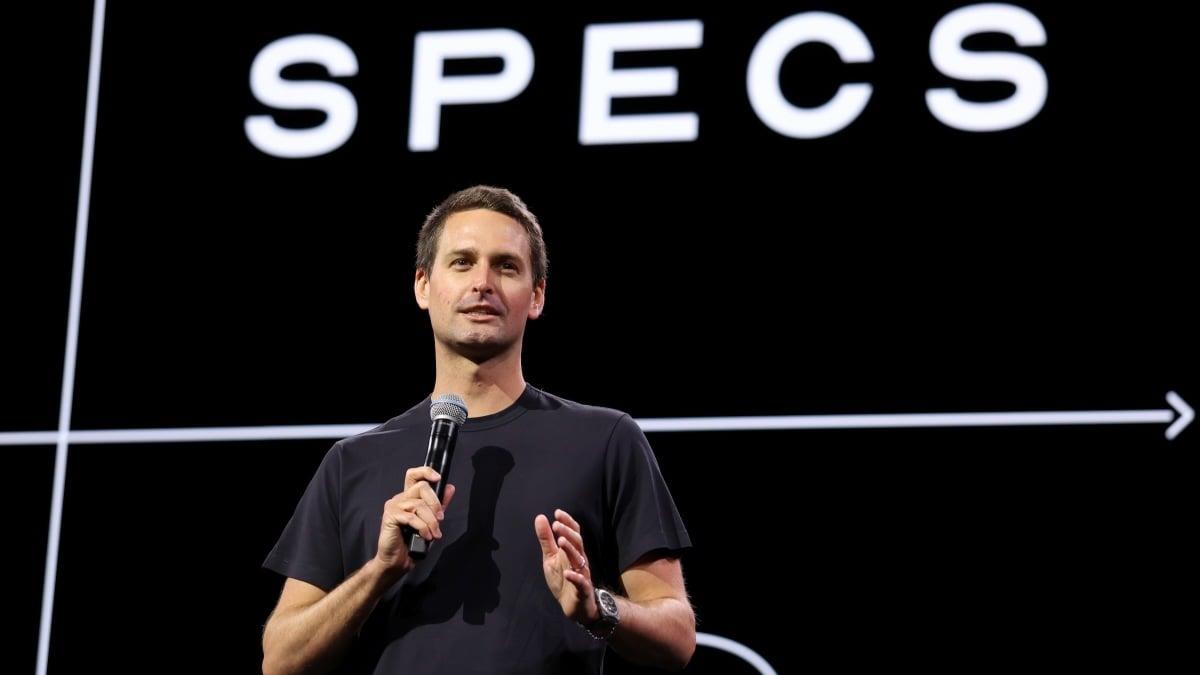
We talked to the young CEO about the new Specs AR Glasses just after his keynote speech.
By

Timothy Beck Werth
Tech Editor
Timothy Beck Werth is the Tech Editor at Mashable, where he leads coverage and assignments for the Tech and Shopping verticals. Tim has over 15 years of experience as a journalist and editor, and he has particular experience covering and testing consumer technology, smart home gadgets, and men’s grooming and style products. Previously, he was the Managing Editor and then Site Director of SPY.com, a men's product review and lifestyle website. As a writer for GQ, he covered everything from bull-riding competitions to the best Legos for adults, and he’s also contributed to publications such as The Daily Beast, Gear Patrol, and The Awl.
and

Neal Broverman
Enterprise Editor
Neal joined Mashable’s Social Good team in 2024, editing and writing stories about digital culture and its effects on the environment and marginalized communities. He is the former editorial director of The Advocate and Out magazines, has contributed to the Los Angeles Times, Curbed, and Los Angeles magazine, and is a recipient of the Sarah Pettit Memorial Award for LGBTQ Journalist of the Year Award from the National Gay and Lesbian Journalists Association (NLGJA). He lives in Los Angeles with his family.
on

Snap CEO Evan Spiegel unveils Specs AR glasses at the Augmented World Expo on June 16, 2026. Credit: Joe Scarnici / Getty Images for Snap
Snap co-founder and CEO Evan Spiegel — who, at 36, is still young for a tech leader even by Silicon Valley wunderkind standards — unveiled Snap's new Specs AR Glasses at the Augmented World Expo in Long Beach, California on Tuesday.
That's where Mashable spoke to Spiegel about the new AR glasses, ways to protect users' privacy, and their intimidating $2,195 price tag.
Snap has released five generations of its Spectacles since 2016, but Specs push smart glasses into new territory. Unlike most augmented reality products, Specs don't have a computing puck or USB-C tether, and feature a proprietary liquid-crystal-on-silicon display.
The new smart glasses are scheduled to ship this fall. Spiegel also introduced a kit for developers who want to create products, apps, and experiences for Specs.
Mashable Enterprise Editor Neal Broverman spoke to Spiegel at AWE 2026; the interview has been edited for clarity.
Who do you see as Specs’ target customers — creators, gamers, early adopters, all of the above?
We're really gonna start with the developer community. There are already 450,000 people who use Snap’s augmented reality tools, who are so passionate about this new era for computing.
And then we'll extend beyond that, with the early adopters and folks who see a lot of value in specific use cases — whether they're trying to improve their golf swing or whether they just want to work on the road and still bring the benefits of that large display or monitor.
It's such a new way of computing — such a different way to think about what a computer even is. And so the big project for us over the next couple of years is just showing people how Specs work, what they do, and really just helping people try them.
How do you see these glasses fitting into people's daily lives?
I think there are a lot of ways — with three major buckets or categories.
Mashable Light Speed
The first would be utility use cases. Things like heads-up directions or translation, when you're exploring a new place. I actually really love the measurement feature [a built-in virtual tape measure]. It's super fun if you're working. We're building some interesting new projects for retail. It's just incredible to have that utility right there, and especially in three-dimensional space.
The second category would be this large private display. That's really meaningful if you're trying to get work done out in the world or on the go. You're sitting on an airplane, or you just want to lie back and stream something on the big screen. I think that's really valuable.
The last category, I'm probably the most passionate about, but I think it will take time for people to discover — which is the ability to have these shared computing experiences — whether that's a game or you're getting work done together because you're looking at a 3D model and sharing that.
There's just so much opportunity to take computing from something that's been historically single player and make it something that's shared. That, to me, is one of the real strengths of Specs.
Google, Samsung, Apple and Meta are all working on smart glasses. What are the advantages of being first?

The new $2,195 Specs AR Glasses. Credit: Snap
Well, I think there are enormous advantages to being the early mover in this new category. Smart glasses are sort of phone accessories, right? Almost like AirPods or something. And then you have these headsets, which are very, very capable, but so heavy and uncomfortable to wear.
Where I think it's really exciting to be an early mover is in augmented reality glasses that are wearable, but also have these really powerful and immersive capabilities to be able to bring a computer into the glasses.
So that, to me, is the opportunity. And because we've been investing over the past 12 years in the full stack, from the developer tools to the operating system to the optics themselves, I think we have a real competitive [product].
Tell us about the privacy aspect.
The outward-facing LEDs are a really helpful indicator that recording's happening. I mean, it's not something that your phone has today, right? So, I think there are real benefits to that.
In addition, one of the things that'll be really important is when people start learning how Specs are actually used. The same way you might be working on a laptop, [that’s] not just a device for recording videos. That sort of understanding, when someone says, ‘Hey, are you recording?’ And that person says, ‘No, I'm watching Netflix?’
That's a real paradigm shift in how people think about Specs and glasses, and I think that will go a long way in helping people understand that folks are wearing Specs to get things done, or to play a game. They're not, you know, using them to record surreptitiously.
As far as the price, do you see it coming down anytime in the near future? When could we maybe see prices come down in this category, if at all?
We care a lot about making Specs more accessible, so that's something that we're really prioritizing and pushing towards. But I think, you know, as I look at other sorts of new computers that are out there, Specs really stands out as something that's more and more accessible than the Macintosh was at the time, or where other new spatial computers are today, like the Vision Pro.
So I feel good about being able to offer Specs and have a ton of value, you know, at a price that may be unattainable today for some folks, but hopefully in the near future, we'll be able to make progress.
Specs are available for preorder at Specs.com for $2,195 with a refundable $200 depost.

Timothy Beck Werth is the Tech Editor at Mashable, where he leads coverage and assignments for the Tech and Shopping verticals. Tim has over 15 years of experience as a journalist and editor, and he has particular experience covering and testing consumer technology, smart home gadgets, and men’s grooming and style products. Previously, he was the Managing Editor and then Site Director of SPY.com, a men's product review and lifestyle website. As a writer for GQ, he covered everything from bull-riding competitions to the best Legos for adults, and he’s also contributed to publications such as The Daily Beast, Gear Patrol, and The Awl.
Tim studied print journalism at the University of Southern California. He currently splits his time between Brooklyn, NY and Charleston, SC. He's currently working on his second novel, a science-fiction book.

Neal joined Mashable’s Social Good team in 2024, editing and writing stories about digital culture and its effects on the environment and marginalized communities. He is the former editorial director of The Advocate and Out magazines, has contributed to the Los Angeles Times, Curbed, and Los Angeles magazine, and is a recipient of the Sarah Pettit Memorial Award for LGBTQ Journalist of the Year Award from the National Gay and Lesbian Journalists Association (NLGJA). He lives in Los Angeles with his family.


 English
 Arabic
 French
 Spanish
 Portuguese
 Deutsch
 Turkish
 Dutch
Dutch
 Russian
 Romaian
 Portuguese (Brazil)
 Greek
Greek