


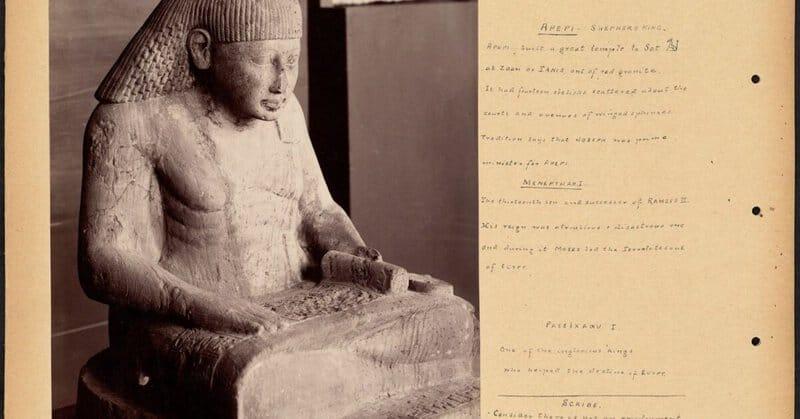
In ancient Egypt, the ability to read and write was not simply a skill — it was a superpower shared by barely one percent of the population, a tiny elite whose command of the written word gave them authority over armies, harvests, temples, and the fate of ordinary citizens. Scribes were the architects of a civilization’s memory, and understanding their world means understanding how one of history’s greatest societies actually functioned from the inside out.
The 1% Who Held the Pen — and the Power

Literacy in ancient Egypt was strikingly rare. Researchers studying the scribal class estimate that only around one percent of the population could read and write, a figure that made every literate individual enormously valuable to the state. While farmers flooded fields and laborers hauled stone under the brutal Egyptian sun, scribes sat at the center of pharaonic power, managing the flow of information that kept a vast and complex civilization from collapsing under its own weight.
Being a scribe was not simply a job. It was entry into one of the most privileged and tightly connected networks in the ancient world — a brotherhood of the literate whose skills were in constant demand from the palace to the temple to the grain storehouse. Those who mastered the written word did not merely record history. They shaped it, filtered it, and in many cases decided what future generations would be allowed to know.
What Did a Scribe Actually Do?

The ancient Egyptian scribe’s responsibilities ranged far beyond simple record-keeping. Their work spanned virtually every domain of organized society: government administration, religious ritual, medical knowledge, military logistics, and trade. A civilization of Egypt’s scale required all of these systems to operate in close coordination, and scribes were the connective tissue holding them together.
Distinct specializations emerged over time. Temple scribes copied and preserved sacred texts, ensuring that religious knowledge passed intact across generations. Administrative scribes managed royal estates and tracked the output of grain stores critical to feeding both the population and the army. Court scribes drafted royal decrees and legal documents that carried the full authority of the pharaoh. Military scribes recorded troop movements, supply inventories, and campaign dispatches. In every case, the scribe served as the essential interface between Egypt’s ruling elite and the mechanics of everyday governance.
Medical scribes deserve particular mention. Ancient Egyptian medical papyri — including the Edwin Smith Papyrus, one of the oldest known surgical texts in the world — survive because scribes faithfully copied and transmitted clinical knowledge across centuries. Without them, that knowledge would have died with the physicians who first acquired it.
Hieroglyphics, Hieratic, Demotic, and the Tools of the Trade

When most people picture ancient Egyptian writing, they picture hieroglyphics — the elaborate pictorial symbols carved into temple walls and painted inside tombs. Scribes certainly worked with hieroglyphics for formal religious and monumental inscriptions, but daily administrative life demanded something faster and more practical. For that, they used hieratic, a cursive script derived from hieroglyphics that could be written far more quickly on papyrus. In the later periods of Egyptian history, an even more simplified script called demotic emerged for everyday commercial and legal documents.
Mastering ancient Egypt’s writing system meant memorizing hundreds of individual symbols, each carrying specific phonetic or ideographic meaning. Hieroglyphics alone comprised more than seven hundred distinct signs during the Middle Kingdom period, with that number expanding significantly in later eras. This was not a skill acquired over a school term. It demanded years of sustained, disciplined study beginning in childhood.
A scribe’s physical toolkit was elegantly practical. Papyrus, manufactured from the pith of the papyrus plant native to the Nile Delta, served as the primary writing surface of the Egyptian bureaucracy. Reed brushes shaped to a fine point formed the stylus of choice. A scribe’s palette held two cakes of ink — black, made from carbon, for the main body of text, and red, made from ochre, for headings, corrections, or significant figures in calculations. That red-and-black convention, born on the banks of the Nile, echoes in document design thousands of years later. Scribes also used wooden or limestone flakes called ostraca for rough drafts and short notes, saving the more expensive papyrus for finished documents.
How Did You Become a Scribe in Ancient Egypt?

Scribal training typically began in early childhood, either at institutions known as “Houses of Life” attached to major temples, or through direct apprenticeship to an established scribe. Students spent years copying texts with painstaking repetition, internalizing not only the symbols themselves but also the formal register of official Egyptian correspondence and religious writing — a literary dialect quite distinct from spoken everyday Egyptian. Surviving student exercises, scratched onto ostraca, show corrections made by teachers and reveal that the curriculum included literary classics alongside administrative formulae.
The path into the scribal profession followed family lines more often than not. Sons of scribes had the clearest route into training, inheriting both the professional connections and the foundational literacy that gave them a decisive head start. The profession was almost exclusively male, though rare evidence exists for literate women in temple and royal contexts. Social background mattered enormously, but it was not an absolute barrier.
Scribal education represented one of the few genuine social mobility mechanisms in the ancient world. Exceptional aptitude occasionally opened doors that birth alone could not, allowing a boy of modest origins to ascend into a class whose privileges — exemption from labor taxes, reliable food rations, access to the highest offices — were otherwise entirely out of reach.
The Scribe Hierarchy: Rank, Status, and Ambition

Egypt’s scribal hierarchy stretched from basic copyists at its base to the Royal Scribe at its summit — a title that placed its holder directly within the pharaoh’s inner circle and carried immense prestige. Between those extremes lay a rich ladder of ranked positions, each with its own responsibilities, compensation, and proximity to power.
Senior scribes could ascend to become viziers — effectively prime ministers who administered the entire kingdom on the pharaoh’s behalf — or overseers of the royal treasury, or chief priests presiding over temple complexes of enormous wealth. The famous scribe Amenhotep son of Hapu, who served Amenhotep III in the Eighteenth Dynasty, rose to such prominence that he was eventually deified after his death — one of only a handful of non-royal Egyptians ever accorded that honor. His career illustrates how completely the scribal path could transform a man’s place in Egyptian society.
Life as a Scribe: Privilege, Posture, and Physical Cost

The life of a scribe was privileged relative to almost everyone else in Egyptian society — but it was not without its physical costs. Scribes worked long hours in a cross-legged or kneeling posture, hunched over papyrus stretched across their laps or resting on low surfaces, steadily manipulating a brush with fine motor precision. That posture, sustained across years and decades of professional life, left measurable traces on the skeleton.
Researchers examining skeletal remains have identified degenerative wear patterns in the joints, spines, and jaw bones of ancient Egyptian scribes consistent with prolonged repetitive posture and sustained fine motor strain. The jaw involvement is thought to reflect the habit of holding brushes or reed tools in the mouth while preparing to write — a mundane occupational detail that survived in bone long after the scribes themselves were gone. The work was cognitively demanding and physically taxing in ways that are easy to overlook when imagining a privileged administrative class.
Even so, the material rewards were substantial. Scribes were among the wealthier inhabitants of artists’ villages in ancient Egypt, enjoying better housing, more reliable food provisions, and — crucially — exemption from the corvée labor and taxation that defined daily existence for most Egyptians. Their graves and tomb equipment reflect a standard of living that placed them firmly among Egypt’s comfortable middle tier, below the great nobles but far above the laboring majority.
What Scribes Left Behind — and Why It Still Matters
Almost everything historians know about ancient Egypt arrived through the work of scribes. The Book of the Dead, agricultural census records, medical treatises, legal contracts, love poetry, astronomical observations, royal annals, and diplomatic correspondence — every category of knowledge that illuminates Egyptian civilization was set down by individuals who understood that writing was how a society outlived its own mortality.
Their meticulous record-keeping is the reason Egyptology exists as a discipline. Without the scribes, the vast majority of what happened along the Nile over three millennia would be silent stone and unreadable imagery. With them, we have a civilization that can speak across four thousand years — describing harvests and heartbreaks, wars and wages, with a specificity that no other ancient culture north of Africa can match for the same period.
Modern scholarship continues to deepen that picture. Studies published as recently as 2024 are reframing how historians understand the scribe’s daily experience — examining not just what they wrote but what their bodies reveal about how they lived, worked, and wore themselves down in service to the written word. The scribes of ancient Egypt offer a timeless reminder that knowledge has always been power, and that those who control the written word ultimately shape the story of their age.

 English
 Arabic
 French
 Spanish
 Portuguese
 Turkish
 Dutch
Dutch
 Italiano
 Russian
 Romaian
 Portuguese (Brazil)
 Greek
Greek