


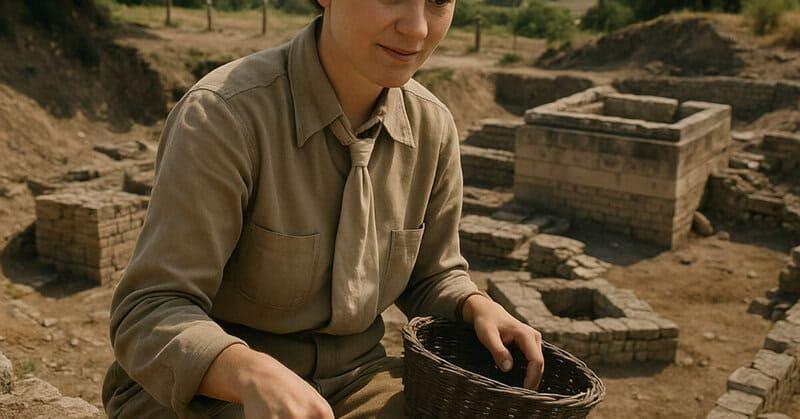
The summer of 1931 in northern Greece was punishing — dry heat, blinding white light, and the ancient earth of Olynthus giving up its secrets one trowelful at a time. Somewhere on that dig, a young American graduate student named Mary Ross Ellingson was doing the kind of painstaking, brilliant work that would eventually fill the pages of a celebrated publication series — work that would appear under someone else’s name.
A Scandal Already in the Air: Athens, 1931

Even as trowels scraped across the floors of ancient Greek houses and notebooks filled with careful observations, something was wrong at Olynthus. A correspondent named Wilhelmina — writing to someone who would preserve her alarm for posterity — described the excavations as being conducted in an unscientific way and named what was happening plainly: a scandal, she said, already being aired in Athens. The dig was still ongoing. The cover-up, in a sense, had not yet begun in earnest. And yet the whispers were already circulating among those who knew the project from the inside.
The stakes were enormous. Olynthus was no minor fieldwork venture — it was considered one of the great American excavations in Greece, a prestige undertaking that would eventually produce fourteen volumes published by Johns Hopkins Press between 1929 and 1952. The ancient city of Olynthus had the rare distinction of being destroyed in antiquity and never rebuilt, leaving its domestic architecture, its mosaic floors, and its household objects locked in something close to a time capsule of classical Greek life. To excavate it properly was to write a chapter in the story of civilization itself. The series that emerged from those digs still sits on library shelves today, still cited, still authoritative — a monument of American classical scholarship. But monuments, as it turns out, can be built on stolen ground.
The Man in Charge: David Robinson and the Making of an Empire

David Robinson was the kind of scholar who filled a room. A professor at Johns Hopkins University and the commanding figure behind the Olynthus project — which ran across multiple field seasons from 1928 to 1938 — he understood exactly what he had found in that sun-baked corner of Macedonia: a city frozen at the moment of its destruction, an archaeologist’s dream, and an opportunity, both intellectual and institutional, that he was not about to share.
The academic culture of the era made his dominance almost inevitable. Senior male professors ran excavations like fiefdoms, and the graduate students — especially the women — who performed the essential intellectual labor of cataloguing, interpreting, and writing up finds were understood to be doing so in service of the project, not in service of their own careers. Credit flowed upward. Recognition pooled at the top. This was not considered scandalous by most participants; it was simply how things worked.
Robinson needed skilled researchers to process the mountains of data that multi-season excavations generate. Mary Ross Ellingson was exactly that — talented, methodical, and capable of the granular scholarly work that transforms a trench full of pottery sherds and mosaic tesserae into publishable argument. She was also, crucially, junior. And in the world Robinson occupied, that made all the difference.
Mary Ross Ellingson: The Scholar Behind the Spade

Ellingson came to the Olynthus project as a graduate student, and what she produced from her work during the 1931 season was serious, original scholarship. Her master’s thesis and her doctoral thesis represented the kind of contribution that, under any fair accounting, would have launched a career. The arguments were hers. The interpretive framework was hers. The prose — careful, specific, built from direct engagement with the material evidence — was hers.
The vulnerability of her position was structural, not incidental. Women in American academia during this period were systematically marginalized — excluded from full participation in professional organizations, passed over for appointments, and left with almost no institutional recourse when a powerful supervisor chose to exploit their research. A female graduate student who challenged a senior professor risked not just her current position but her entire future in the field. The power differential was not simply professional. It was total.
What happened to Ellingson’s work is, in retrospect, almost breathtaking in its brazenness. The scholarship she produced for her theses — the arguments she had constructed from the evidence of the 1931 season — reappeared in two of the Olynthus volumes published under Robinson’s name. Without credit. Without permission. Without acknowledgment of any kind. Her ideas, her prose, her intellectual labor: absorbed into his monument as though they had always belonged there.
The Theft in Print: Fourteen Volumes and a Buried Name

Academic publication is the currency of scholarly reputation, and Robinson understood this better than most. By absorbing Ellingson’s theses into his published volumes, he did not merely steal her ideas — he actively prevented her from ever claiming them. Had she attempted to publish her own findings afterward, she would have appeared to be the one doing the borrowing. The sequence of publication, the prestige of the Johns Hopkins imprint, and the sheer weight of the fourteen-volume series all conspired to make the theft invisible.
The monument of the series was its own alibi. Who would look beneath fourteen imposing volumes, each bearing the name of a distinguished Johns Hopkins professor, and suspect that portions of the intellectual architecture had been lifted from a graduate student’s unpublished work? The structure of academic authority — the publisher, the institution, the professional title — performed the work of suppression without anyone having to actively enforce it.
And yet Wilhelmina’s letter remains. The scandal, she said, was already being aired in Athens in 1931. The whispers existed. The knowledge existed, at least among some of those close to the project. What did not exist were the mechanisms — institutional, legal, cultural — that might have amplified those whispers into something that could not be ignored.
Silence and Suppression: Why It Took So Long to Surface

The structural reasons the story stayed buried are not difficult to trace. Robinson’s institutional prestige at Johns Hopkins provided a kind of protective canopy. The gendered power imbalance meant that the person with the most to gain from speaking out was also the person with the most to lose. And there was no formal mechanism in mid-twentieth-century American academia for the kind of whistleblowing that would have been required to make the misconduct visible to the wider scholarly world.
Consider what speaking out would have cost Ellingson: her reputation in a field controlled by the very networks Robinson inhabited, her future employment prospects, and her standing among colleagues who might have chosen institutional loyalty over truth-telling. The calculus of silence was not cowardice. It was survival.
The broader pattern matters here too. Olynthus was an extreme case, but it was not an isolated one. Across early American archaeology — and across other humanistic disciplines of the same era — women’s fieldwork, women’s analysis, and women’s writing was routinely absorbed into male-authored scholarship as a matter of professional course. What made Olynthus different was the scale and the documentary trail: the theses existed, the parallel texts existed, and eventually someone would sit down and read them side by side.
The excavations concluded in 1938. The final volume of the series appeared in 1952. Decades passed. The scholarship calcified into citation and counter-citation, layer upon layer of subsequent work resting on the original volumes, few scholars stopping to ask who had actually done the thinking.
Alan Kaiser Breaks It Open

The intervention that finally brought the Olynthus case into public view came in the form of a book by archaeologist Alan Kaiser: Archaeology, Sexism, and Scandal: The Long-Suppressed Story of One Woman’s Discoveries and the Man Who Stole Credit for Them. Kaiser did the unglamorous but essential work of reconstruction — tracing the textual parallels between Ellingson’s theses and Robinson’s published volumes, piecing together the timeline of events, and situating the individual misconduct within the larger history of sexism in American archaeology. The book is also widely held in public library collections, a measure of the broad interest it has generated beyond specialist circles.
The significance of Kaiser’s approach was, in part, a matter of language. He called it plagiarism. He called it theft. In a field that had long preferred euphemism — the language of “collaboration,” “assistance,” or simply the erasure of junior names from the record — naming the thing plainly was itself a scholarly act. Reviewers of Kaiser’s work recognized it as a landmark intervention in the discipline’s reckoning with its own history, and the Olynthus case has since become a reference point in conversations about attribution, credit, and the gendered structure of academic labor.
Close examination of Robinson’s publications alongside Ellingson’s theses confirms what Kaiser’s investigation laid out: the parallels are not coincidental, not a matter of shared sources or common scholarly vocabulary. They are the unmistakable mark of one scholar’s work appearing under another scholar’s name. Kaiser’s findings have also been discussed in academic reviews engaging with the broader scholarly implications of the case for how archaeology understands its own disciplinary past.
What the Olynthus Case Actually Proves — and Why It Matters Now
The fourteen volumes of the Olynthus series still sit on library shelves. They are still cited in classical scholarship. They remain, in many respects, useful — the excavation data they contain does not become less real because of the misconduct woven through the project’s history. But they can no longer be read innocently, as straightforward monuments to American archaeological achievement in Greece. They are also documents of what early twentieth-century academia was willing to do to women who had the misfortune of being talented and junior at the same time.
The uncomfortable question the Olynthus case forces is not limited to Robinson and Ellingson. How many other celebrated excavation reports, synthetic monographs, and foundational texts of the early twentieth century rest on unacknowledged labor — labor performed by women, by junior scholars, by the invisible workforce that made the visible monuments possible? The answer, almost certainly, is: more than the field has yet reckoned with. Kaiser’s book is, among other things, an invitation to ask that question systematically rather than leaving it to the occasional archival discovery.
There are also practical implications for contemporary scholarship. The Olynthus volumes remain in active citation circulation. Scholars who use them are, in effect, still citing Robinson. The question of whether and how the field should formally acknowledge Ellingson’s contribution — in databases, in bibliographic practice, in the apparatus of the scholarly record itself — has no clean answer, but it is a question the discipline can no longer avoid simply by not asking it.
The place to begin any reckoning is with a name. Mary Ross Ellingson. Graduate student, scholar, and the person whose careful intellectual work on the 1931 Olynthus season helped build one of the most celebrated excavation series in American classical archaeology — a contribution that was taken from her, buried under fourteen volumes of someone else’s reputation, and suppressed for decades by the structural weight of academic power.
The dust settled long ago over the ancient ruins of Olynthus. The city that Philip of Macedon destroyed and time preserved has given up its secrets to a century of scholarship. But the scandal that Wilhelmina said was already in the air in Athens in 1931 — circulating in whispers among those who knew, dismissed by those with the power to suppress it — has finally, fully landed. And the field of archaeology, with its own buried histories still waiting to be excavated, will not be quite the same for it.

 Arabic
 French
 Spanish
 Portuguese
 Deutsch
 Turkish
 Dutch
Dutch
 Italiano
 Russian
 Romaian
 Portuguese (Brazil)
 Greek
Greek