


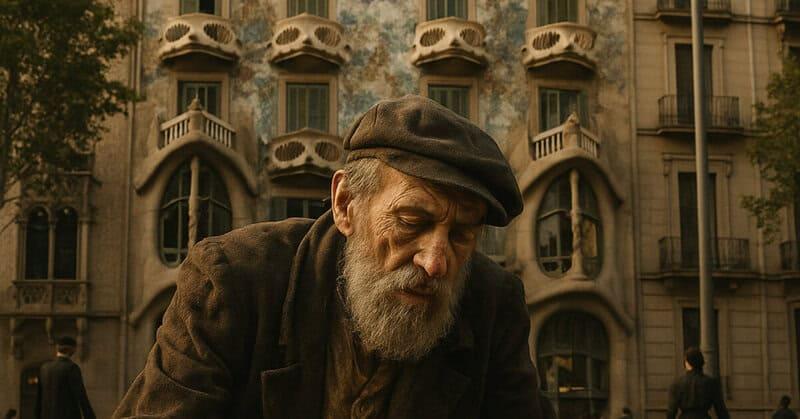
On a warm June evening in Barcelona, a frail old man in shabby clothes was struck by a tram, thrown bleeding onto the cobblestones, and left there — while passersby assumed he was just another beggar. He was, in fact, the most consequential architect the city had ever produced, and Barcelona would spend the next three days not knowing what it had lost.
A Man Nobody Recognized Lying in the Street

The scene unfolds with almost unbearable irony. It is June 10, 1926, around five in the afternoon. The Gran Via de les Corts Catalanes is alive with the ordinary noise of a Barcelona weekday — tram bells, street vendors, the grind of wheels on stone. The light at that hour in early summer falls long and golden across the Eixample district, the kind of light that makes even a rigid city grid look forgiving.
Tram No. 30 strikes an elderly man near the intersection of Gran Via and Carrer de Bailèn. He is thrown to the cobblestones, bleeding from the head. He wears threadbare clothing. His shoes are worn through. He carries almost nothing. Passersby slow, assess what they see — an old man, poorly dressed, apparently penniless — and hesitate. Several taxis decline to take him. He is eventually carried on a stretcher to the Hospital de la Santa Creu, the medieval charity hospital that had served Barcelona’s destitute for centuries. He arrives without a name.
He will lie there, unidentified, for three days. The man bleeding anonymously into a charity ward cot is Antoni Gaudí — the architect whose singular vision shaped nearly every piece of Barcelona’s eccentric, unmistakable skyline.
Who Was This Strange Old Man, Really?

Gaudí was born on June 25, 1852, in the Catalonian province of Tarragona. Whether his precise birthplace was the town of Reus or the nearby village of Riudoms has been disputed by historians almost since his death — a biographical ambiguity that feels strangely fitting for a man who spent his life defying easy categorization. He came from a family of coppersmiths, craftsmen who worked with their hands to shape functional forms, and that lineage runs quietly through everything he ever built.
As a child he suffered from severe rheumatic fever, a condition that made walking painful and pushed him toward stillness, observation, and drawing. Unable to move freely with other children, he spent long hours studying the structures nature had already perfected — the geometry inside a bone, the compressive logic of an eggshell, the repeating mathematics of a honeycomb. This was not romantic inspiration. It was close, patient attention to engineering that evolution had refined over millions of years, and it would become the foundation of everything he built.
He graduated from the Barcelona School of Architecture in 1878. The school’s director reportedly remarked at the time that the diploma was going either to a madman or a genius. By 1926, after nearly five decades of building, that verdict had long since been rendered — though Barcelona that morning had not yet realized it was reading his obituary in the newspaper.
The Walk He Took Every Single Evening

In the final years of his life, Gaudí had largely withdrawn from conventional society. He had effectively moved into the workshop on the Sagrada Família construction site, sleeping there, eating sparingly, receiving almost no visitors. His clothing had become so worn that workmen on the site sometimes failed to recognize him as the architect in charge. He had shed wealth, comfort, and social standing with what appeared to be genuine relief, as though he had been waiting for permission to disappear entirely into the work.
Each evening he made the same walk. From the Sant Felip Neri area he would head towards the Sagrada Família. The route was a ritual — a meditation in motion, the kind of repeated daily gesture that can come to structure an entire life. He had been making this walk for years. The path was familiar. The hour was perfectly ordinary.
That is part of what makes June 10, 1926, so disorienting as a date. The accident that killed Gaudí happened in the most unremarkable possible circumstances — not during some dramatic public moment, but during an evening errand he had performed hundreds of times before, on a street he knew completely, in good light, at a sensible hour. Tram No. 30 simply struck him, and that was that.
Three Days in the Charity Hospital, Still Unnamed

He lay in the Hospital de la Santa Creu for three days — June 10 through June 12 — before anyone formally confirmed his identity. Friends and colleagues who eventually came searching for the missing architect reportedly struggled to recognize the battered, white-bearded figure in the charity ward. The man they found bore little resemblance to any public image of prominence or authority. He looked exactly as he had chosen to look: like one of the poor.
When Barcelona’s mayor and other prominent citizens came and offered to move him to a private clinic — somewhere more suited, they felt, to a man of his stature — Gaudí reportedly refused. He had ended up in the right place, he indicated. He belonged among the people in those beds around him.
He died on the afternoon of June 12, 1926. He was 73 years old. His 74th birthday would have fallen just fifteen days later, on June 25 — the same date that had marked his arrival into the world in 1852.
The Buildings That Outlived Their Maker — and Still Aren’t Finished

To understand what Barcelona lost that June, it helps to walk slowly through what Gaudí actually left behind. His architecture reads like nature made permanent in stone and ceramic tile: the undulating scaled facade of Casa Batlló, which ripples along the Passeig de Gràcia like the back of some vast sleeping creature; the bone-white columns and mosaic terraces of Park Güell, which feel less like a public park than like an ancient organism that decided to fossilize in the middle of a hill; the encrusted, organic surfaces of Casa Milà, which locals call La Pedrera — the stone quarry — with the affectionate mockery cities reserve for things they quietly love.
But above everything else there is the Sagrada Família. Gaudí took over the project in 1883 and spent the remaining 43 years of his life increasingly consumed by it — not as a detached professional but as something closer to an acolyte. His structural innovations were genuinely ahead of his time: catenary arches, hyperboloid vaults, parabolic forms derived from hanging-chain models he built from wire and weights, then photographed upside-down to reveal the natural geometry of compression. He was solving structural problems by asking gravity to show him the answer, decades before such methods were formalized in engineering practice.
He also knew he would never see the building finished, and said so openly. The Sagrada Família has continued rising through the twentieth century and into the twenty-first, generation after generation of architects and craftsmen working from his models and plans — many of which were destroyed during the Spanish Civil War and had to be painstakingly reconstructed from photographs and surviving fragments. Nearly a century after Gaudí’s death, the basilica remains incomplete, making it one of the longest continuously active architectural projects in the modern world.
The Ascetic Behind the Extravagance

The central contradiction of Gaudí’s life is worth sitting with carefully. The man who designed some of the most visually overwhelming, maximalist, and color-saturated buildings in European history chose for his private self precisely the opposite: silence, poverty, fasting, and repetition. He refused personal payment for his work on the Sagrada Família. He solicited donations for the project from strangers on the street — a shabbily dressed old man asking passersby to fund a cathedral, an encounter that must have been genuinely startling for those who did not know him. He wore out his shoes and did not replace them.
His faith had deepened throughout his life until it became the governing framework through which he understood his own work. He described his role in building the Sagrada Família as merely instrumental — he was not the author but the vessel. This appears to have been a genuine theological position, not false modesty, and it shaped every personal decision he made in his final decades: including, perhaps, the decision to go on making that evening walk alone and on foot through the city rather than accepting any comfort that might have separated him from ordinary life.
His personal world had contracted over the years. Close friends died. His longtime patron, the industrialist Eusebi Güell, whose support had made some of Gaudí’s most ambitious early work possible, was gone. A romantic attachment that had once seemed possible never developed into anything lasting. By the time Tram No. 30 struck him on that June afternoon, he was largely alone — by choice, it seems, as much as by circumstance.
Why His Death Anniversary Still Matters
Gaudí was buried in the crypt of the Sagrada Família — inside the building that had consumed the last four decades of his life. He remains there today. Every visitor who walks through the basilica’s doors is, without necessarily knowing it, walking over his grave. There is something deeply strange and fitting about that arrangement: the man and his life’s work occupying the same ground permanently, neither entirely finished, neither truly separable from the other.
In 2000, the Vatican formally opened the cause for his beatification, meaning the Catholic Church is actively investigating whether Antoni Gaudí should one day be declared a saint. An architect. A potential saint. Buried inside his own unfinished cathedral. The story keeps accumulating layers of strangeness the longer you look at it.
His death on June 10, 1926 — fifteen days before his birthday — has a quality that feels almost composed, though of course it was not. A man who spent his life building monuments explicitly designed to outlast him died the way he had chosen to live: without ceremony, without announcement, moving quietly through a city that did not immediately understand what had just left it. Barcelona woke on June 11 to discover that the unidentified old man in the charity ward had been carrying, in that worn-out head, the entire future of its skyline.

 Arabic
 French
 Spanish
 Portuguese
 Deutsch
 Turkish
 Dutch
Dutch
 Italiano
 Russian
 Romaian
 Portuguese (Brazil)
 Greek
Greek