


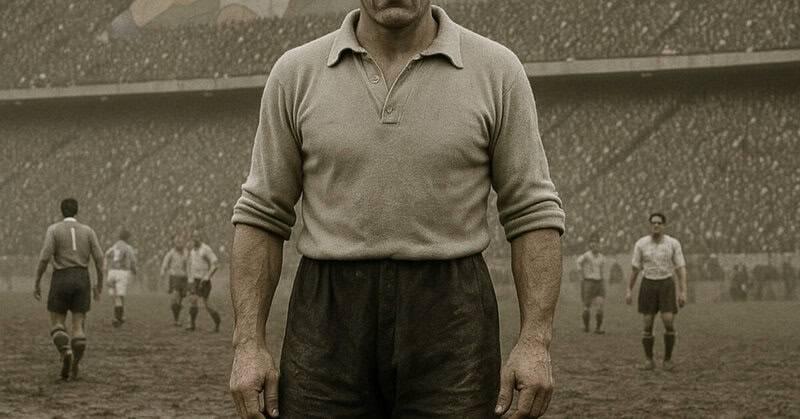
On July 30, 1930, ninety-three thousand people pressed into a stadium that still smelled of fresh concrete, squinting through the Montevideo winter haze at a rectangle of grass where history was about to be made — though almost nobody outside South America was paying attention.
A Muddy Pitch, a Packed Grandstand, and a Dream Nobody Thought Would Work

The Estadio Centenario had been built in eight months, a monument to a century of Uruguayan independence, and it was barely dry. Workers had hammered and plastered through the Southern Hemisphere winter to have it ready in time. Now it was full to the point of danger, the crowd spilling into every available corner, the noise already enormous before Uruguay and Argentina had even taken the field.
This was the first-ever World Cup final, and the entire improbable experiment — one man’s obsession with turning football into a global religion — either succeeded here or collapsed into the most expensive embarrassment in sporting history. How did a tournament now watched by billions begin in a country most Europeans couldn’t find on a map? The answer starts with a problem nobody was sure could be solved, a visionary who refused to accept that, and a series of contingencies that somehow cohered into something magnificent.
Football Before the World Cup: A Sport Without a Crown

By the early 1900s, football had spread from Victorian England across continents with the speed of a rumour. Dock workers in Buenos Aires played it. Textile workers in Montevideo formed clubs. In Europe, national leagues were growing rowdy and profitable. The game had gone everywhere — and yet it had no single competition to declare a true world champion.
The Olympic football tournament existed, but it was restricted to amateurs by strict definition, which meant the professional players who actually defined the highest level of the game were barred from participating. It was a bit like hosting a world cooking championship and forbidding anyone who had ever worked in a restaurant. The result was a glaring gap at the summit of world sport.
Meanwhile, national rivalries were fierce and unresolved. South American teams burned with the desire to prove themselves against Europe. The continent had developed its own style of play, produced extraordinary players, and wanted a legitimate stage. The central tension that would drive the entire founding story was already forming: who owned football’s future — the Europeans who had invented it, or the wider world that had embraced it and made it their own?
Jules Rimet and the Impossible Idea

Into this unresolved argument stepped Jules Rimet. A French lawyer with the bearing of a diplomat and the stubbornness of a true believer, Rimet became FIFA president in 1921 carrying a conviction that football could do something politics had manifestly failed to do: bring nations scarred by the First World War back into meaningful contact with one another. He was an idealist, but the organised kind — the kind who reads the room, counts the votes, and stays in the meeting long after everyone else has given up.
The pivotal moment came at the 1928 FIFA Congress in Amsterdam. Delegates voted to create a World Cup open to professional players — the moment the idea moved from a dream discussed over dinner into an official resolution on paper. But the debate that followed was fierce. European football associations were skeptical at best and hostile at worst. The cost of traveling to South America by sea — a journey of roughly two weeks each way — was not a trivial concern. Clubs would lose their best players for months. The financial risk was real.
Rimet lobbied, cajoled, and manoeuvred. He was the kind of man who understood that history rarely happens by accident — it happens because someone keeps pushing after everyone else has sat down. His stubborn idealism would prove to be the tournament’s most important ingredient.
Why Uruguay? The Audacious Bid That Launched the First World Cup

Several nations expressed interest in hosting, but Uruguay’s pitch was extraordinary in its generosity and nerve. They offered to build an entirely new national stadium from scratch, to cover the travel and accommodation costs of every visiting team, and to absorb the financial risk themselves. They also had clear credentials: back-to-back Olympic football gold medals in 1924 and 1928 gave them a legitimate claim to be among the best teams on the planet. It was an offer FIFA did not refuse.
But the European revolt that followed nearly sank the tournament before a ball was kicked. The long Atlantic crossing, the expense, and the disruption to domestic seasons led one major nation after another to decline. England, Germany, Italy, Spain, and the Netherlands were all absent. In the end, only four European nations made the journey: France, Belgium, Romania, and Yugoslavia. Romania’s participation carries a detail that perfectly captures the chaos of the whole enterprise — King Carol II reportedly selected the squad personally and arranged paid leave from their employers so the players could attend. When a monarch has to personally manage the logistics for his national football team, you know the tournament is operating in extraordinary conditions.
Thirteen teams in total arrived in Montevideo, a city in a country of just 1.9 million people, to stage world sport’s most ambitious experiment. Something was being attempted that had never been attempted before, and everyone present knew it.
Thirteen Teams, One Trophy, and Matches That Made History

The FIFA World Cup in its first edition was compact and raw — four groups feeding into a knockout semi-final stage, nothing like the sprawling machinery of modern tournaments. Thirteen nations. One trophy. And a series of matches that would write the first chapter of the most consequential recurring event in world sport.
The tournament’s opening match was played on July 13, 1930: France against Mexico. A French player named Lucien Laurent scored what would become the most historically significant goal in football — the first in World Cup history. Laurent himself, interviewed decades later, described the moment with characteristic modesty, suggesting he had no idea at the time that it would matter. He was just a footballer trying to win a game on a winter afternoon in South America. That ordinariness, set against the magnitude of what the moment would come to represent, is part of what makes the story so compelling.
The tournament built toward a final that nobody had scripted but everyone wanted. Uruguay versus Argentina: the two great River Plate rivals, separated by a stretch of water and united by a mutual, burning desire to prove superiority. The atmosphere was supercharged. There were genuine fears of disorder in Montevideo’s streets. Before the match, the two teams argued bitterly over which ball to use — a dispute so intractable that they eventually agreed to use each team’s own ball for one half apiece. It is one of the great details in World Cup history, the kind of thing that reminds you these were real people with real stakes and real pride, not symbols in a historical tableau.
Uruguay won 4-2. The crowd erupted. Uruguay declared a national holiday. Jules Rimet quietly presented a small gold trophy — one that would eventually bear his name — to the victors. It was a modest moment for an immodest achievement.
What the 1930 Tournament Actually Built

Beyond the scoreline, the 1930 World Cup established something more durable than any result: a proof of concept. International football could generate mass emotion, national identity, and global attention simultaneously. It could make a small nation feel, for ninety minutes, like the centre of the universe. It could also, as Rimet had always believed, pull countries into contact with one another around something joyful rather than something destructive.
The tournament also settled the professionalism question decisively. By welcoming paid players from the outset, the World Cup immediately became the true pinnacle of the sport in a way the Olympic tournament never could. The Olympics retained football on its programme, but from 1930 onward it would always be playing second fiddle to the competition that admitted the world’s best players without restriction.
The imperfections are worth acknowledging honestly, because they are part of the story. The European absence was a genuine wound to the tournament’s credibility. The political maneuvering that placed the event in Uruguay was as much about financial practicality as sporting merit. The whole enterprise was held together, in places, with goodwill and improvisation. The World Cup was born messy — and that humanity, that sense of people finding their way toward something great, is part of what makes its origin story so enduring.
From 13 Teams in Montevideo to 48 Teams Across a Continent
A direct line runs from those thirteen teams in Montevideo to the FIFA World Cup 2026, the 23rd edition of the tournament and the first to feature 48 teams, co-hosted across three countries: Canada, Mexico, and the United States. The scale has changed almost beyond recognition. The underlying purpose has not.
The Estadio Centenario — built in eight months as a monument to Uruguayan independence, barely dry when ninety-three thousand people filled it — remains the perfect symbol for everything the first World Cup was: audacious, underprepared, slightly miraculous, and ultimately triumphant. A country of fewer than two million people built a stadium for ninety-three thousand, invited the world, and hosted the birth of global sport’s greatest recurring event. The concrete was barely set. The ambition was not.
The World Cup endures because it was always about more than football. It was about nations telling stories about themselves on a global stage — stories of pride, identity, history, and longing — and finding, in the telling, an unexpected connection with people telling entirely different stories from entirely different places. That function, which Jules Rimet intuited before anyone had the vocabulary to describe it, is still what the tournament does every four years. As 2026 approaches, the spirit of 1930 remains the engine underneath it all: ambitious, chaotic, idealistic, and utterly convinced that this is worth doing. Rimet’s impossible idea didn’t just survive. It became the world’s game.

 Arabic
 French
 Spanish
 Portuguese
 Deutsch
 Turkish
 Dutch
Dutch
 Italiano
 Russian
 Romaian
 Portuguese (Brazil)
 Greek
Greek