


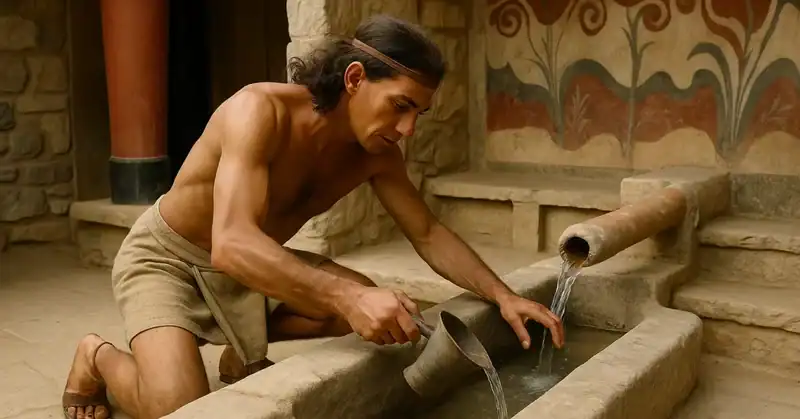
Imagine arriving at Knossos around 1600 BC. There are no walls to stop you, no moat, no garrison of spear-carriers eyeing you with suspicion. You simply walk in — through open corridors that catch the Aegean breeze, past light wells dropping shafts of Mediterranean sun into rooms several storeys below ground level, and into a palace that smells of saffron, cedar oil, and the sea. It is a building that trusts the world not to destroy it. That trust, as it turned out, was catastrophically misplaced.
Europe’s First Civilisation, Hiding in Plain Sight

The Minoan civilization flourished on the island of Crete from roughly 2700 BC, reaching its dazzling peak between about 1700 and 1450 BC. That peak predates classical Greece by more than a thousand years — by the time Socrates was walking around Athens asking uncomfortable questions, the Minoans had already been gone longer than the Roman Empire has been gone from us today. For centuries, later Greeks preserved no memory of them at all. They had not faded into legend. They had simply vanished from history’s keeping.
For a long time, scholars debated where the Minoans came from, with theories ranging from Egyptian migration to Near Eastern origins. A 2013 study published in Nature brought DNA evidence to bear on the question, concluding that the Minoans were of European origin rather than from populations from Africa or the Near East. They were, in short, a homegrown European phenomenon: a civilisation that built itself into extraordinary complexity on a single island in the middle of the sea.
What they built there was unlike anything else in the Bronze Age European world. Knossos alone covered approximately 20,000 square metres and contained well over a thousand rooms — storerooms stacked with giant ceramic jars of olive oil and grain, workshops occupied by specialised craftspeople, ceremonial halls decorated with some of the most arrestingly alive art the ancient world produced. Minoan frescoes do not carry the rigid, hierarchical stiffness of Egyptian wall painting. They have movement, joy, and an almost cinematic energy: young athletes caught mid-flight over the backs of charging bulls, dolphins curving through painted waves, women in elaborate tiered dresses watching festivals with expressions of genuine engagement. Looking at Minoan art across four millennia of distance, you feel the presence of specific human beings rather than symbolic figures. That feeling is rare in ancient art and rarer still at this age.
Engineering That Arrived Too Early

The art alone would make the Minoans remarkable. What makes them genuinely strange is the engineering underneath the art.
Knossos had flush toilets. It had a clay pipe plumbing system sophisticated enough that modern engineers studying the site have noted its hydraulic competence — tapered pipes that maintained water pressure and directed both fresh water and waste water through separate channels. The palace featured light wells: open vertical shafts cut through multiple storeys that channelled natural daylight deep into interior rooms that would otherwise have been entirely dark. The walls were built using a technique of timber lacing — wooden beams embedded within the masonry in a lattice structure — that gave the building flexibility and a capacity to absorb seismic shocks in a region that was then, as now, highly earthquake-prone. This was not accidental construction. It was deliberate structural thinking applied to a known environmental hazard.
In the workshops, Minoan craftspeople produced gold jewellery of extraordinary delicacy, carved stone vessels from materials imported from hundreds of miles away, and worked with faience — a glassy ceramic material requiring precise kiln temperature control — at a level of consistency that implies specialised knowledge maintained deliberately across generations. This was not amateur production. It was professional craft tradition sustained by people who had trained for years, learned from masters, and built upon accumulated technique. The palace economy depended on it.
And then there is the writing. The Minoans were literate. They used a script called Linear A — visible on clay tablets, stone vessels, and ritual objects across Crete — that appears to record administrative accounts and possibly religious texts. The problem is that nobody alive can read it. Linear A has never been deciphered. We know the Minoans were organised enough to need administrative records and literate enough to produce them. We simply cannot access any of what they wrote. Entire bodies of technical knowledge — craft processes, agricultural practices, religious cosmology — may be encoded in symbols that remain opaque to modern scholarship. The Minoans left us a message. We cannot open it.
Navigators of the Stars: Sailing Without a Compass

The plumbing and the art are impressive enough. But what the Minoans achieved on the open water may be their most consequential lost accomplishment.
The archaeological record of Minoan trade is remarkable in its reach. Cretan pottery appears in Egypt. Minoan copper objects turn up on Cyprus. Obsidian, tin, and luxury goods moved back and forth across the Eastern Mediterranean in patterns that can only be explained by regular, reliable, large-scale sea trade. Minoan merchants were not occasionally crossing the Aegean in favorable weather. They were running a functioning trade network across open ocean, year after year, in the Bronze Age, without a magnetic compass.
How they managed this is a question that research is beginning to answer. Research reported in 2023 suggests the Minoans may have used celestial star-path navigation techniques — a method of memorising the rising and setting points of specific stars at specific seasons to hold a reliable course across open water. The technique is well documented among Polynesian navigators, who used comparable methods to cross the Pacific. The Minoans, it appears, may have independently developed or inherited an equivalent system for the Mediterranean and Aegean.
What this means in practice is that Minoan navigators carried their charts in their heads. They knew which star rose over which horizon at which time of year, and they used the sky’s geometry to stay on course through darkness across water with no visible landmarks. Crucially, this was a transmissible, teachable system — something passed from experienced pilot to apprentice, generation after generation, so long as the culture holding it remained intact. The moment that transmission chain broke, the knowledge was gone. There were no written sailing manuals to fall back on. The maps existed only in trained human memory.
The Collapse: What the Evidence Says and What It Does Not

Around 1450 BC, something broke everything.
Across Crete, palace sites burn. Zakros on the eastern coast. Malia on the north. Phaistos in the south. Site after site shows thick destruction layers in the archaeological record — charred timber, collapsed walls, the physical signature of sudden catastrophe. Within a generation, the culture that built and maintained these places is gone, or so radically transformed as to be unrecognisable. The open, unwalled palace civilisation ceases.
Scholars have debated the cause for decades, and the honest answer is that no single explanation fits all the evidence cleanly. The most dramatic candidate is the catastrophic eruption of the Thera volcano — modern Santorini, visible from Crete — which almost certainly sent tsunamis across the Aegean and disrupted regional agriculture through ash fall and atmospheric effects. But the dating of the Thera eruption remains contested, and volcanic disaster alone does not account for the full pattern of destruction. Mycenaean Greek invasion and conquest is another strong candidate, supported by clear archaeological evidence of Mycenaean presence at Knossos following the destruction events. Internal political fracture, rebellion, and a compounding sequence of environmental stress and social instability are also credible contributing factors. Most contemporary scholars favour some combination of these pressures — which is a careful way of saying the precise sequence of causes remains unresolved.
The telling detail lies in what the Mycenaeans did when they occupied Knossos. They took the structure of Linear A and adapted it to write their own Greek language, producing Linear B — a script we can read because it encodes an early form of Greek. They kept the administrative habit. But they did not maintain the plumbing. The fresco tradition faded. The open palace culture, with its light wells and its conspicuous lack of defensive walls, gave way to something more militarised and more fortified. The Mycenaeans inherited the shell of Minoan civilisation. The knowledge inside that shell did not survive the transfer intact.
The Archaeology of Absence

Lost technology, in the Minoan context, is not a romantic metaphor. It is a measurable archaeological fact. The hydraulic systems of Knossos do not reappear in the Aegean for centuries. Open-sea trade navigation at Minoan scale does not return to the region in the same form. The craft traditions — the faience work, the carved stone vessels, the specific techniques of Minoan goldsmithing — disappear from the record. The Greek Dark Ages that followed, roughly 1100 to 800 BC, brought population collapse, the complete loss of writing in the Greek world, and a retreat to far simpler architectural forms. A civilisation that had multi-storey plumbed buildings was followed, within a few generations, by cultures living in structures of radically greater simplicity.
This civilisational regression only makes full sense if we understand that what was lost was not primarily buildings or objects — those can, in principle, be rebuilt and remade — but knowledge itself. The navigational star paths lived in trained human minds, not written manuals. The craft techniques were passed mouth to ear in workshops, not recorded in reference texts. The engineering principles of the plumbing existed in the heads of specialists who taught apprentices who taught further apprentices. When those specialists were killed, dispersed, or simply not replaced across a generation or two of disruption, the knowledge died with them. It is a lesson with uncomfortable modern resonance: the most fragile form of technology is the kind that exists only in human memory and human practice, with no written redundancy behind it.
Archaeology continues to add detail without always adding resolution. Ongoing excavations at the site of Zominthos in the Cretan highlands, and continuing work at Knossos itself, regularly refine the picture of Minoan organisation and daily life. Each season’s dig adds evidence of complexity. Each season also generates questions the available evidence cannot yet settle.
What the Minoans Still Have to Tell Us

The Minoans are not a closed historical file. The 2013 genetic study and the 2023 navigation research are reminders that new science keeps reopening questions that earlier scholarship thought settled. This is a story still being actively written — by geneticists, archaeologists, historians, and linguists, all circling the same central mystery from different angles and with different tools.
As a cultural case study, the Minoans offer something unusual and slightly unsettling. They built one of the ancient world’s most sophisticated civilisations without placing militarism at its visible centre. The surviving art does not celebrate conquest or military hierarchy. The palaces show no evidence of having been designed for defence. The cultural energy went into beauty, trade, ceremony, and engineering. Whether this reflects genuine political pacifism, confidence derived from maritime dominance, or simply the limits of what archaeology can recover from a largely unread civilisation is itself an open and genuinely important question. That this particular civilisation was erased so thoroughly, while more militarised neighbours endured, raises issues that extend well beyond the academic.
Somewhere in museum storage drawers and excavation archives, there are clay tablets and stone vessels inscribed with Linear A — a script no living person can read, in a language not spoken for three thousand years. The Minoans, who administered a complex palace economy with enough care to write things down, who recorded their religious practices alongside their trade accounts, left us a record of themselves. It sits in storage, waiting for the linguistic or computational breakthrough that might finally open it.
The greatest lost Minoan technology may not be the flush toilets, or the earthquake-resistant walls, or the star-path navigation systems that let Bronze Age sailors cross open ocean by reading the sky. It may be something both simpler and more irrecoverable than any of those: the decipherment that would finally let the Minoans speak for themselves, in their own words, about who they were, what they understood, how they built what they built — and why, in the end, it all came down.

 English
 Arabic
 French
 Spanish
 Deutsch
 Turkish
 Dutch
Dutch
 Italiano
 Russian
 Romaian
 Portuguese (Brazil)
 Greek
Greek