


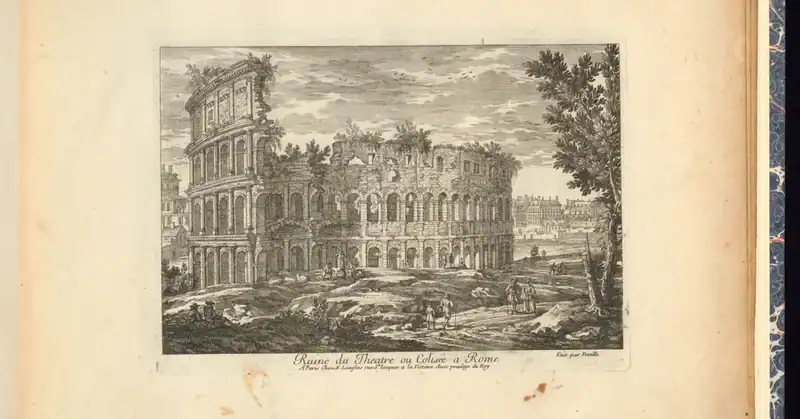
The sand was still fresh, the stone still clean, and the air already thick with the smell of iron and animal fear. In AD 80, Rome poured itself — senators and slaves, soldiers and street vendors, somewhere between fifty thousand and eighty thousand souls — into the newly dedicated Flavian Amphitheatre, and for one hundred days straight, the killing did not stop.
One Hundred Days of Death

Imagine standing inside that bowl on the first morning. Above you, a vast retractable awning — the velarium, rigged by Roman sailors using ropes, masts, and pulleys anchored around the upper rim — sliced the Mediterranean sun into tolerable shadow. Below you, the elliptical arena floor was spread with pale sand, chosen precisely because it absorbed blood well and could be raked clean between bouts. Around you, tens of thousands of Romans were wedged into their assigned seats by rank, by wealth, by sex — the hierarchy of the empire encoded in the very stone beneath them. And down in the dark beneath the arena, hidden in a two-storey labyrinth of tunnels and cages, animals from the edges of the known world — lions, elephants, bears, exotic creatures that most Romans had never seen — waited for the elevators to carry them, blinking and furious, up into the light.
The hundred days of inaugural games that Emperor Titus staged to dedicate the Colosseum were not entertainment in any casual sense. They were a statement — possibly the loudest architectural and political statement the ancient world had ever made. Thousands of animals died. Gladiators fell in the sand to the crowd’s roar. And the structure itself, rising four storeys above Rome’s skyline, announced something that no speech or proclamation could match: the Flavian dynasty was here, it was permanent, and it controlled life and death itself. Two questions pull you back across nineteen centuries — how did Rome build the ancient world’s largest amphitheatre in under a decade, and what exactly was it built to say?
A Dynasty Needs a Monument: Vespasian’s Calculated Vision

The story begins not in triumph but in chaos. The year AD 69 — known to history as the Year of the Four Emperors — saw the Roman world tear itself apart in civil war. Four men claimed the throne in a single year. Only one survived it: Titus Flavius Vespasianus, a blunt, practical military general who had spent recent years fighting a brutal campaign in Judaea. Vespasian was not glamorous. He was not descended from Augustus. He was a man who had clawed power from a burning year and needed, urgently, to make his dynasty feel inevitable.
His answer was stone. Construction of what would become the Colosseum began in AD 70, on ground that carried enormous symbolic weight. The site had previously held the ornamental lake at the heart of Nero’s Domus Aurea — the Golden House, a vast private pleasure complex that had scandalized Rome by swallowing land the city regarded as its own. Draining that lake and breaking ground for a public amphitheatre was not merely a construction decision. It was a political declaration: Vespasian was giving Rome back its stolen ground. The emperor who came before was selfish and monstrous; the new dynasty was generous and Roman.
The money to build it came, in substantial part, from conquest. The Jewish War of AD 66-73 — which Vespasian had prosecuted and his son Titus ultimately concluded with the destruction of Jerusalem in AD 70 — generated enormous plunder. Empire, in other words, was financing its own spectacle. The wealth extracted from the edges of the Roman world was being poured back into the centre, transformed into stone arches and marble seating and the infrastructure of public death. The amphitheatre’s official name, Amphitheatrum Flavium, announced dynastic ownership in Latin as permanent as the travertine limestone it was built from. This was the Flavians’ gift, their brand, their bid for immortality.
Engineering at a Scale Rome Had Never Attempted

What Vespasian commissioned, and what his architects and engineers delivered, was simply the largest amphitheatre the ancient world had ever produced — a record the Flavian Amphitheatre still holds. Its elliptical footprint stretches roughly 188 metres by 156 metres. Its outer wall rose across four storeys of travertine limestone, volcanic tuff, brick, and Roman concrete — a material whose binding chemistry engineers still study with admiration. The sheer mass of the building is almost impossible to feel from photographs. You have to stand at its base and look up to begin to understand it.
But scale alone is not what made the Colosseum a feat of engineering. The real genius was in the flow. Eighty arched entrances were designed with crowd-management precision that would not embarrass a modern stadium architect. A crowd of tens of thousands could fill and empty the structure rapidly, each entrance numbered, each spectator’s ticket indicating a specific gate, staircase, and tier. The Roman talent for infrastructure, usually applied to roads and aqueducts, was here turned to the problem of moving masses of people in and out of a spectacle without catastrophe.
Beneath the arena floor lay the hypogeum: a two-level underground network of corridors, cages, ramps, and counterweight elevators known as pegmata. This was the engine of surprise, the machinery of wonder. A cage door could open, a platform could rise, and a tiger would appear in the centre of the sand as if the earth itself had delivered it. Condemned prisoners, gladiators, exotic beasts — the hypogeum gave the games their theatrical punctuation, their ability to shock. Above the crowd, the velarium — that enormous retractable awning operated by sailors from the fleet at Misenum — provided shade for the upper tiers, a feat of rope-and-pulley engineering that amounted to ancient climate control for a crowd the size of a small city.
Tens of thousands of workers built this in roughly a decade. Many of them were enslaved prisoners taken during the Jewish War that had also funded the project. The Colosseum’s construction was, in this sense, a doubly brutal enterprise: the conquered peoples of the empire providing both the money and the labour for a monument to the power that had conquered them.
Titus Opens the Gates

Vespasian died in AD 79 — the same year Vesuvius buried Pompeii and Herculaneum, the year the empire was reminded that it was not invincible. He had given Rome the skeleton of a monument but would not live to see it filled with crowds. That honour fell to his son Titus, who completed and dedicated the Colosseum in AD 80 with inaugural games that lasted one hundred days. One hundred days functions less as a measurement of time than as a demonstration of will. It said: we have so much wealth, so many animals, so many fighters, so much organisational power, that we can sustain this for one hundred consecutive days. Try to match us.
What those hundred days contained is partly inference — ancient sources are vivid but not always precise — but the broad shape is clear. Gladiatorial combat in multiple styles. Venationes: organised hunts in which wild animals from across the empire, collected at extraordinary expense and logistical effort, were released onto the sand and killed. Executions staged as mythology — condemned criminals playing doomed figures from Greek legend, their deaths given narrative structure and theatrical costume. Morning, afternoon, and evening, the sand was refreshed and the show continued.
Titus understood the moment perfectly. Rome was still shaken by Vesuvius, grieving and unsettled. The Colosseum and its games were not a distraction in the pejorative sense — they were a re-stabilisation, a demonstration that Roman power was not only intact but capable of producing wonder on a scale that a volcano could not match. The emperor who could deliver one hundred days of spectacle was an emperor who had things under control.
Power Made Visible: What the Colosseum Said About Rome

The seating plan of the Colosseum was a precise map of Roman society. Senators occupied the ringside marble podium, close enough to see the sweat on a gladiator’s skin. Equestrians sat above them. Citizens were ranked by wealth and status across the rising tiers. Women and the poor occupied the uppermost levels, farthest from the action — proximity to the sand was a privilege, a marker of standing. Every person who entered the building was placed, literally and physically, in their position in the Roman order. The arena did not merely reflect Roman hierarchy; it performed and reinforced it, day after day, decade after decade.
The games themselves were not neutral entertainment. Emperors used them to demonstrate munificence — admission was free, the cost borne by the emperor or wealthy sponsors — and to display the empire’s geographic reach. The exotic animals in the venationes were living proof that Rome’s power extended to the jungles of Africa and the forests of northern Europe. The condemned criminals executed in the arena demonstrated that Roman justice was absolute and theatrical. The gladiators, many of them enslaved or condemned, showed that even death could be made into craft, into spectacle, into something the crowd could evaluate and judge.
The satirist Juvenal, writing in the early second century, coined the phrase that still echoes: panem et circenses — bread and circuses. The Colosseum was the circus at its most literal, a pressure valve for a city of perhaps a million people, a space in which the emperor performed his relationship with the crowd in real time. When the crowd roared for mercy, sometimes the emperor granted it. When they demanded death, death was usually provided. It was participatory in a way that still feels uncomfortably familiar.
What the Name “Colosseum” Actually Means

The building was not called the Colosseum in antiquity. Its official designation was the Amphitheatrum Flavium — the Flavian Amphitheatre. The name Colosseum emerged in the medieval period, most likely derived from a colossal bronze statue of Nero that once stood nearby. The eighth-century monk and scholar Bede recorded a saying that had apparently already entered common usage: Quamdiu stat Colysaeus, stat et Roma; et quando cadet Colysaeus, cadet et Roma — “While the Colosseum stands, Rome shall stand; when the Colosseum falls, Rome shall fall; and when Rome falls, the world shall fall.” That the building had acquired its own prophecy within a few centuries of its construction tells you something about how quickly it had become more than a building. It had become an idea.
Ruin, Survival, and Why It Still Haunts Us
The games continued in the Colosseum for centuries. Gladiatorial combat appears to have ended in the early fifth century; animal hunts lasted somewhat longer. Earthquakes struck, and struck again. Medieval builders, working without sentiment, stripped the structure for its materials — a significant portion of the Colosseum’s original stone was carted away over the centuries to construct churches, palaces, and papal fortifications across Rome. What remains is a gap-toothed shell, its southern outer wall largely gone, its interior a warren of exposed brick and repaired concrete. And yet the fundamental structure — the elliptical logic, the tiered seating, the vaulted corridors — is not only intact but immediately legible.
That legibility is the Colosseum’s strangest quality. You can walk into it today and understand it in thirty seconds. The entrances work. The sightlines work. The basic engineering proposition — here is a large oval space, here are the people who will watch, here is where the spectacle happens — communicates across two millennia without translation. The Romans built it to last because they intended it to advertise their power forever, and it has done exactly that, long after the power it advertised has dissolved entirely into dust and scholarship.
The hundred days that Titus staged in AD 80 are over. The emperors who sponsored the games are gone. The animals imported from the edges of a dead empire are bones. But the stone bowl they filled with sand and blood is still among the most visited ancient monuments on earth, still drawing millions of people a year to stand in the Roman sun and look up at four storeys of travertine limestone and feel something they cannot quite name. That feeling is not just awe at scale, and it is not merely the pleasant melancholy of ruins. It is the uncomfortable recognition that the engineering logic of the place — the way it gathers a crowd, focuses their attention, and makes collective experience of spectacle feel natural and necessary — is not ancient at all. It is, in every way that matters, still completely modern.

 Arabic
 French
 Spanish
 Portuguese
 Deutsch
 Turkish
 Dutch
Dutch
 Italiano
 Russian
 Romaian
 Portuguese (Brazil)
 Greek
Greek