


Framesstock/Shutterstock
We may receive a commission on purchases made from links.
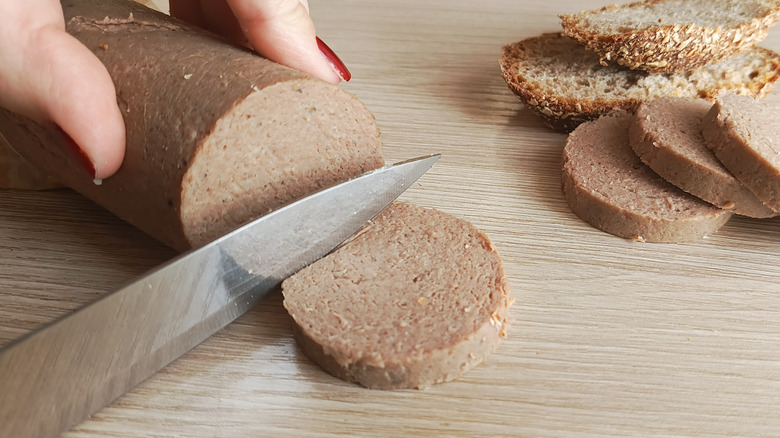
History is dotted with old-school sandwiches nobody eats anymore. Nestled between the weird flavor combos and passé preparations is a notable member of the has-been sandwich club: liverwurst. Similar to bologna, which is made of assorted ground meats, liverwurst is a sausage made from finely ground pork or calf livers. Often, other offal, cuts of meat, or fat are added along with spices. Go into the average American supermarket today, and you are unlikely to spot fresh liverwurst. How did this meat go from being a deli staple to falling out of mainstream sandwich culture?
Versions of liver sausages date back centuries. The density of nutrients in liver helped popularize the food, and in Germany, a sausage called leberwurst, drawing its name from "leber," the German word for liver, became common. Leberwurst morphed into liverwurst as Eastern European immigrants brought the sausage to the United States in the early 1900s. It became a staple, especially in delis catering to Eastern Europeans in cities like New York and Chicago.
Through the mid-20th century, liverwurst and similar meats like bologna and braunschweiger (smoked liverwurst) stayed popular because they were cheap — they're the product of inexpensive cuts and organ meat after all. As people sought healthier options, offal gained its bad rap, and the salty, fatty liver sausages fell out of favor. Now, they're largely relegated to retro delis, as less major brands produce them and few supermarkets keep them in stock.
Most cold-cut makers skip liverwurst, but its smoked cousin is still common
Irada Zaitova/Getty Images
Liverwurst lunchmeat is increasingly rare as manufacturers eschew it in favor of more popular items. Boar's Head was one of the last major deli brands to produce the sausage and distribute it to delis and supermarkets nationwide. In 2024, Boar's Head liverwurst tested positive for listeria, a dangerous foodborne bacterium, causing a deadly outbreak and one of history's biggest deli meat recalls. That year, Boar's Head ended its production of liverwurst altogether.
Smaller brands like Hatfield still make liverwurst, but braunschweiger, the smoked version of the sandwich meat, remains common. Oscar Mayer produces braunschweiger, but not liverwurst, and the same is true of Boar's Head rival Dietz & Watson. Many big-chain supermarkets sell braunschweiger, but few carry fresh liverwurst. In and around New York City, some local market chains, like Key Food and ShopRite, offer traditional liverwurst. Canned liverwurst spread is also available on Amazon, although it's not exactly the same as fresh-sliced.
Even if liverwurst has slowly disappeared from mainstream deli counters, liver-based foods haven't faded entirely. Pâtés made with liver are easy to find in specialty grocery stores, and while these tend to be softer and spreadable rather than firmer and sliced, they're a similar liver-focused substitute. You can also make pâté at home by finely grinding livers up with aromatics like garlic, onion, and spices.

 Arabic
 French
 Spanish
 Portuguese
 Deutsch
 Turkish
 Dutch
Dutch
 Italiano
 Russian
 Romaian
 Portuguese (Brazil)
 Greek
Greek