


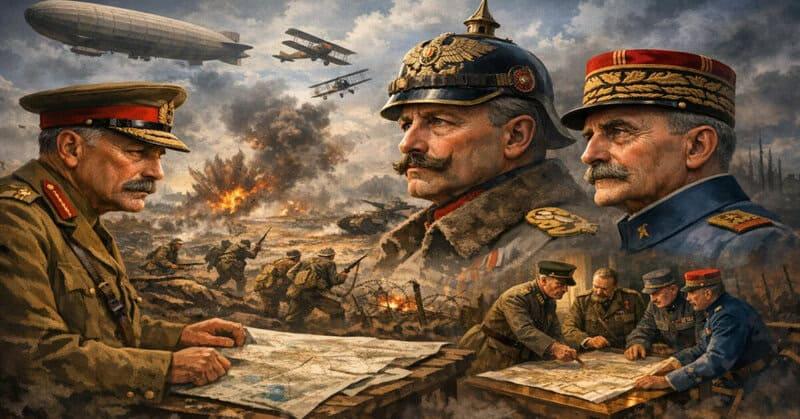
6. The Gallipoli Campaign

The Gallipoli Campaign, conducted from April 25, 1915, to January 9, 1916, was an Allied operation aimed at securing the Dardanelles Strait and capturing Constantinople to knock the Ottoman Empire out of World War I. The campaign involved British, French, Australian, and New Zealand forces landing on the Gallipoli Peninsula. Despite initial surprise, the Allies faced strong Turkish resistance, leading to a protracted and costly stalemate. The campaign resulted in over 250,000 Allied casualties, including approximately 58,000 deaths, and more than 300,000 Turkish casualties, with over 87,000 fatalities. The failure of the campaign had significant military and political repercussions, including the resignation of British First Lord of the Admiralty, Winston Churchill, and the eventual replacement of British Prime Minister H.H. Asquith. (britannica.com)
The Gallipoli Campaign holds profound significance in the national identities of Australia and Turkey. For Australia and New Zealand, the campaign is regarded as a “baptism of fire,” symbolizing the emergence of a unique national identity and the “Anzac spirit.” The landing on April 25 is commemorated annually as Anzac Day, a day of national remembrance. In Turkey, the campaign is known as the Battle of Çanakkale, and the successful defense against Allied forces under the leadership of Mustafa Kemal (later Atatürk) is a source of national pride. The campaign’s legacy continues to influence the relationship between Australia, New Zealand, and Turkey, fostering mutual respect and remembrance. (awm.gov.au)


 Arabic
 French
 Spanish
 Portuguese
 Deutsch
 Turkish
 Dutch
Dutch
 Italiano
 Russian
 Romaian
 Portuguese (Brazil)
 Greek
Greek