




Matt Gush/Shutterstock
Los Angeles' Little Ethiopia is a short segment of Fairfax Avenue that is home to the second-largest population of Ethiopians in the U.S. after Washington, D.C. Restaurants I love there include Meals by Genet, Lalibela, and Rahel Ethiopian Vegan Cuisine. The Ethiopian restaurant I find myself returning to consistently, however, is Aunt Yvette's Kitchen, and it's far from Little Ethiopia. I've traveled through Ethiopia and have always loved the food. I'm no expert — I didn't grow up with the cuisine and only spent two weeks in the country — but I know what I like. Fresh ingredients, a depth of flavor, and a variety of textures are what I look for in restaurant fare, and Aunt Yvette's delivers on all three.
Aunt Yvette's Kitchen is in the middle of a strip mall in the far-flung Los Angeles neighborhood of Eagle Rock. I've brought a few friends and family to Aunt Yvette's, who have never had Ethiopian food, and it's an excellent place to introduce first-timers to it. The friendly staff guides newcomers through the menu without making them feel lost. The dishes are comprised of spicy, thick stews of vegetables, lentils, and meats. Ginger, garlic, and berbere, a complex, piquant spice mix, are common flavors. It's all eaten with injera, a tangy flatbread made from a gluten-free grain called teff. In the U.S., injera is commonly wheat-based because teff is hard to find outside of Ethiopia. Yvette's is small — it's best to make a reservation instead of dropping in and hoping for a table. The dining area is dark, reminding me of some of the nicer restaurants in Addis Ababa that include a band with your dinner.
What to eat at Aunt Yvette's
Garrett Palm/Static Media
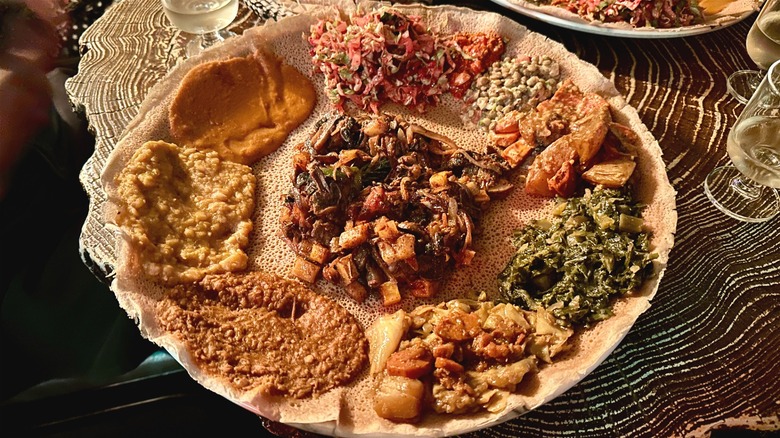
Eating an Ethiopian meal is a communal experience. Various dals, wots (stews), salads, tibs (sautéed meats), are arranged upon a platter of injera (a tangy fermented flatbread). To eat it, you tear off a small piece of injera and scoop up as much food as you can with it. Everyone shares a large plate. Don't worry, your server brings rosewater to wash your hands before the meal.
For those who drink, start with some t'ej, or Ethiopian wine made with honey and gesho leaves. The t'ej at Aunt Yvette's Kitchen is a bit drier and clearer than the funky, cloudy honey wine I drank throughout Ethiopia. For two people, order the vegan combo as a base. Its components go around the edge of the injera, and you can add a dish to go in the middle. Berbere, a complex Ethiopian spice mix consisting of chili and a long list of warming, earthy spices, can be found to some degree in most dishes. All are well-spiced and delicious, but the gomen (braised kale with onion and garlic), misir wat (red lentil stew), and cabbage and carrot are personal standouts.
A signature dish at Aunt Yvette's is Doro Wat, a preparation of berbere braised chicken with hard-boiled eggs. The tofu or mushroom tibs (sautéed with serrano, onion, and rosemary) is also outstanding. The homemade ice creams earn their place, too, full of flavor with a rich, creamy base. Berbere spice ice cream is something you won't find anywhere else, with its warm spice followed by a delayed heat. I don't think I could eat a scoop on its own — it partners well with a scoop of cardamom ice cream.

 Arabic
 French
 Spanish
 Portuguese
 Deutsch
 Turkish
 Dutch
Dutch
 Italiano
 Russian
 Romaian
 Portuguese (Brazil)
 Greek
Greek